
Figuring out how to calculate mortgage affordability with 1099 income and alimony can feel like solving a puzzle with missing pieces. If you're self-employed and also receive alimony, you're working with two income streams that lenders treat very differently from a traditional W-2 paycheck. The good news is that both types of income can count toward your mortgage qualification — but knowing the rules, the documentation requirements, and the math behind it all makes a big difference. Whether you're a first-time homebuyer or a seasoned homeowner looking to refinance, this guide walks you through exactly what lenders look for and how you can put your best financial foot forward.
Why 1099 Income and Alimony Create a Unique Mortgage Scenario
Most mortgage lenders are comfortable evaluating a borrower who earns a steady salary from a single employer. When you introduce 1099 income — the kind earned by freelancers, independent contractors, gig workers, and self-employed professionals — the picture becomes more complex. Add alimony payments you're receiving on top of that, and lenders need a more nuanced process to assess your true earning power.
The challenge with 1099 income is its variability. Lenders can't simply look at a pay stub; instead, they typically average your net self-employment income over a two-year period using your federal tax returns. Alimony, on the other hand, is a fixed payment that may continue for years — but lenders want assurance it will last long enough to be a reliable source of repayment.
Understanding how these two income types are evaluated separately — and then combined — is the first step in accurately estimating how much home you can afford. It also helps you prepare the right paperwork before you ever sit down with a loan officer.
How Lenders Calculate Qualifying Income from 1099 Earnings
When a lender reviews your 1099 income, they're not simply looking at the gross amount you received. Because self-employed borrowers can deduct a wide range of business expenses, lenders focus on your net income after deductions as reported on your federal tax returns — typically Schedule C, Schedule E, or Schedule K-1, depending on your business structure.
Here's a simplified version of how lenders often approach this calculation:
- Gather two years of tax returns: Lenders typically require your most recent two years of personal and, if applicable, business tax returns.
- Add back certain deductions: Some non-cash deductions, like depreciation, may be added back to your qualifying income because they don't represent actual cash flowing out of your pocket.
- Average the two years: If your income was $60,000 in Year 1 and $80,000 in Year 2, lenders will often use $70,000 as your qualifying annual income — though some may use only the lower figure if income is declining.
- Divide by 12: The annual qualifying income is divided by 12 to arrive at a monthly income figure used in your debt-to-income (DTI) ratio calculation.
It's worth noting that if your income has been declining year over year, some lenders may use the most recent, lower year rather than averaging. This is why maintaining consistent or growing earnings as a self-employed borrower could work in your favor when applying for a mortgage.
Some lenders — particularly those offering non-QM or bank statement loan programs — may allow 12 to 24 months of bank statements as an alternative to tax returns. This could be especially helpful if your tax deductions significantly reduce your net income on paper, even though your actual cash flow is strong.
Including Alimony as Qualifying Income on Your Mortgage Application
Alimony — also called spousal support or spousal maintenance — can be counted as qualifying income for a mortgage, but only when it meets specific criteria set by lenders and loan program guidelines. The key factors lenders typically evaluate include:
- Duration: Alimony payments generally need to continue for at least three years after the mortgage closing date. If your payments are set to end sooner, lenders may not count them as stable qualifying income.
- Documentation: You'll likely need to provide a fully executed divorce decree or legal separation agreement that clearly states the payment amount and duration.
- Payment history: Lenders may request bank statements or other records showing that alimony payments have been received consistently — often for six to twelve months prior to your application.
One important point worth knowing: under federal fair lending laws, lenders cannot require you to disclose alimony income if you choose not to use it for qualification purposes. You only need to disclose it if you want it considered as part of your qualifying income.
If alimony is a significant portion of your household income, including it can meaningfully improve your debt-to-income ratio and expand your purchasing power. However, if it's minimal or nearing its end date, it may not be worth the extra paperwork.
The Debt-to-Income Ratio: Combining Both Income Sources Effectively
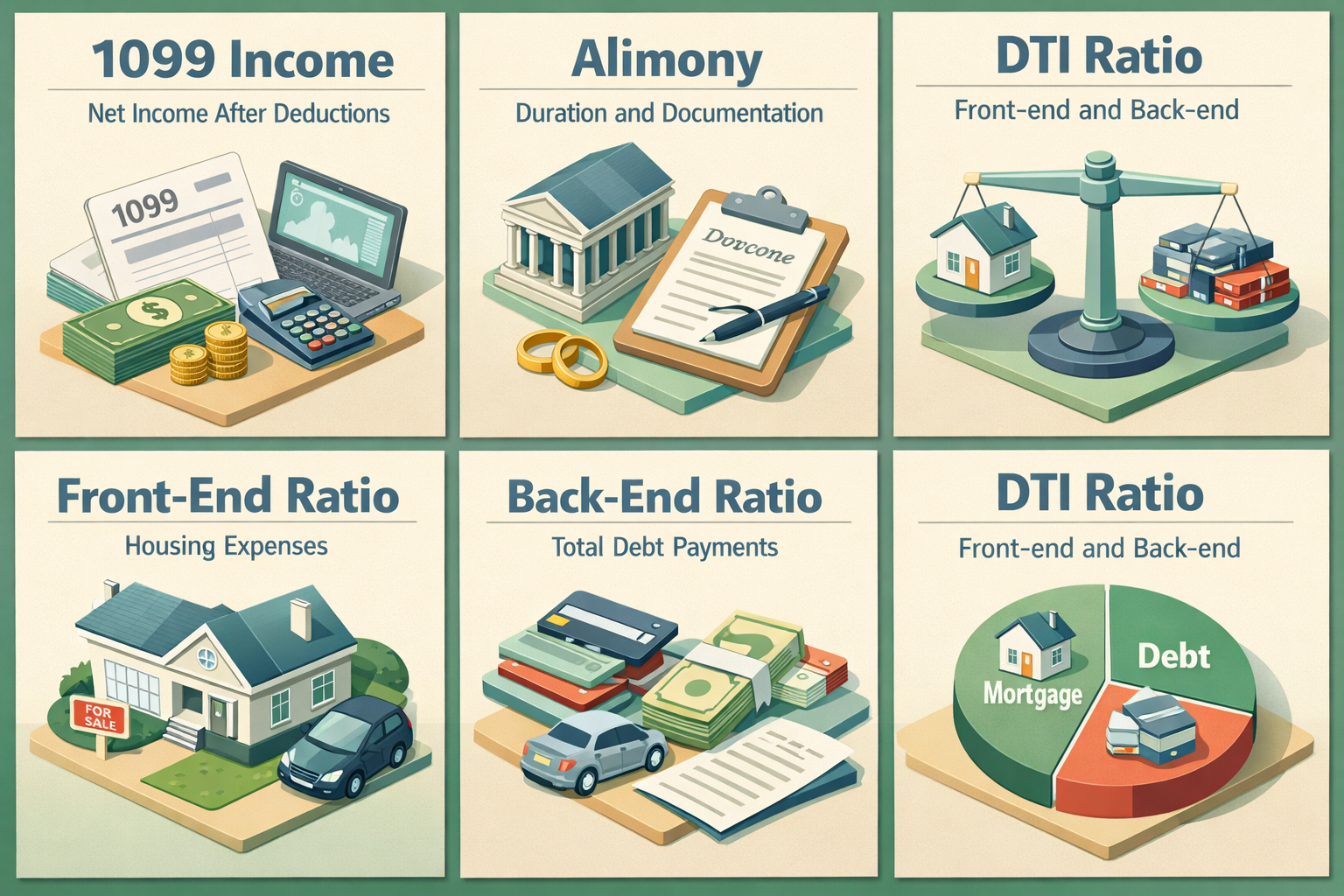
Once you've established your qualifying monthly income from both 1099 income and alimony, the next step is calculating your debt-to-income (DTI) ratio. This is arguably the most important number in determining how much mortgage you can afford.
Your DTI ratio is calculated by dividing your total monthly debt obligations by your total gross monthly qualifying income. Lenders typically look at two versions:
- Front-end DTI: This includes only your proposed housing costs — principal, interest, taxes, insurance, and any HOA fees — divided by your monthly income.
- Back-end DTI: This includes all monthly debt payments, including the housing costs above plus car loans, student loans, credit card minimums, and any other recurring obligations.
For conventional loans, many lenders prefer a back-end DTI at or below 43%, though some programs may allow higher ratios with compensating factors like strong credit or significant cash reserves. FHA loans may allow slightly higher DTI ratios in certain circumstances.
Here's a simplified example. Suppose your averaged 1099 net income is $5,500 per month and you receive $1,200 per month in qualifying alimony. Your total qualifying income is $6,700 per month. If your proposed mortgage payment is $1,800 and you have $500 in other monthly debts, your back-end DTI would be approximately 34% — well within most lender guidelines.
A mortgage calculator for self-employed with alimony can help you run these numbers quickly. Many online tools allow you to enter different income and debt scenarios to see how they affect your purchasing power before you apply.
Documentation You'll Need to Gather Before Applying
One of the most common reasons self-employed borrowers with alimony experience delays in the mortgage process is incomplete documentation. Getting organized early can save you significant time and frustration. Here's what lenders will typically request:
- For 1099 income: Two years of personal federal tax returns (all pages and schedules), two years of business tax returns if applicable, year-to-date profit and loss statement, and recent bank statements.
- For alimony income: A copy of your divorce decree or legal separation agreement, recent bank statements or deposit records showing receipt of payments, and potentially a letter from your attorney confirming the arrangement.
- General mortgage documents: Government-issued ID, Social Security number, two months of bank statements for all accounts, investment or retirement account statements, and any other assets you plan to use for a down payment or reserves.
It may also be wise to work with a CPA or tax professional familiar with mortgage lending before you apply. In some cases, reducing deductions strategically in the year or two prior to applying can increase your qualifying income on paper — though this should be weighed carefully against your overall tax strategy.
Loan Program Options Worth Exploring for Your Situation
Not every mortgage program handles 1099 income and alimony the same way. Understanding your options can help you find the best fit for your financial profile.
Conventional Loans
Conventional loans backed by Fannie Mae and Freddie Mac have specific guidelines for self-employed income and allow alimony to be counted as qualifying income when it meets duration and documentation requirements. These loans often offer competitive interest rates for borrowers with strong credit scores.
FHA Loans
FHA loans may be a good option if your credit score is lower or your DTI is on the higher side. They also allow alimony income to be counted, provided it meets the same continuity requirements. Down payment requirements can be as low as 3.5% for qualifying borrowers.
Non-QM and Bank Statement Loans
For self-employed borrowers whose tax returns don't fully reflect their earning capacity, non-qualified mortgage (non-QM) programs can offer more flexibility. Bank statement loans, for instance, may use 12 to 24 months of personal or business bank deposits to calculate qualifying income — bypassing the tax return process entirely. These programs may carry slightly higher interest rates but could open doors that traditional programs can't.
It's worth speaking with a licensed mortgage professional who specializes in self-employed borrowers to identify which program aligns best with your income structure and financial goals.
Tips to Strengthen Your Mortgage Application as a 1099 Earner Receiving Alimony
Knowing how to calculate mortgage affordability with 1099 income and alimony is only part of the equation. Presenting yourself as a strong borrower requires deliberate preparation. Here are some practical strategies that may help:
- Build or maintain a strong credit score: A higher credit score can offset some of the perceived risk lenders associate with variable self-employment income. Aim to pay down revolving balances and avoid opening new credit lines before applying.
- Keep consistent income records: Lenders feel more confident when income trends are stable or growing. If possible, show at least two years of consistent 1099 earnings before applying.
- Maintain cash reserves: Having several months of mortgage payments in savings after closing can serve as a compensating factor that may help you qualify for better terms.
- Work with a specialized lender: Not all lenders are equally experienced with self-employed borrowers. Seek out a mortgage professional who has a track record with 1099 earners and understands how to present alimony income properly.
- Get pre-approved before shopping: A mortgage pre-approval gives you a realistic budget and shows sellers you're a serious buyer — particularly valuable in competitive real estate markets.
Using a mortgage calculator for self-employed with alimony as an early planning tool can help you model different income scenarios and set realistic expectations before you engage with a lender.
●Conclusion
Understanding how to calculate mortgage affordability with 1099 income and alimony gives you a meaningful advantage in the homebuying process. While the path may involve more paperwork and preparation than a standard W-2 application, it's entirely achievable with the right knowledge and the right lending partner. By knowing how lenders evaluate your self-employment income, how alimony qualifies, and how both contribute to your overall DTI, you can walk into the mortgage process with confidence. Take time to gather your documents, model your numbers with an affordability calculator, and connect with a loan professional who truly understands your financial picture. Your goal of homeownership is closer than it might seem.