Buying a home as a freelance photographer comes with a unique set of financial challenges. Unlike salaried employees who can hand over a W-2 and call it a day, self-employed borrowers often face a more involved approval process. When you add student loan payments into the equation, calculating how much home you can afford becomes even more layered. But here's the good news — it's absolutely possible to get a mortgage as a 1099 earner with student debt. Understanding how to calculate mortgage affordability with 1099 freelance photography income and student loan payments is the first step toward making your homeownership goals a reality.
Why 1099 Income Is Treated Differently by Mortgage Lenders
When a lender reviews your mortgage application, their primary concern is whether you can reliably repay the loan. For a salaried employee, this is relatively straightforward. For freelance photographers earning 1099 income, lenders need more evidence of income stability and consistency.
Most conventional mortgage lenders require at least two years of self-employment history before they'll consider your freelance income as qualifying income. This is because freelance earnings can vary month to month, and lenders want to see a track record of sustainable revenue. They'll typically average your net income over those two years using your federal tax returns — specifically your Schedule C — to determine your usable monthly income.
Here's where it can get tricky: many freelance photographers write off business expenses like camera gear, editing software, travel, and studio costs. While deductions reduce your tax liability, they also reduce your reported net income, which is what lenders use to calculate affordability. A photographer earning $90,000 in gross revenue but claiming $35,000 in deductions may only show $55,000 in qualifying income. That gap can meaningfully affect how much mortgage you're eligible for.
It's worth noting that some non-QM (non-qualified mortgage) lenders and bank statement loan programs may allow alternative income documentation, such as 12 or 24 months of bank statements, which could result in a higher qualifying income for borrowers whose tax returns understate their actual cash flow. These programs often come with slightly higher interest rates but may be worth exploring if traditional documentation puts you at a disadvantage.
How Lenders Calculate Your Qualifying Income as a Freelance Photographer
Let's walk through how a lender might actually calculate your qualifying income as a 1099 freelance photographer. This process typically involves reviewing your last two years of personal tax returns, along with any business returns if you've structured your photography business as an LLC or S-corp.
From your Schedule C, lenders will look at your net profit after expenses. They may add back certain non-cash deductions — such as depreciation on equipment — since those don't represent actual money leaving your account. This adjusted figure is then averaged over 24 months to arrive at a monthly qualifying income.
For example, if your net Schedule C income was $48,000 in Year 1 and $60,000 in Year 2, your two-year average would be $54,000. Dividing by 24 months gives you a qualifying monthly income of $2,250. That's the number a lender would use when evaluating your debt-to-income (DTI) ratio and determining how large a mortgage payment you could support.
If your income is trending upward — which is common for growing freelance businesses — some lenders may use just the most recent year's income. However, if income declined from one year to the next, lenders may use the lower figure or average the two, depending on their guidelines. It's important to ask your loan officer how they handle income trends before applying.
Understanding Debt-to-Income Ratios and the Impact of Student Loans
Your debt-to-income (DTI) ratio is one of the most critical factors in mortgage qualification. It compares your total monthly debt obligations to your gross monthly income. Most conventional loan programs prefer a DTI at or below 43%, though some programs may allow slightly higher ratios with compensating factors like strong credit or a larger down payment.
Student loan payments can significantly affect your DTI. Even if your loans are in deferment or on an income-driven repayment plan with a low monthly payment, lenders may still count a calculated figure against you. For conventional loans backed by Fannie Mae or Freddie Mac, lenders typically use the actual monthly payment shown on your credit report. If that payment is $0 — as is sometimes the case with income-driven plans — some lenders may calculate 0.5% to 1% of the outstanding loan balance as a monthly obligation instead.
Let's put this in practical terms. Suppose your qualifying monthly income is $4,500, and you have the following monthly obligations:
- Student loan payment: $350
- Car payment: $275
- Proposed mortgage payment (principal, interest, taxes, insurance): $1,400
Your total monthly debt would be $2,025, giving you a DTI of approximately 45%. That may push you above some lenders' limits. In this case, you might need to either reduce other debts, increase your qualifying income, lower the purchase price, or make a larger down payment to reduce the mortgage payment itself.
This is why understanding student loan mortgage impact before you start house hunting is so important. Running the numbers in advance helps you set a realistic budget and avoid surprises during underwriting.
How to Calculate Mortgage Affordability With 1099 Freelance Photography Income and Student Loan Payments
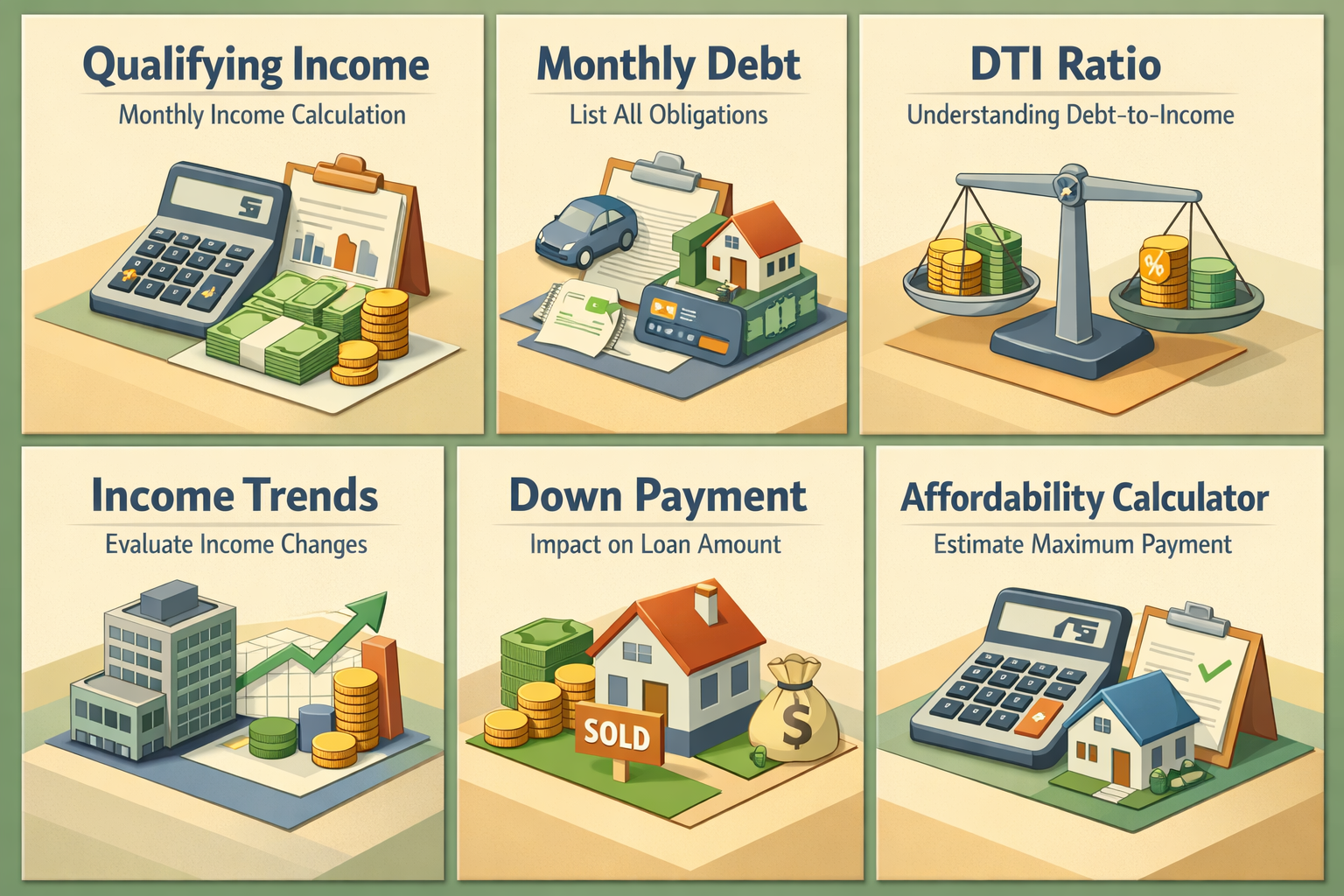
Now let's bring everything together. Knowing how to calculate mortgage affordability with 1099 freelance photography income and student loan payments requires a step-by-step approach that accounts for both your income documentation method and your existing debt load.
Step 1: Determine Your Qualifying Monthly Income
Gather your last two years of federal tax returns and locate your Schedule C net profit figures. Add back any depreciation deductions, then average the two years. Divide by 24 to get your monthly qualifying income. If you're using a bank statement loan program, work with your lender to calculate the average monthly deposits over the qualifying period.
Step 2: List All Monthly Debt Obligations
Pull your credit report and list every recurring monthly payment — student loans, auto loans, credit card minimums, and any other installment debts. If your student loans are deferred, find out how your target lender treats deferred balances, since this could add a significant phantom payment to your DTI calculation.
Step 3: Use a 1099 Income Mortgage Calculator
A 1099 income mortgage calculator can help you estimate how much home you may afford based on your self-employment income and existing debts. Many online tools allow you to input your net self-employed income, monthly debts, desired loan term, and estimated interest rate. The result gives you an approximate maximum monthly payment and corresponding loan amount. Keep in mind these are estimates — your actual qualifying amount will depend on lender-specific guidelines, your credit score, and the loan program you choose.
Step 4: Factor in Down Payment and Reserves
Your down payment directly affects your loan amount and monthly payment. A larger down payment reduces the amount you need to borrow, which lowers your DTI and may help offset a higher student loan burden. Lenders may also require that you have cash reserves — typically two to six months of mortgage payments — in savings after closing. Plan for this as part of your overall mortgage affordability calculation.
Step 5: Estimate Property Taxes, Insurance, and HOA Fees
Don't forget that your mortgage payment includes more than just principal and interest. Property taxes, homeowner's insurance, and any HOA fees are factored into your monthly payment — and into your DTI. Use local tax rate estimates and insurance quotes to make your affordability calculation as accurate as possible.
Loan Programs That May Work Well for Freelance Photographers
Not all mortgage programs treat 1099 income the same way. Knowing your options can help you find the right fit for your financial profile.
- Conventional loans: These follow Fannie Mae or Freddie Mac guidelines and typically require two years of self-employment history with tax return documentation. They offer competitive rates and flexible down payment options but may be restrictive if your net income after deductions is significantly lower than your gross revenue.
- FHA loans: Backed by the Federal Housing Administration, FHA loans may be a good option for freelancers with lower credit scores or smaller down payments. They also follow the two-year self-employment standard but are sometimes more flexible on DTI with compensating factors.
- Bank statement loans (Non-QM): These programs allow lenders to qualify borrowers based on 12 to 24 months of bank deposits rather than tax returns. This can be a game-changer for photographers whose write-offs significantly reduce their taxable income but whose actual cash flow is strong. Rates tend to be higher than conventional products.
- Profit and loss statement loans: Some non-QM lenders accept a CPA-prepared P&L statement as income documentation, offering another path for self-employed borrowers who may not have two full years of tax returns on file.
Working with a lender experienced in freelance mortgage approval can make a significant difference. They'll know which programs best match your documentation profile and may be able to structure your application more favorably.
Strategies to Strengthen Your Mortgage Application as a Self-Employed Borrower
If your initial affordability calculation comes up short, don't be discouraged. There are several practical strategies that may improve your position before you apply.
Minimize New Deductions in the Year Before Applying
While deductions are a valuable tax planning tool, reducing discretionary write-offs in the one to two years before applying for a mortgage could increase your reported net income. Talk to a tax professional to understand the trade-offs before making this decision.
Pay Down High-Balance Debt
Reducing or eliminating credit card balances and smaller installment loans can lower your DTI meaningfully. Even paying off one or two smaller accounts could free up enough monthly cash flow to qualify for a mortgage amount that meets your goals.
Refinance Student Loans for a Lower Payment
If your student loan payments are eating into your DTI, refinancing to a longer repayment term could reduce your monthly obligation — though this may increase the total interest you pay over time. Alternatively, switching to an income-driven repayment plan that results in a lower monthly payment might help, but be aware of how your lender treats deferred or low-payment balances.
Build Up Savings and Reserves
A strong savings account not only helps with your down payment but also demonstrates financial stability to lenders. Having six or more months of mortgage payments in reserves could serve as a compensating factor that helps offset other weaknesses in your application.
Improve Your Credit Score
A higher credit score may qualify you for better interest rates, which directly affects your monthly payment and, therefore, your DTI. Review your credit report for errors, pay bills on time, and keep credit utilization low in the months leading up to your application.
●Conclusion
Navigating the mortgage process as a freelance photographer with student loan debt requires more preparation than the average borrower — but it's far from impossible. By understanding how lenders evaluate 1099 income, how student loan payments factor into your DTI, and how to use a 1099 income mortgage calculator to estimate what you can realistically afford, you're already ahead of the curve. The key is to start early, get organized with your documentation, and work with a lender who has experience with self-employed borrowers. At LoanWise, we're here to help you find the right loan program for your unique financial situation. Reach out today to explore your options and take the next step toward homeownership.