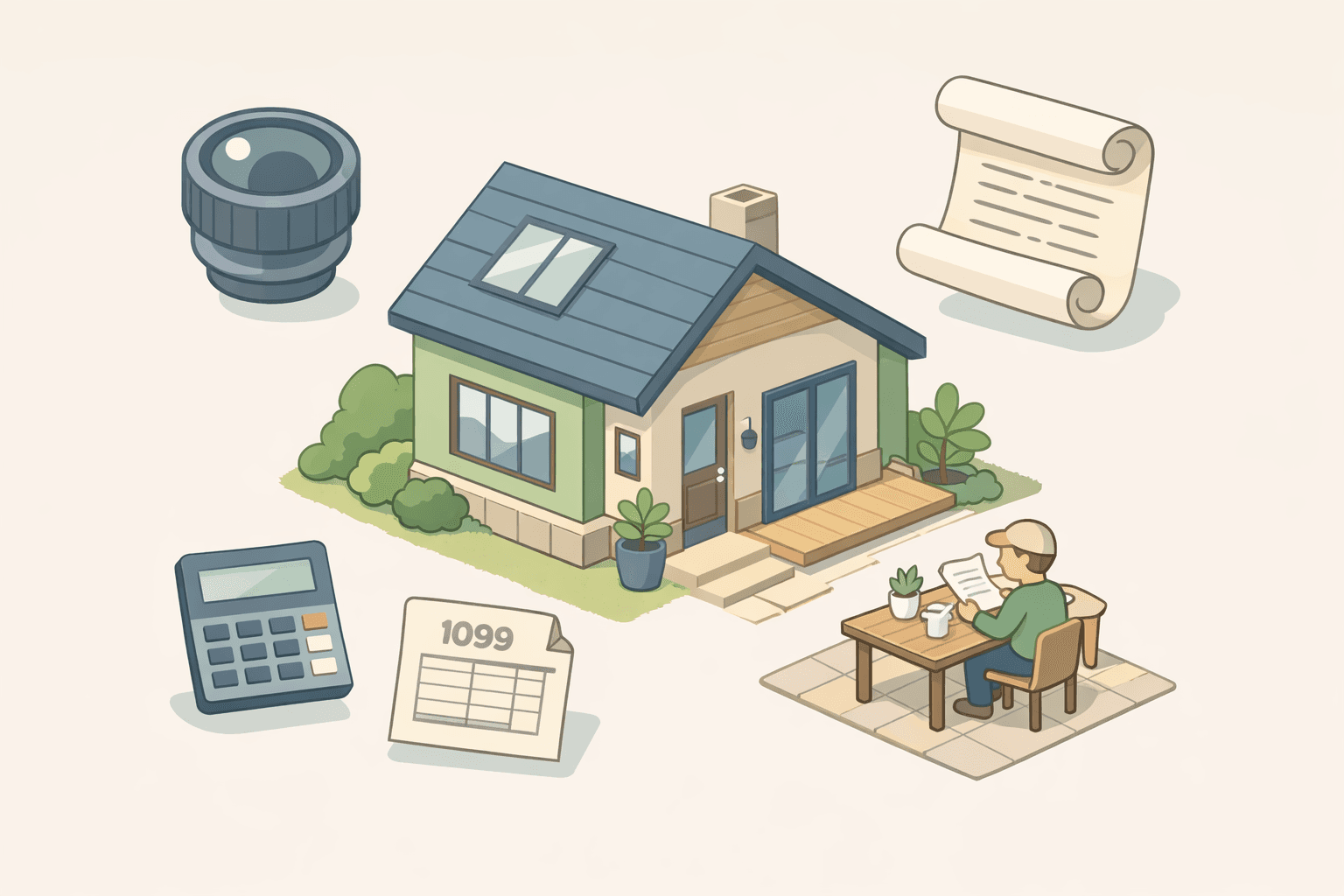
Buying a home as a freelance photographer can feel like a complicated exposure — you're trying to balance variable income, self-employment taxes, and lender expectations all at once. If you've ever wondered how to calculate mortgage affordability with 1099 freelance photography income, you're not alone. Many creative professionals earn strong livings through contract work, yet still find mortgage qualification confusing and sometimes frustrating. The good news is that lenders do have established methods for evaluating self-employed borrowers, and with the right preparation, a mortgage is absolutely within reach. This article breaks down exactly what lenders look at, how your income is calculated, and what steps you can take to strengthen your application.
Why 1099 Income Complicates the Mortgage Process
When you work as a freelance photographer, you typically receive 1099 forms from clients rather than W-2s from an employer. This distinction matters enormously to mortgage lenders. Traditional underwriting was largely built around predictable, salaried income — steady paychecks arriving on a reliable schedule. Freelance income, by contrast, can fluctuate month to month depending on bookings, contracts, and seasonal demand.
Lenders aren't necessarily opposed to 1099 earners, but they do require more documentation to verify that your income is stable and likely to continue. That's a key phrase in mortgage underwriting: the income must be reasonably expected to persist for at least three years from the date of the loan. A single strong season isn't enough on its own — lenders typically want to see a pattern of consistent or growing earnings over time.
It's also worth noting that self-employed borrowers often reduce their taxable income through legitimate business deductions — equipment purchases, home office expenses, travel, software subscriptions, and more. While those deductions are smart tax strategy, they can reduce the income figure that lenders are able to count. This is one of the central tensions freelance photographers face when applying for a home loan.
How Lenders Determine Your Qualifying Income From Tax Returns
For most conventional and government-backed loans, lenders will require two years of federal tax returns — both your personal returns (Form 1040) and, if applicable, a Schedule C that details your self-employment profit and loss. The income figure lenders use is typically your net income after deductions, not your gross receipts.
Here's a simplified look at how the calculation might work for a freelance photographer filing a Schedule C:
- Gross receipts (total photography income): $90,000
- Less business deductions (equipment, editing software, travel, etc.): $25,000
- Net self-employment income: $65,000
- Add back certain non-cash deductions (e.g., depreciation): $3,000
- Adjusted qualifying income: $68,000 per year, or approximately $5,667 per month
Lenders will typically average this figure across two years. So if your net income was $60,000 in year one and $68,000 in year two, they may average those to arrive at roughly $64,000 annually, or about $5,333 per month. If your income has declined year over year, lenders may use the lower year's figure or flag the application for additional review.
Some lenders may also add back depletion and business use of home deductions when calculating qualifying income. It's worth working with a mortgage professional who has experience with self-employed borrowers, as these nuances can meaningfully affect what you qualify for.
DTI Calculation for Self-Employed Photographers Explained
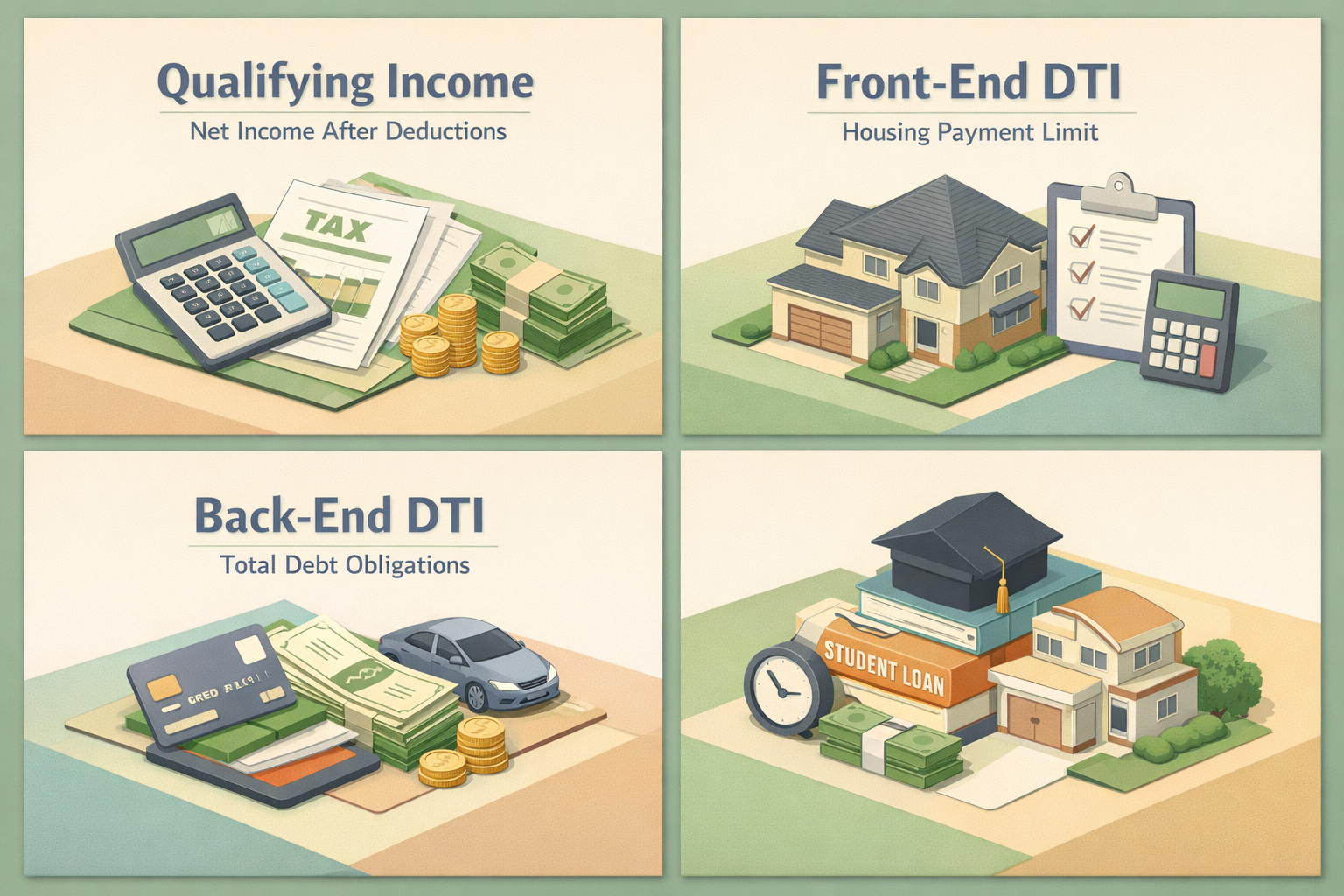
Your debt-to-income ratio (DTI) is one of the most important numbers in your mortgage application. Understanding the DTI calculation for self-employed photographers is essential because your qualifying income — derived from tax returns as described above — forms the denominator in that equation.
DTI is calculated by dividing your total monthly debt obligations by your gross qualifying monthly income. There are two components lenders examine:
- Front-end DTI: This includes only your proposed housing payment (principal, interest, taxes, and insurance, or PITI). Lenders often prefer this to stay below 28% to 31% of your monthly income.
- Back-end DTI: This includes your housing payment plus all other recurring monthly debts — student loans, car payments, credit card minimums, and any other obligations. Most conventional lenders prefer back-end DTI to remain under 43%, though some programs allow higher ratios with compensating factors.
Let's apply this to a real-world scenario. Suppose your qualifying monthly income from your photography business is $5,333. If you're looking at a home with a monthly mortgage payment of $1,500, your front-end DTI would be approximately 28% — right at the typical threshold. If you also carry $400 in car payments and $200 in student loan minimums, your total monthly debt is $2,100, giving you a back-end DTI of about 39% — generally within acceptable range for most lenders.
The challenge is that many self-employed photographers have a lower qualifying income than their actual cash flow suggests, due to tax deductions. This is why keeping your personal debt load low and your credit score strong becomes especially important when you're self-employed.
Estimating How Much Home You Can Realistically Afford
Now that you understand how lenders calculate your income and DTI, you can start to run your own rough affordability estimates. Knowing how to calculate mortgage affordability with 1099 freelance photography income on your own — before you ever speak with a lender — puts you in a much stronger position.
Here's a practical framework to get started:
- Step 1 — Estimate your qualifying monthly income: Pull your last two years of Schedule C net income, add back any allowable deductions, and divide the two-year average by 12.
- Step 2 — Apply the front-end DTI limit: Multiply your qualifying monthly income by 0.28 (or 0.31 for FHA loans). This gives you the approximate maximum monthly housing payment a lender may allow.
- Step 3 — Subtract taxes and insurance: Estimate property taxes and homeowner's insurance for the area you're shopping. Subtract these from your maximum housing payment to arrive at the portion available for principal and interest.
- Step 4 — Use a mortgage calculator: Enter your estimated principal and interest payment, current interest rate, and loan term to what you can truly afford. At current market rates, every $1,000 of monthly principal and interest might support roughly $150,000 to $180,000 in loan amount, depending on the rate environment.
- Step 5 — Factor in your back-end DTI: If you carry other debts, subtract those monthly payments from your available housing budget before running Step 4.
Keep in mind this is an estimate. A licensed mortgage professional will apply lender-specific overlays, credit score adjustments, and program guidelines that could shift your qualifying amount in either direction.
Documentation You'll Need to Support Your Application
Self-employed borrowers generally face a higher documentation burden than W-2 employees, but being organized and proactive can make the process significantly smoother. Here's what you'll likely need to gather:
- Two years of personal federal tax returns (all pages and schedules, including Schedule C)
- Two years of business tax returns if your photography business is structured as an LLC, S-corp, or partnership
- Year-to-date profit and loss statement prepared or verified by a licensed CPA
- Two to three months of bank statements showing business income deposits and operating activity
- 1099 forms from clients for each of the past two years
- Business license or professional documentation confirming you've been operating for at least two years
- Letters from ongoing clients or contracts showing future booked work, which can help demonstrate income continuity
Some lenders may also request a written explanation of any income gaps or significant year-over-year fluctuations. Being transparent and prepared with a brief, factual explanation can prevent underwriting delays.
Alternative Loan Programs That May Suit Freelance Borrowers
If your tax returns don't paint an accurate picture of your true cash flow, you may want to explore non-QM (non-qualified mortgage) loan programs designed specifically for self-employed borrowers. These products have grown in availability and may offer meaningful flexibility for freelance photographers who have strong bank account activity but lower net income on paper.
Bank Statement Loans
Rather than relying on tax returns, bank statement loans allow lenders to average your monthly deposits over 12 to 24 months to estimate income. This can be a significant advantage if your gross deposits are considerably higher than your reported net income. Lenders typically apply an expense ratio — often 50% or more — to your deposits to arrive at a qualifying income figure, but even so, this method may yield a higher qualifying income than the Schedule C approach for some borrowers.
Asset Depletion and Stated Income Programs
Some specialty lenders offer programs that allow substantial liquid assets to be factored into income calculations, or that require reduced documentation for borrowers with strong credit profiles. These programs often carry slightly higher interest rates than conventional loans, but they may open doors that traditional underwriting would otherwise close.
It's important to work with a lender or mortgage broker who is familiar with non-QM lending. Not every lender offers these products, and the terms can vary widely.
●Conclusion
Navigating the mortgage process as a freelance photographer takes preparation, patience, and the right guidance — but it's far from impossible. The key is understanding exactly how lenders view your 1099 income, how your DTI is calculated, and what loan programs might best fit your financial profile. By running your own rough affordability estimates early, organizing your documentation in advance, and connecting with a lender experienced in self-employed borrowers, you can approach homeownership with confidence. Whether you qualify through traditional tax-return underwriting or a bank statement program, knowing how to calculate mortgage affordability with 1099 freelance photography income is the first and most important step on your path to homeownership. Ready to take the next step? Speak with a LoanWise mortgage specialist today to explore your options and get pre-qualified on your terms.