
Buying a home as a freelancer or independent contractor is absolutely possible — but the path to approval looks a little different than it does for salaried workers. If you receive 1099 forms instead of a W-2, lenders will evaluate your income through a different lens. Understanding how to calculate mortgage affordability with 1099 freelance income is the first step toward approaching the homebuying process with confidence. Whether you're a graphic designer, consultant, gig worker, or any other type of self-employed professional, this guide walks you through what lenders typically look for and how you can position yourself for success.
Why 1099 Income Is Treated Differently by Mortgage Lenders
When a salaried employee applies for a mortgage, the lender can easily verify income using pay stubs and a W-2. That consistency and predictability make qualification relatively straightforward. For 1099 earners, however, income can fluctuate month to month — and that variability is what lenders spend most of their time analyzing.
Lenders aren't just looking at how much you earn. They want to understand whether your income is stable, consistent, and likely to continue. Because freelancers and self-employed borrowers control their own workload, lenders typically require more documentation to build a complete picture of your financial health.
It's also worth noting that self-employed individuals often deduct a significant portion of their gross income on their tax returns. While this is a smart tax strategy, it can reduce the income figure that lenders use to calculate your borrowing power. This is one of the most important nuances to understand when exploring mortgage affordability with 1099 income.
How Lenders Calculate Qualifying Income for Self-Employed Borrowers
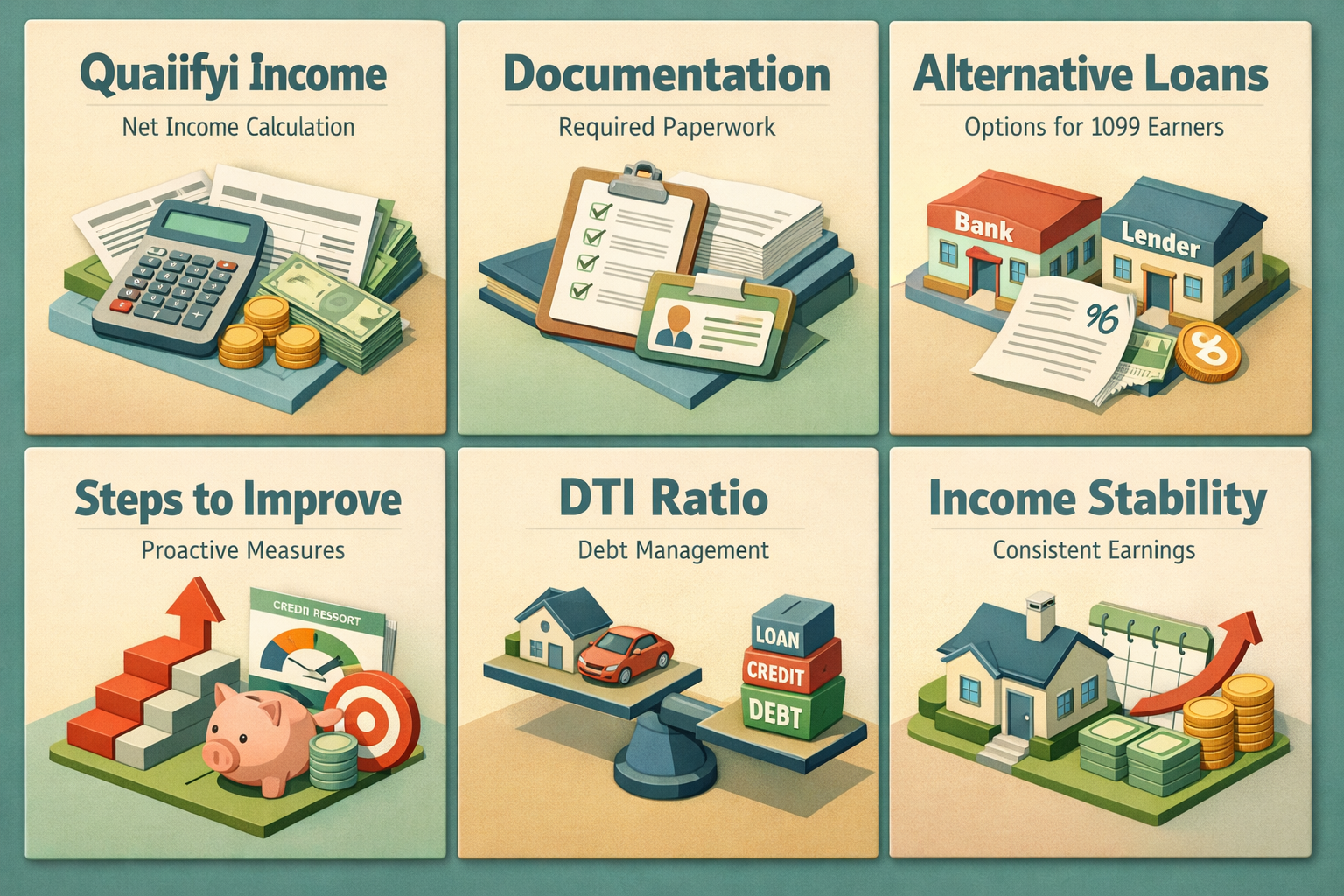
For most conventional loan programs, lenders use your net income — not your gross earnings — to determine what you may afford. This means they typically start with your adjusted gross income (AGI) as reported on your federal tax returns, then may add back certain deductions like depreciation or business use of a home, depending on the loan program and lender guidelines.
Here's a simplified version of how a lender might calculate your qualifying income:
- Step 1: Gather your last two years of federal tax returns (both personal and business, if applicable).
- Step 2: Identify your net profit from Schedule C, Schedule E, or your K-1 forms, depending on your business structure.
- Step 3: Add back any allowable deductions such as depreciation, amortization, or one-time losses.
- Step 4: Average the adjusted net income over 24 months to arrive at your monthly qualifying income.
For example, if your adjusted net income was $60,000 in Year 1 and $80,000 in Year 2, your average annual qualifying income would be $70,000, or roughly $5,833 per month. This monthly figure is then used to calculate mortgage affordability and determine how much of a mortgage payment you may be able to afford.
It's important to work with a knowledgeable loan officer who has experience with self-employed borrowers, as the income calculation process can vary by lender and loan program.
Understanding Debt-to-Income Ratio for Freelance Mortgage Applicants
Once your qualifying income is established, lenders use your debt-to-income (DTI) ratio to determine how large of a mortgage payment you can reasonably handle. DTI is calculated by dividing your total monthly debt obligations by your gross monthly qualifying income.
Most conventional loan programs prefer a DTI ratio at or below 43%, though some programs may allow higher ratios depending on other compensating factors like strong credit or a large down payment. Government-backed loans such as FHA may offer a bit more flexibility in certain situations.
Here's a basic example: If your monthly qualifying income is $5,833 and your total monthly debts — including your projected mortgage payment, car loan, student loans, and credit cards — equal $2,333, your DTI would be approximately 40%. That may fall within acceptable limits for many loan programs.
For freelancers, keeping non-mortgage debt low before applying for a mortgage can be a meaningful strategy. Paying down credit card balances or eliminating a car payment could improve your DTI and expand your purchasing power.
Documentation You'll Likely Need to Prove Freelance Income
One of the biggest differences in the self-employed mortgage calculation process is the documentation requirement. Lenders need to see a paper trail that supports your income claims. While requirements can vary, here's what you'll typically need to prepare:
- Two years of personal federal tax returns — including all schedules and attachments
- Two years of business tax returns — if you operate as an LLC, S-Corp, or partnership
- Year-to-date profit and loss statement — often prepared by a CPA or accountant
- Business bank statements — typically covering 12 to 24 months
- 1099 forms from clients — to corroborate reported income
- Proof of self-employment — such as a business license, client contracts, or a letter from a CPA confirming your business is active
Having these documents organized and ready before you apply can significantly speed up the underwriting process. Lenders want to see that your freelance work is legitimate, ongoing, and financially sustainable — so the more clearly you can document your income history, the better positioned you'll be.
Alternative Loan Programs Designed for 1099 Earners
If your tax returns show a lower net income due to business deductions, you might still have options beyond conventional financing. Several alternative mortgage programs may be worth exploring:
Bank Statement Loans
Instead of relying on tax returns, these programs use 12 to 24 months of personal or business bank statements to verify income. This can be a strong option for freelancers who have healthy cash flow but show lower net income on their taxes due to legitimate deductions.
1099-Only Loans
Some lenders offer programs that allow borrowers to qualify based solely on their 1099 income forms, without requiring full tax returns. Eligibility requirements and availability may vary, so it's worth asking multiple lenders about this option.
Profit and Loss (P&L) Statement Loans
Certain non-QM (non-qualified mortgage) lenders may allow a CPA-prepared profit and loss statement as the primary income document. These programs can offer more flexibility but may come with higher interest rates or stricter credit requirements.
Each of these programs carries its own trade-offs, so it's wise to compare them carefully and discuss the implications with a trusted mortgage professional before committing to any one path.
Practical Steps to Improve Your Mortgage Affordability as a Freelancer
If you're planning to buy a home in the next one to two years, there are several proactive steps that could strengthen your application and expand what you can afford:
- Maintain consistent income: Lenders look favorably on steady or growing income over two years. Avoid major income gaps or dramatic year-over-year fluctuations if possible.
- Be mindful of deductions: Writing off large business expenses can reduce your taxable income — but it also reduces your qualifying income. Some freelancers find it beneficial to take fewer deductions in the year or two before applying for a mortgage.
- Build your credit score: A higher credit score may help you qualify for better rates and more favorable loan terms, even with variable income.
- Save a larger down payment: A down payment of 20% or more can eliminate private mortgage insurance (PMI) and may give lenders more confidence in your application.
- Reduce existing debt: Lowering your DTI by paying down outstanding balances could meaningfully increase the loan amount you qualify for.
- Work with a self-employed mortgage specialist: Not all loan officers have deep experience with 1099 borrowers. Finding one who does can make a significant difference in how your income is structured and presented.
●Conclusion
Knowing how to calculate mortgage affordability with 1099 freelance income gives you a real advantage when it's time to apply. Yes, the process requires more preparation and documentation than a traditional W-2 application — but it's far from out of reach. Lenders work with self-employed borrowers every day, and the right loan officer can help you navigate the nuances of income verification, DTI calculation, and program selection. At LoanWise, we understand the unique financial lives of freelancers and independent contractors. If you're ready to explore your home financing options, connect with one of our experienced mortgage advisors today — and take the first step toward owning the home you've worked hard for.