Buying a home when you earn variable income can feel like navigating a maze. If you receive 1099 forms instead of W-2s, work on commission, or run a side hustle alongside your main gig, you're not alone — and you're not out of options. The key is understanding how to calculate mortgage affordability with 1099 commission income and side hustle earnings so you can walk into a lender's office prepared. Mortgage lenders don't automatically disqualify self-employed borrowers or freelancers, but they do evaluate income differently. This guide breaks down the process step by step so you can move closer to homeownership with confidence.
Why 1099 and Commission Income Is Treated Differently by Mortgage Lenders
When a salaried employee applies for a mortgage, a lender can quickly verify income through pay stubs and a W-2. For 1099 earners, commission-based workers, and side hustlers, income tends to fluctuate month to month, which makes lenders look a little more carefully at your financial history.
Lenders are primarily concerned with two things: consistency and continuity. They want to see that your income has been stable over time and is likely to continue into the future. Because self-employed and commission-based borrowers often experience swings in earnings, lenders typically use a two-year average to determine your qualifying income rather than your most recent paycheck.
This approach can work in your favor if your income has been growing, but it may reduce your qualifying amount if you had a lower-earning year recently. Understanding this framework is the first step toward figuring out how to calculate mortgage affordability with 1099 commission income and side hustle revenue.
- 1099-NEC or 1099-MISC forms are typically used to verify freelance and contractor income.
- Commission income may require 24 months of employer verification plus tax returns.
- Side hustle income must usually appear on your tax returns for at least two years to be counted.
It's also worth noting that lenders often look at your net income after business deductions rather than your gross receipts. If you write off a large portion of your earnings, your qualifying income could be significantly lower than what your bank account suggests.
The Two-Year Average Method: How Lenders Calculate Your Usable Income
Most conventional lenders, as well as those offering FHA and other government-backed loans, use a two-year average of your self-employment or commission income to determine how much you can borrow. Here's how that process generally works in practice.
Let's say your Schedule C (for sole proprietors) or your K-1 (for business partners) shows the following net income after deductions:
- Year 1: $62,000
- Year 2: $74,000
In this case, your lender would likely average these two figures and arrive at approximately $68,000 per year, or about $5,667 per month as your qualifying income. This number then feeds into standard affordability calculations like your debt-to-income ratio.
However, if your income declined from Year 1 to Year 2, some lenders may use the lower figure or may decline the loan altogether. A decrease in year-over-year income is a red flag for lenders, even if you still earn a solid amount. This is why it's smart to plan your mortgage application timing strategically.
For commission-based employees who receive both a base salary and commission, lenders may average the commission portion over 24 months and add it to your base pay. The base salary is usually treated more like stable W-2 income, which can strengthen your overall application.
What Counts Toward Your Qualifying Income?
When combining a primary 1099 income stream with side hustle earnings, lenders will typically want to verify each income source separately. Your side hustle income may be included if it has been reported on your tax returns for two consecutive years and shows consistency or growth. Income that's brand new or undocumented generally won't be counted toward your qualifying total.
Understanding Debt-to-Income Ratio for Freelancers and Commission Earners
Your debt-to-income (DTI) ratio is one of the most critical numbers in any mortgage application, and it plays an especially important role for 1099 earners. DTI is calculated by dividing your total monthly debt payments by your gross monthly income.
Most conventional loan programs prefer a DTI at or below 43%, though some programs allow higher ratios with compensating factors like strong credit scores or significant cash reserves. FHA loans may allow somewhat higher DTI limits in certain situations.
For a freelancer or gig worker, the challenge is that your qualifying income may be lower than your actual cash flow due to business expense deductions. This can push your DTI higher than expected, which is why managing your outstanding debts before applying for a mortgage affordability calculation is a smart move.
A Simple DTI Example for a 1099 Earner
Suppose your averaged qualifying income works out to $5,500 per month. If your monthly debt obligations — including student loans, car payments, and credit cards — total $1,200, your back-end DTI would be roughly 22% before adding a mortgage payment. A lender allowing a 43% DTI ceiling might approve a mortgage payment of up to approximately $1,165 per month, which would include principal, interest, taxes, and insurance (PITI).
This kind of calculation is the heart of using a mortgage affordability calculator for 1099 income scenarios. Many online calculators allow you to input monthly income and debt to estimate a comfortable purchase price range.
How to Use a Mortgage Affordability Calculator With 1099 Income and Freelance Earnings
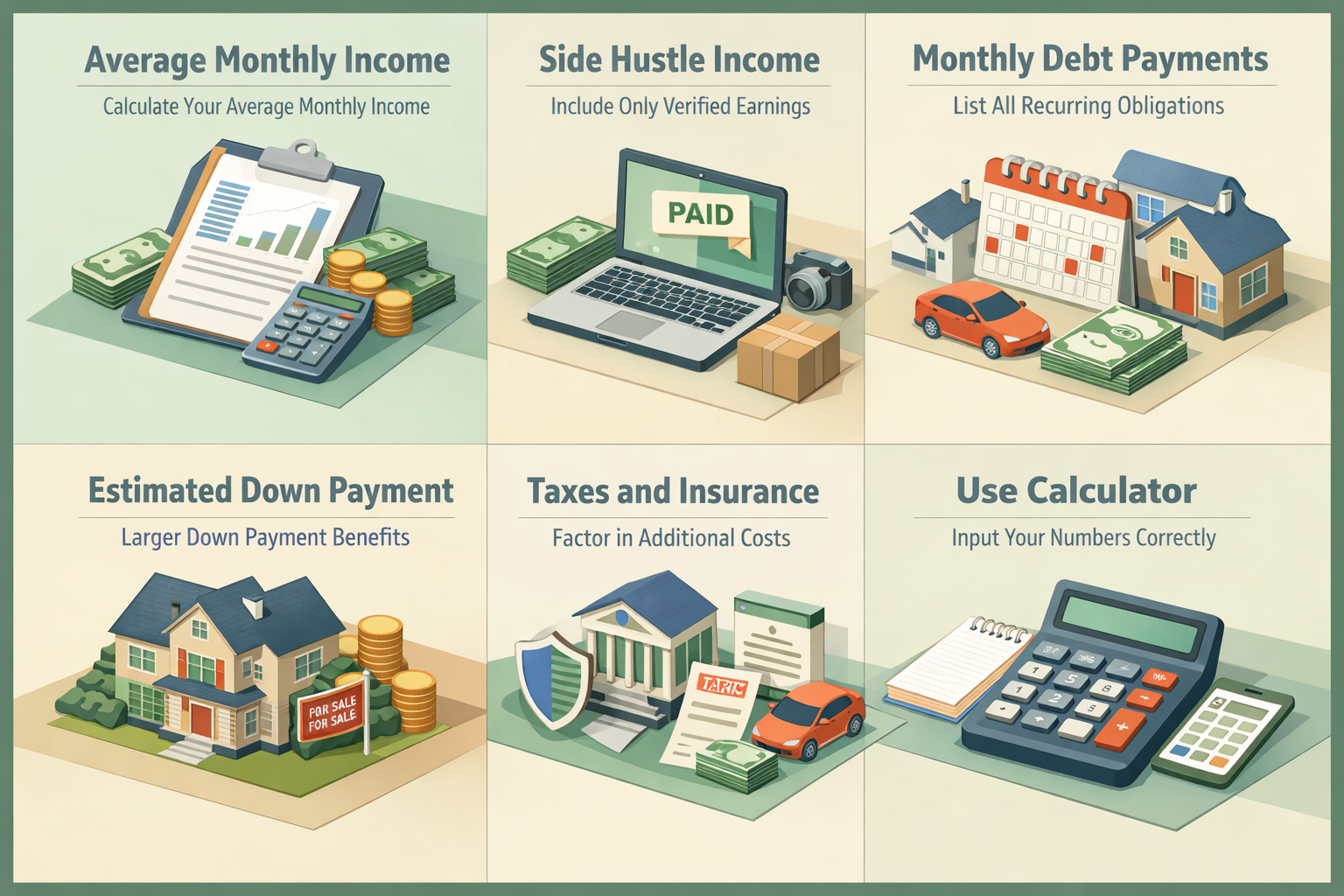
A mortgage affordability calculator for 1099 income freelance scenarios can be a valuable starting point, but it's important to input your numbers correctly to get a realistic estimate. Here's how to use these tools effectively when your income doesn't come from a traditional employer.
- Step 1 — Calculate your average monthly income: Add your net self-employment income from your last two tax returns and divide by 24. This gives you your monthly qualifying income figure.
- Step 2 — Add side hustle income carefully: Only include side hustle earnings that have appeared on at least two years of tax returns. Use the same averaging method.
- Step 3 — List all monthly debt payments: Include minimum payments on credit cards, student loans, auto loans, and any other recurring obligations.
- Step 4 — Enter your estimated down payment: A larger down payment reduces your loan amount and monthly payment, which can improve your DTI ratio and approval odds.
- Step 5 — Factor in taxes, insurance, and HOA fees: These costs are part of your total housing payment and affect affordability calculations significantly.
Keep in mind that online calculators provide estimates, not guaranteed approvals. A licensed mortgage professional can run a more precise analysis using your actual tax documents and credit profile. That said, running your numbers through a calculator first helps you set realistic expectations before you start house hunting.
It's also helpful to understand that lenders may add back certain deductions — like depreciation — to your net income when calculating your qualifying amount. This is known as an add-back and can meaningfully increase the income figure a lender uses on your behalf.
Documentation You'll Need to Prove Self-Employment and Side Hustle Income
One area where 1099 borrowers often face friction is documentation. Lenders need to verify that your income is real, consistent, and likely to continue. Being organized and proactive with your paperwork can make the difference between a smooth approval and a frustrating delay.
Here's a general list of documents most lenders will request from 1099 earners and freelancers:
- Two years of personal federal tax returns (all pages and schedules)
- Two years of business tax returns if you operate as an LLC, S-Corp, or partnership
- Year-to-date profit and loss statement prepared by a CPA or accountant
- 1099 forms from all clients or platforms for the past two years
- Bank statements showing consistent deposits that align with reported income
- Business license or professional certifications to confirm your business is active
For side hustle income specifically, lenders want to see that the activity is ongoing and not a one-time event. A history of consistent deposits, combined with tax documentation, helps establish legitimacy in the eyes of an underwriter.
If your tax returns show very low net income due to aggressive deductions, you might explore non-QM loan programs — sometimes called bank statement loans — which allow lenders to qualify you based on 12 to 24 months of bank deposits rather than tax returns. These programs typically come with slightly higher interest rates but can open doors for borrowers whose tax filings don't reflect their true earning power.
Strategies to Strengthen Your Mortgage Application as a 1099 Borrower
Knowing how to calculate mortgage affordability with 1099 commission income and side hustle earnings is only part of the equation. You also need to position your application as attractively as possible. Fortunately, there are several practical strategies that may improve your chances of approval and help you qualify for a better loan.
Build and Maintain a Strong Credit Score
For self-employed and freelance borrowers, a high credit score can serve as a powerful compensating factor. Lenders may be more flexible on DTI or income documentation requirements when a borrower demonstrates excellent credit history. Aim to pay all bills on time, keep credit card balances low, and avoid opening new credit accounts before applying.
Grow Your Cash Reserves
Lenders often feel more comfortable approving 1099 borrowers who have substantial savings in the bank. Having several months of mortgage payments set aside — often referred to as reserves — signals financial stability and reduces perceived risk. The more reserves you can show, the stronger your application may appear.
Time Your Application Strategically
If you've had a particularly strong earning year, it may be worth applying sooner to capture that income in your two-year average. Conversely, if you recently started a new side hustle, waiting until it's been documented on two years of tax returns could increase your qualifying income.
Consider a Larger Down Payment
A bigger down payment reduces your loan-to-value ratio, which may make lenders more comfortable with the risks associated with variable income. It also lowers your monthly payment, which can help bring your DTI ratio into an acceptable range.
Loan Programs That May Be a Good Fit for Freelancers and Commission Earners
Not every mortgage program is equally friendly to 1099 earners, but several options are worth exploring depending on your financial profile.
- Conventional loans: Available to self-employed borrowers with two years of tax returns and strong credit. Fannie Mae and Freddie Mac guidelines allow for income averaging and certain add-backs, which can help increase your qualifying amount.
- FHA loans: These government-backed loans may offer more flexibility on DTI ratios and credit scores, making them a practical option for freelancers who are still building their financial profile. The same two-year income documentation standard typically applies.
- Bank statement loans (Non-QM): Designed specifically for self-employed borrowers, these programs use 12 to 24 months of personal or business bank statements to verify income instead of tax returns. They may carry higher rates but can be a game-changer for high earners with significant deductions.
- Asset depletion loans: If you have substantial liquid assets, some lenders may allow you to use those assets as a form of income qualification. This could benefit gig workers or investors who hold significant savings or investment accounts.
It's always wise to speak with a mortgage professional who specializes in working with self-employed and non-traditional income borrowers. They can help you identify the right program and structure your application to highlight your financial strengths.
●Conclusion
Navigating the mortgage process as a freelancer, commission earner, or side hustler doesn't have to be overwhelming. The most important things you can do are understand how lenders calculate your qualifying income, keep your financial documentation organized, and strategically strengthen your application before you apply. By learning how to calculate mortgage affordability with 1099 commission income and side hustle earnings, you give yourself a clear picture of what's possible — and a roadmap to get there. Whether you're exploring a conventional loan, an FHA program, or a non-QM option, the right mortgage solution is likely within reach. Start by running your numbers, speaking with a knowledgeable lender, and building the financial profile that puts homeownership within your grasp.