
Buying a home when your income fluctuates throughout the year can feel overwhelming. Whether you work in agriculture, construction, tourism, or run your own seasonal business, you might wonder if a mortgage is even within reach. The good news is that the Federal Housing Administration (FHA) loan program is designed with flexible qualifying guidelines that may work in your favor. Understanding how to calculate FHA loan affordability with seasonal income is the first step toward making informed decisions and moving confidently toward homeownership. This guide breaks down the process in plain language so you know exactly what lenders look at — and how to prepare.
What Makes FHA Loans a Strong Option for Non-Traditional Earners
FHA loans are backed by the federal government, which means lenders take on less risk when approving borrowers. That reduced risk typically translates into more flexible qualification standards compared to conventional mortgages. For seasonal income workers and self-employed individuals, this flexibility can be a real advantage.
Some of the most notable features of FHA loans include lower minimum down payment requirements, more lenient credit score thresholds, and a willingness to consider non-traditional income documentation. While no loan program is a guaranteed approval, FHA guidelines are generally considered more accessible for borrowers whose earnings don't follow a standard nine-to-five pay schedule.
- Down payment: As low as 3.5% for borrowers with qualifying credit scores
- Credit flexibility: May accommodate credit scores lower than conventional programs require
- Income documentation: Lenders may use a two-year average of documented earnings
- Debt-to-income ratio: FHA may allow higher ratios in certain circumstances
It's worth noting that individual lenders can set their own overlays — meaning stricter standards on top of FHA minimums. So while the program itself offers flexibility, the specific lender you work with may have additional requirements.
How Lenders Define and Verify Seasonal Income for FHA Qualification
Before you can calculate what you can afford, it helps to understand exactly how a lender views seasonal income. The FHA generally defines seasonal employment as work that is tied to a particular time of year — such as summer resort jobs, holiday retail positions, or agricultural harvesting roles. If you've been working seasonally in the same field for at least two years, lenders may be willing to count that income toward your qualifying figures.
The key documents lenders often request to verify seasonal income include:
- Two years of signed federal tax returns (personal and, if applicable, business)
- W-2 forms or 1099s covering the past two years
- Employer verification or a letter confirming the likelihood of continued seasonal employment
- Bank statements showing consistent deposits during your working season
- Profit and loss statements for self-employed seasonal workers
Lenders typically want to see a consistent pattern. If your income has grown or remained stable over two years, that's generally viewed as a positive sign. Significant year-over-year drops in earnings could raise questions during underwriting, so it's important to be prepared to explain any unusual fluctuations.
Step-by-Step: How to Calculate FHA Loan Affordability With Seasonal Income
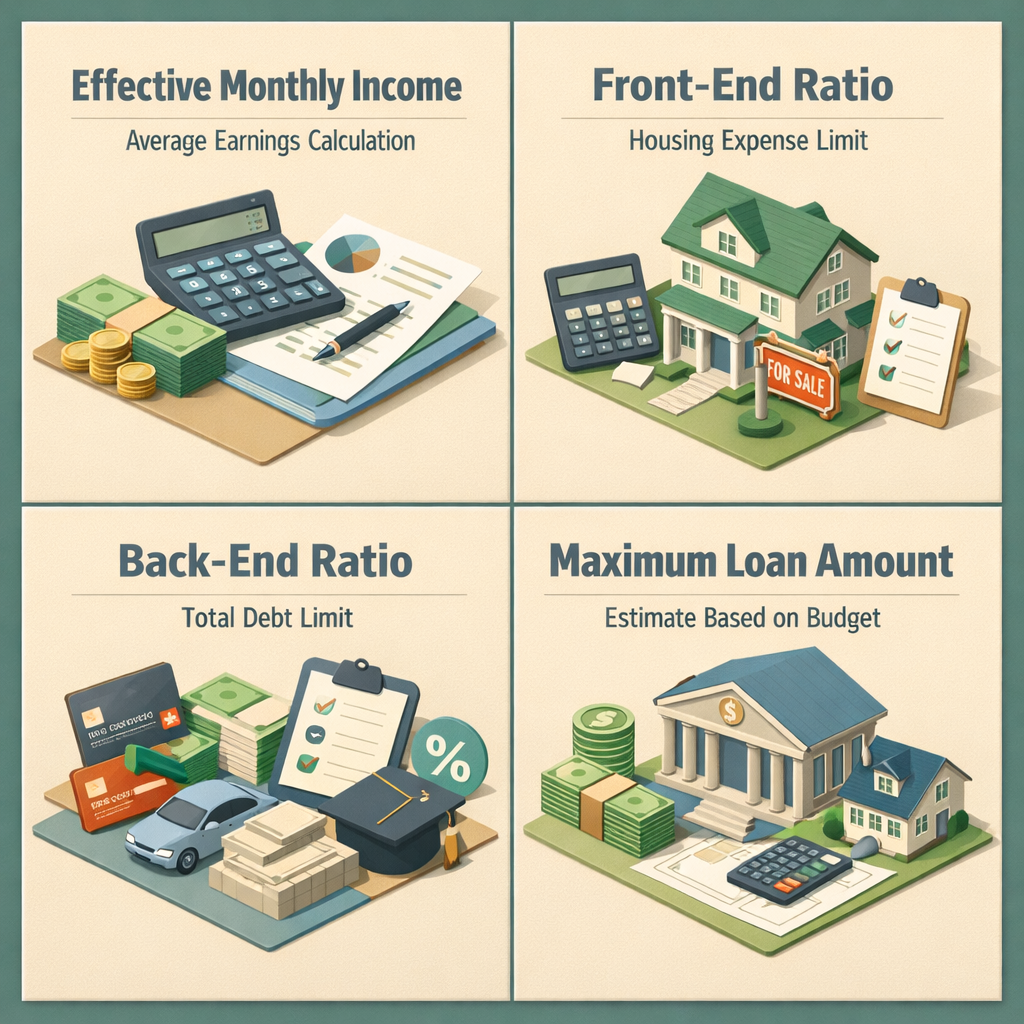
Learning how to calculate FHA loan affordability with seasonal income involves understanding two core concepts: your effective monthly income and your debt-to-income (DTI) ratio. Here's how the process typically works:
Step 1: Determine Your Effective Monthly Income
Add up your total documented earnings from the past two years (using tax returns or verified income records), then divide by 24. This gives you your average monthly income. For example, if you earned $48,000 one year and $52,000 the next, your combined two-year total is $100,000, and your average monthly income would be approximately $4,167.
Step 2: Calculate Your Front-End Ratio
FHA guidelines suggest that your housing expenses — including principal, interest, property taxes, homeowner's insurance, and any mortgage insurance premiums — should generally not exceed about 31% of your gross monthly income. Using the example above: $4,167 x 0.31 = approximately $1,292 per month toward housing costs.
Step 3: Calculate Your Back-End Ratio
Your total monthly debt payments, including housing costs plus any other obligations like car loans, student loans, or credit card minimums, should typically stay below 43% of gross monthly income under standard FHA guidelines. Some lenders may allow higher ratios with compensating factors. In our example: $4,167 x 0.43 = approximately $1,792 in total monthly debt.
Step 4: Estimate Your Maximum Loan Amount
Once you know your maximum monthly housing payment, you can use an online mortgage calculator or speak with a loan officer to estimate the maximum loan amount that fits within that budget. Don't forget to factor in property taxes, insurance, and FHA mortgage insurance premiums, as these add to your monthly obligation.
These calculations offer a useful starting point, but keep in mind that lender overlays, local loan limits, and your overall financial profile can all shift the final numbers.
FHA Loan Requirements for Self-Employed With Seasonal Income
For self-employed individuals whose work follows a seasonal pattern, qualifying for an FHA loan involves an additional layer of documentation. FHA loan requirements for self-employed with seasonal income typically center on proving both the stability of your business and the reliability of your earnings over time.
Lenders generally require at least two years of self-employment history in the same or a closely related field. Gaps in operation due to the nature of a seasonal business are usually understandable, but lenders will want a clear picture of when the business operates and how much it earns during active periods.
Common Documentation Requirements
- Two years of complete personal federal tax returns, including all schedules
- Two years of business tax returns if you operate as an LLC, S-corp, or partnership
- A current profit and loss statement, often prepared by a CPA
- Business license or registration documentation
- Proof that the business is still active, such as recent invoices or client contracts
How Lenders Treat Business Write-Offs
One challenge that self-employed seasonal borrowers often face is that tax deductions reduce reported income on paper. A lender calculating your qualifying income will typically start with your net income after deductions, then may add back certain non-cash expenses like depreciation. This adjusted figure is what they use for DTI calculations — which is why working with a knowledgeable loan officer early in the process can be very helpful.
Common Challenges Seasonal Borrowers Face — and How to Overcome Them
Even with FHA's flexible framework, seasonal income borrowers may encounter some hurdles. Being aware of these challenges ahead of time can help you prepare more effectively and avoid surprises during underwriting.
Inconsistent Income Patterns
If your income varies significantly from year to year, lenders may use the lower of the two years as a conservative estimate, or they may average them. Either approach could affect the loan amount you qualify for. Keeping detailed records and showing a general upward or stable trend in earnings may help your case.
Gaps in Employment History
Seasonal workers often have periods with no paycheck. Lenders generally understand this if the pattern is consistent and documented. A letter from your employer confirming that you're expected to return for the upcoming season can be a helpful supporting document.
Higher Debt-to-Income Ratios
Because seasonal income may be averaged at a lower monthly figure, your DTI could come out higher than expected. Paying down existing debts before applying, or choosing a less expensive property, could help bring your ratio into an acceptable range.
Proactive Steps to Strengthen Your Application
- Save tax returns and income records for at least two full years before applying
- Maintain clean bank statements showing consistent seasonal deposits
- Work with a CPA who understands mortgage qualification and can present your income clearly
- Avoid taking on new debt in the months leading up to your application
- Consider getting pre-qualified early to identify any gaps in your documentation
Understanding FHA Mortgage Insurance and Its Impact on Your Monthly Budget
When you calculate FHA loan affordability, mortgage insurance is a cost you can't ignore. FHA loans require two types of mortgage insurance: an upfront mortgage insurance premium (UFMIP) and an annual mortgage insurance premium (MIP) that's paid monthly.
The upfront premium is typically 1.75% of the loan amount and can usually be rolled into the loan rather than paid out of pocket at closing. The annual MIP varies based on the loan term, loan amount, and down payment percentage. For most 30-year FHA loans with a down payment below 10%, MIP continues for the life of the loan.
What this means practically is that your effective monthly payment will be higher than just principal and interest. For example, on a $250,000 FHA loan, the monthly MIP could add over $100 to your payment depending on current rates. This is an important figure to include when running your affordability calculations.
Some borrowers consider refinancing into a conventional loan later — once they've built sufficient equity — to eliminate the ongoing MIP cost. For seasonal income borrowers, this may become easier once income documentation becomes more robust over time.
Why Choosing an Experienced FHA Lender Matters for Seasonal Income Borrowers
Not all lenders are equally experienced with seasonal or self-employed income scenarios. Some may apply stricter overlays or be less familiar with how to document and present non-traditional income effectively. Choosing a lender who has worked with seasonal workers, freelancers, or self-employed borrowers can make a real difference in how smoothly your application moves through underwriting.
When evaluating lenders, it can be helpful to ask specific questions:
- How do you calculate qualifying income for seasonal workers?
- Do you accept a two-year average for borrowers with variable earnings?
- What documentation will I need beyond tax returns?
- Are there any lender overlays that might affect my eligibility?
A loan officer who asks thoughtful questions about your work history and income patterns — rather than simply running your application through a checklist — is often a sign that you're in good hands. Getting pre-qualified before you begin house shopping is also a smart move, as it gives you a realistic budget and helps identify any issues early enough to address them.
At LoanWise, we understand that financial situations don't always fit a standard mold. Our team is here to help you navigate how to calculate FHA loan affordability with seasonal income and explore every option available to you as a homebuyer with a unique income profile.
●Conclusion
Homeownership is a realistic goal even when your income follows the rhythms of the seasons. The FHA loan program offers a pathway that accounts for the realities of seasonal and self-employed work — as long as you're prepared with the right documentation and a clear understanding of how lenders evaluate your financial picture. By learning how lenders average your earnings, apply debt-to-income calculations, and assess your work history, you put yourself in a much stronger position to qualify. Take the time to organize your records, consult with a knowledgeable loan officer, and don't hesitate to reach out to LoanWise for personalized guidance. Your next chapter as a homeowner may be closer than you think.