
Applying for a mortgage after a major life change — like a job loss or a divorce — can feel overwhelming. Two of the most common income sources that arise in these situations are severance packages and alimony payments. But how do lenders actually view these income types when they're calculating your debt-to-income (DTI) ratio? Understanding how to calculate DTI with severance package and alimony is a critical step for homebuyers and refinancers who want to put their best foot forward during the loan approval process. This guide breaks down the rules, the nuances, and the strategies that could help you qualify for the mortgage you need.
What Is the Debt-to-Income Ratio and Why Does It Matter for Homebuyers
Your debt-to-income ratio is one of the most important numbers a mortgage lender will evaluate. It compares your total monthly debt obligations to your gross monthly income and is expressed as a percentage. In simple terms, the lower your DTI, the stronger your financial profile appears to lenders.
There are two versions of DTI that lenders typically review:
- Front-end DTI: This measures your proposed monthly housing costs — including principal, interest, taxes, and insurance — as a percentage of your gross monthly income.
- Back-end DTI: This includes all monthly debt payments, such as credit cards, auto loans, student loans, and the proposed mortgage payment, divided by gross monthly income.
Most conventional loan programs prefer a back-end DTI of 43% or below, though some programs may allow higher ratios with compensating factors. FHA loans can sometimes accommodate DTI ratios up to 50% or more depending on the borrower's overall profile. The key takeaway is that both your income and your debts play equally important roles in this equation.
When your income picture is complicated — as it often is after a job loss or a divorce — lenders must carefully determine which income sources are eligible and how to count them accurately.
How Lenders Treat Severance Pay When Calculating Income for a Mortgage
A severance package is typically a lump-sum payment or a series of payments made by an employer when an employee is laid off or let go. While it may feel like income — and technically it is — mortgage lenders tend to view it quite differently than regular employment earnings.
For the purposes of the debt to income ratio calculation after job loss, lenders generally want income to meet two key criteria: it must be stable and it must be expected to continue. Severance pay, by its nature, is temporary. Because it has a defined end date, most lenders will not count it as qualifying income for a long-term mortgage obligation.
That said, there are some circumstances where severance may play a supporting role:
- As a reserve asset: If your severance has been deposited into a bank account, lenders may count those funds as reserves — meaning they can demonstrate your ability to make mortgage payments even without a current job.
- Bridge income documentation: Some lenders, particularly those offering non-QM (non-qualified mortgage) products, may consider severance as temporary income if supported by a severance agreement outlining the payment schedule and duration.
- Return-to-work documentation: If you've received a written offer letter for new employment and your start date is imminent, lenders may combine the future salary with existing severance documentation to build a stronger income case.
It's worth noting that guidelines can vary significantly between lenders and loan types. Consulting directly with a mortgage professional is often the best way to understand how your specific severance arrangement will be viewed.
Understanding How Alimony Income Is Counted in Your DTI Calculation
Unlike severance, alimony — also called spousal support — can often be counted as qualifying income for a mortgage, provided it meets specific lender criteria. This can be a significant advantage for homebuyers or refinancers who are recently divorced and relying on court-ordered support payments.
To include alimony as qualifying income in a DTI calculation, most lenders typically require:
- A court order or legally binding divorce decree: The alimony arrangement must be documented in writing. Verbal agreements generally won't be accepted.
- Proof of receipt: Lenders will usually want to see 6 to 12 months of bank statements showing consistent alimony deposits.
- Continuance for at least three years: Most conventional loan guidelines — including those from Fannie Mae and Freddie Mac — require that the income will continue for a minimum of three years after the mortgage application date. If the support is set to expire within that window, it may not be counted.
When alimony is properly documented and meets these requirements, it can be added directly to your gross monthly income, which in turn improves your debt-to-income ratio. For example, if you earn $3,500 per month from part-time work and receive $1,000 per month in alimony, your total qualifying income could be $4,500 — a meaningful difference when a lender is evaluating your borrowing capacity.
It's also worth mentioning that alimony payments you make as the paying spouse are treated as a monthly debt obligation, which increases your DTI. This is an important distinction depending on which side of the agreement you're on.
How to Calculate DTI With Severance Package and Alimony Step by Step
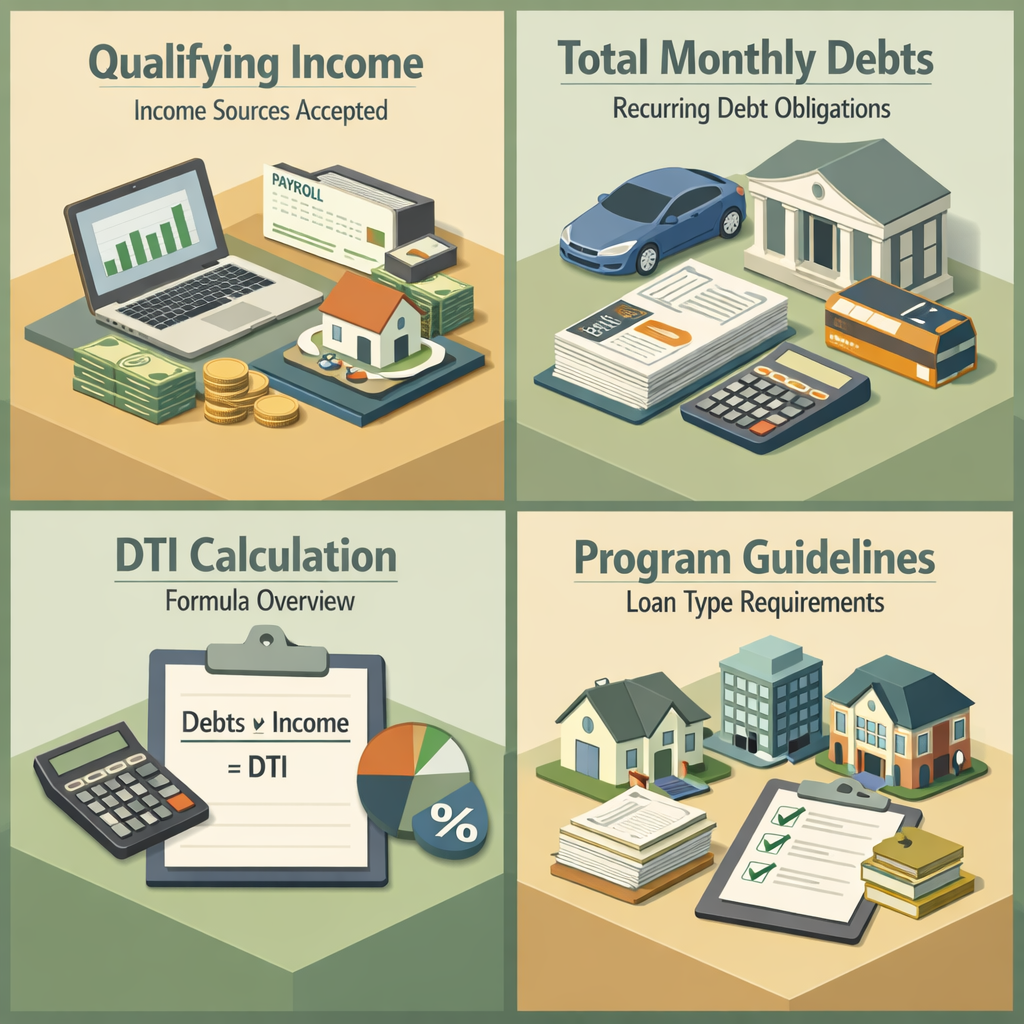
Now that we understand how each income type is treated, let's walk through how to calculate DTI with severance package and alimony in a practical scenario. Keep in mind that lender-specific rules may apply, so treat this as an illustrative framework rather than a guarantee.
Step 1: Identify your qualifying monthly income.
Start by listing all income sources that lenders are likely to accept. For most borrowers navigating a job transition and divorce, this might include:
- New employment income (if you've returned to work)
- Part-time or freelance income (typically averaged over 24 months)
- Alimony received (if it meets the continuance and documentation requirements)
- Investment or rental income (if applicable and documented)
If your severance qualifies as reserves rather than income, it won't factor into the numerator of your DTI but can still strengthen your loan file.
Step 2: Add up your total monthly debt obligations.
Include all recurring monthly debts as they appear on your credit report, plus your proposed new mortgage payment:
- Minimum credit card payments
- Auto loan payments
- Student loan payments
- Any alimony you pay (if you are the paying spouse)
- Proposed monthly mortgage payment (principal, interest, taxes, insurance, and HOA if applicable)
Step 3: Divide total monthly debts by total qualifying income.
The formula is straightforward: Total Monthly Debts ÷ Total Qualifying Monthly Income = DTI Ratio. For instance, if your qualifying income totals $5,000 per month and your total monthly debts — including the proposed mortgage — are $2,000, your back-end DTI would be 40%. That's typically within an acceptable range for many loan programs.
Step 4: Compare your DTI to program guidelines.
Check your calculated DTI against the requirements of the loan program you're targeting. Conventional loans, FHA, VA, and USDA programs all have their own thresholds, and a mortgage professional can help you identify which program best fits your situation.
Documentation Strategies That Strengthen Your Mortgage Application
When your income sources are non-traditional — such as alimony and severance — documentation becomes especially critical. Lenders need a clear paper trail to verify that your income is real, consistent, and likely to continue. Here are some practical steps you can take to build a compelling loan file:
- Gather your divorce decree or separation agreement: This is the foundational document for alimony income. Make sure it clearly outlines the payment amount, frequency, and duration.
- Print 12 months of bank statements: Showing a consistent deposit pattern each month demonstrates that alimony payments are being made on schedule.
- Obtain your severance agreement in writing: Even if it won't be counted as qualifying income, having the document available shows full transparency and can help lenders understand your complete financial picture.
- Request an offer letter if you're returning to work: A signed offer letter with a confirmed start date and salary can significantly strengthen a file where current income is limited.
- Work with a CPA or financial advisor: If your income picture is complex, having a professional prepare an income summary letter may help your loan officer present your case more effectively to underwriters.
Transparency is your best tool. Attempting to hide gaps in employment or inconsistencies in income can create bigger problems during underwriting. Lenders appreciate borrowers who proactively explain their circumstances with supporting documentation.
Loan Programs Worth Exploring When Your Income Profile Is Unconventional
Not every borrower fits neatly into a conventional loan box. If your income currently relies heavily on alimony or if you're still transitioning back into the workforce after a severance situation, certain loan programs may offer more flexibility.
FHA Loans
FHA loans are backed by the Federal Housing Administration and are known for accommodating a wider range of borrower profiles. They may allow higher DTI ratios and are generally more flexible with income documentation requirements. Alimony income that meets continuance requirements can typically be used to qualify.
Non-QM (Non-Qualified Mortgage) Loans
Non-QM loans don't follow standard agency guidelines, which means lenders can apply their own underwriting criteria. For borrowers with complex income — such as a combination of severance reserves, alimony, and gig work — non-QM products may offer a viable path. However, they often come with higher interest rates to compensate for the additional lender risk.
Asset Depletion Loans
If you have significant savings — including a severance lump sum — some lenders offer asset depletion or asset dissipation loans. In this model, lenders divide your total eligible assets by a set number of months (often 60 to 84) and treat the result as monthly income. This could be especially useful if your severance was substantial.
VA Loans
Eligible veterans and active-duty service members may find that VA loans offer some of the most generous qualifying criteria available, including flexible DTI guidelines and no private mortgage insurance requirements. If alimony is properly documented, it may be counted toward qualifying income here as well.
●Conclusion
Understanding how to calculate DTI with severance package and alimony is about more than just running numbers — it's about telling a complete and credible financial story to your lender. While severance pay is typically viewed as a temporary resource rather than qualifying income, alimony can be a meaningful income source when properly documented and meeting continuance requirements. By gathering the right paperwork, selecting the appropriate loan program, and working with an experienced mortgage professional, homebuyers and refinancers in transitional financial situations can still achieve their goals.
At LoanWise, we believe every borrower deserves clear guidance — no matter how complex their income picture looks. If you're navigating a job transition, a divorce, or both, our team is here to help you map out the best path forward. Reach out to a LoanWise mortgage specialist today and let's build a strategy that works for your unique situation.