
If you're applying for a mortgage, your debt-to-income ratio — commonly called DTI — is one of the most important numbers a lender will look at. It tells them how much of your monthly gross income goes toward paying debts. But what happens when your income includes recent bonus payments? Or when child support is part of your financial picture — either as income you receive or a payment you make? These situations add a layer of complexity that many homebuyers don't expect. Understanding how to calculate DTI with recent bonus income and child support can make the difference between a smooth approval and an unexpected denial. This guide breaks it all down in plain language so you can walk into your mortgage conversation fully prepared.
What Is DTI and Why Does It Matter for Homebuyers
Your debt-to-income ratio is a simple formula: take your total monthly debt obligations and divide them by your gross monthly income. The result, expressed as a percentage, shows lenders how financially stretched you might be. For example, if your gross monthly income is $6,000 and your total monthly debts are $2,100, your DTI would be 35%.
Lenders typically look at two versions of DTI. The front-end ratio covers only housing-related costs — your proposed mortgage payment, property taxes, homeowner's insurance, and any HOA fees. The back-end ratio includes all monthly debt obligations, such as car loans, student loans, credit cards, and the new housing payment combined. Most lenders focus heavily on the back-end DTI when making approval decisions.
Different loan programs carry different DTI thresholds. Conventional loans often prefer a back-end DTI at or below 43%, though some automated underwriting systems may allow higher ratios depending on compensating factors like strong credit or a larger down payment. FHA loans may permit higher DTI ratios in certain cases, while VA and USDA loans each have their own guidelines. The key takeaway is that the lower your DTI, the stronger your mortgage application typically appears to a lender.
What makes DTI calculations tricky is that not all income and not all debts are treated the same way. This is especially true when bonus income or child support enters the equation.
How Lenders Treat Bonus Income When Calculating Your Qualifying Income
Bonus income can significantly boost your earnings, but lenders tend to approach it cautiously. Because bonuses are considered variable — meaning they're not guaranteed from one year to the next — most lenders will not count a bonus at its full face value. Instead, they typically average the bonus income over a two-year period to establish a stable monthly figure.
Here's how that might look in practice. If you received a $12,000 bonus last year and a $10,000 bonus the year before, a lender might average those to arrive at $11,000 per year, or approximately $917 per month in qualifying bonus income. That additional monthly income is then added to your base salary when calculating your gross monthly income for DTI purposes.
However, there are important conditions. Most lenders require:
- A two-year history of receiving bonus income from the same employer, evidenced by W-2s or tax returns.
- Documentation showing the bonus is likely to continue, often confirmed through a verification of employment or a letter from your employer.
- Consistency in the bonus amounts — if your bonus dropped significantly from one year to the next, some lenders may use the lower figure or exclude the income entirely.
If you've only recently started receiving bonuses — say, within the past year — many lenders may not be able to count that income at all, or they may apply a more conservative calculation. It's worth asking your loan officer exactly how they plan to treat your bonus when running the numbers, because different lenders and loan programs may handle this differently.
The bottom line: recent bonus income can help your DTI, but it needs to be documented carefully and have a reliable track record to count toward your qualifying income.
Child Support as Income: When It Works in Your Favor
If you receive child support payments, the good news is that lenders can count this as qualifying income — but there are specific rules you'll need to meet. Child support received is generally treated similarly to other non-employment income sources, and when documented correctly, it can meaningfully reduce your DTI by increasing the income side of the equation.
To use child support as qualifying income for a mortgage, most lenders will require:
- A court order or legal agreement confirming the child support obligation and the payment amount.
- Evidence that payments have been received consistently, typically for the past 12 months. Bank statements showing regular deposits are the most common form of proof.
- Proof that the payments are likely to continue for at least three years from the date of your mortgage application. If the child support is set to end soon — for example, because a child is nearly 18 — a lender may not be able to count it as ongoing qualifying income.
When these conditions are met, the monthly child support amount you receive can be added to your gross income before calculating your DTI ratio. For a borrower on a tight DTI margin, even a few hundred dollars per month in additional qualifying income could make a meaningful difference in loan eligibility.
It's also worth noting that disclosing child support income is voluntary. You're not required to include it if you prefer not to — but if you need it to qualify, proper documentation is essential.
How to Calculate DTI With Recent Bonus Income and Child Support: A Step-by-Step Example
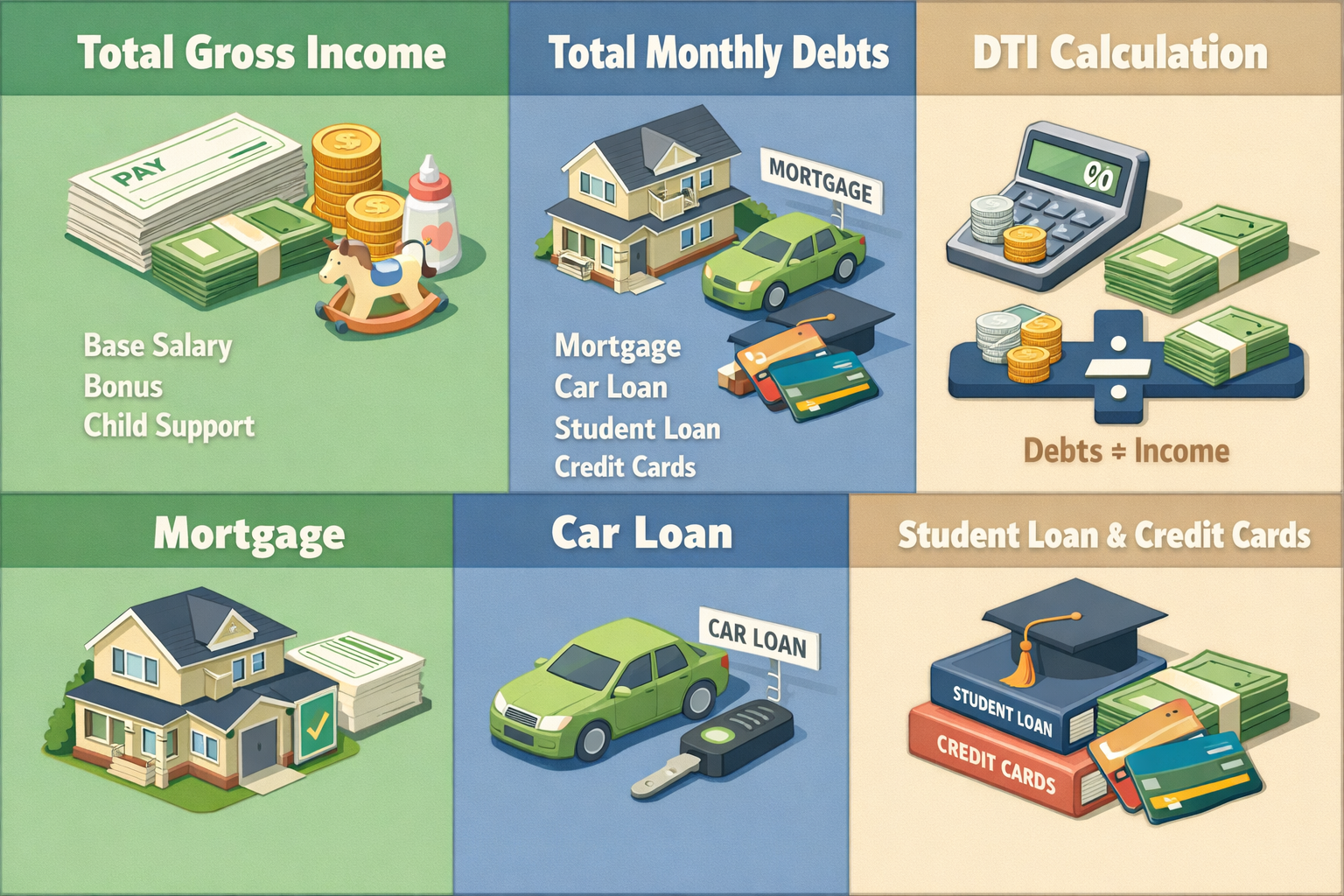
Let's walk through a practical example of how to calculate DTI with recent bonus income and child support so you can see how all the pieces fit together.
Scenario: Sarah is a homebuyer with the following financial profile:
- Base salary: $5,000 per month (gross)
- Average bonus income (two-year average): $800 per month
- Child support received: $600 per month (documented and continuing for 5+ more years)
- Proposed monthly mortgage payment (PITI): $1,500
- Car loan payment: $350 per month
- Student loan payment: $200 per month
- Credit card minimum payments: $100 per month
Step 1 — Calculate total gross monthly income:
$5,000 (base) + $800 (bonus) + $600 (child support) = $6,400 per month
Step 2 — Calculate total monthly debts:
$1,500 (mortgage) + $350 (car) + $200 (student loan) + $100 (credit cards) = $2,150 per month
Step 3 — Divide debts by income:
$2,150 ÷ $6,400 = 0.336, or approximately 33.6% DTI
In this scenario, Sarah's back-end DTI lands well within acceptable ranges for most loan programs. Without the bonus and child support income, her DTI would climb to 43% — still potentially acceptable under some programs, but much closer to the limit. This example shows how properly documenting variable income sources can genuinely strengthen a mortgage application.
Using a debt to income ratio calculator child support feature — available through many lender websites and financial tools — can help you run similar scenarios before speaking with a loan officer, giving you a clearer picture of where you stand.
Child Support as a Debt Obligation: The Side That Raises Your DTI
If you're the one making child support payments rather than receiving them, the calculation works in the opposite direction. Court-ordered child support payments are treated as a monthly debt obligation, just like a car payment or credit card minimum. This means they go on the debt side of your DTI equation and increase your ratio.
Lenders will typically verify child support obligations through your credit report, court documents, or a signed statement disclosing your monthly obligations. Even if the payments don't appear on your credit report, lenders are required to ask about them during the application process, and providing accurate information is essential.
Here's a simplified comparison to show the impact:
- Without child support payment: $1,800 in debts ÷ $5,500 income = 32.7% DTI
- With $500 child support payment added: $2,300 in debts ÷ $5,500 income = 41.8% DTI
That difference of roughly 9 percentage points could push a borrower closer to — or over — a lender's DTI threshold. If your DTI is approaching the upper limit, strategies like paying down other debts, increasing your documented income, or exploring loan programs with more flexible DTI guidelines may help you qualify.
It's also worth noting that temporary or informal child support arrangements may be handled differently than court-ordered obligations. Always discuss your specific situation openly with a knowledgeable loan officer.
Documentation Tips to Support Your DTI Calculation
Whether you're counting on bonus income, reporting child support received, or disclosing child support paid, strong documentation is the foundation of a smooth underwriting process. Here are practical steps to help you prepare:
- For bonus income: Gather your last two years of W-2s and federal tax returns. If your employer can provide a written letter confirming that bonuses are expected to continue, that may strengthen your file. Recent pay stubs showing year-to-date earnings can also help if a bonus has already been paid during the current year.
- For child support received: Collect your divorce decree or court order showing the payment amount, along with 12 months of bank statements showing consistent deposits. If payments have been made directly or informally, they may be harder to document — work with your loan officer to determine the best approach.
- For child support paid: Be prepared to share court documents and payment history. If you're ahead on payments or have a modified order, bring that documentation as well.
- General tip: Keep a clear paper trail. Lenders and underwriters work with what they can verify on paper. The more organized and complete your documentation, the faster your loan can move through the approval process.
Working with an experienced mortgage professional who understands how variable income and family obligation disclosures interact with DTI guidelines can save you significant stress and potentially open up loan options you might not have considered on your own.
●Conclusion
Understanding how to calculate DTI with recent bonus income and child support is one of the most valuable things you can do before starting your mortgage journey. These income sources and obligations may seem complicated, but with the right documentation and a clear understanding of how lenders evaluate them, they don't have to stand in the way of homeownership. Bonus income that's consistent and well-documented can increase your qualifying income and lower your DTI. Child support you receive — when properly verified — can work in your favor the same way. And if you're paying child support, knowing how it affects your ratio helps you plan ahead. Use an online debt to income ratio calculator child support tool as a starting point, but always follow up with a licensed mortgage professional who can look at your full financial picture. At LoanWise, we're here to help you navigate every detail of your mortgage application with confidence. Reach out today to connect with a lending expert who can guide you through the numbers and toward the home you're working toward.