
Getting approved for a mortgage when your income isn't a steady paycheck can feel overwhelming. Freelancers, independent contractors, and commission-based earners often wonder how lenders will view their variable income — and whether they'll even qualify. That's where understanding how to calculate DTI with freelance commission income and a co-signer becomes incredibly important. Your debt-to-income ratio, or DTI, is one of the most critical factors a lender examines during the mortgage underwriting process. When your income fluctuates month to month, calculating that ratio accurately — and presenting it strategically — can make or break your application. The good news is that there are established methods lenders use to evaluate non-traditional income, and adding a co-signer to your application may significantly strengthen your position. This guide will walk you through everything you need to know.
What Is a Debt-to-Income Ratio and Why It Matters for Mortgage Approval
Your debt-to-income ratio is a simple but powerful number. It compares your total monthly debt obligations to your gross monthly income. Lenders use it to assess whether you can comfortably manage a new mortgage payment alongside your existing financial commitments.
Here's the basic formula:
- DTI = Total Monthly Debt Payments ÷ Gross Monthly Income × 100
For example, if your total monthly debts — including your expected mortgage payment — come to $2,000, and your gross monthly income is $6,000, your DTI would be approximately 33%. Most conventional lenders typically prefer a DTI at or below 43%, though some loan programs may allow higher ratios under certain conditions. FHA loans, for instance, may permit DTIs up to 50% in some cases, depending on compensating factors.
There are actually two types of DTI ratios lenders often review:
- Front-end DTI: This only includes housing-related expenses such as your mortgage payment, property taxes, homeowner's insurance, and HOA fees if applicable.
- Back-end DTI: This is the more comprehensive ratio that includes all monthly debt obligations — housing costs plus car loans, student loans, credit card minimum payments, and other recurring debts.
When you're a freelancer or commission earner, the income side of this equation becomes the main challenge. Lenders need to feel confident that your earnings are stable and likely to continue, which requires more documentation than a standard W-2 employee typically provides.
How Lenders Evaluate Freelance and Commission-Based Income for Mortgage Qualification
Lenders don't simply look at what you earned last month. When it comes to variable or self-generated income, most lenders require a two-year history of consistent earnings before they'll use that income in your DTI calculation. This is a standard underwriting guideline across many loan programs, including conventional, FHA, and others.
For freelance income, lenders will typically ask for:
- Two years of federal tax returns (both personal and business, if applicable)
- A current profit and loss statement
- Bank statements showing regular deposits
- A copy of your business license or client contracts if available
For commission income, which often applies to real estate agents, sales professionals, and mortgage brokers, lenders generally want to see that commission earnings have been received for at least two years in the same field. They may average your commission income over 24 months to arrive at a monthly figure.
Here's a simplified example of how that averaging works:
- Year 1 commission income: $48,000
- Year 2 commission income: $60,000
- Total over 2 years: $108,000
- Monthly average: $108,000 ÷ 24 = $4,500 per month
This monthly average is what lenders would likely plug into the income side of your DTI calculation. It's worth noting that if your income has been declining from year to year, lenders may only use the lower of the two figures — or may question the stability of your earnings altogether. Conversely, if income is trending upward, lenders may view that more favorably.
One important caveat: lenders look at your net self-employment income after deducting business expenses, not your gross revenue. Because many freelancers and contractors deduct significant business expenses on their tax returns, the qualifying income used by the lender could be notably lower than what you actually brought in. This is a common surprise for many self-employed borrowers, and it highlights the importance of working with a knowledgeable loan officer early in the process.
Step-by-Step: How to Calculate DTI With Freelance Commission Income and a Co-Signer
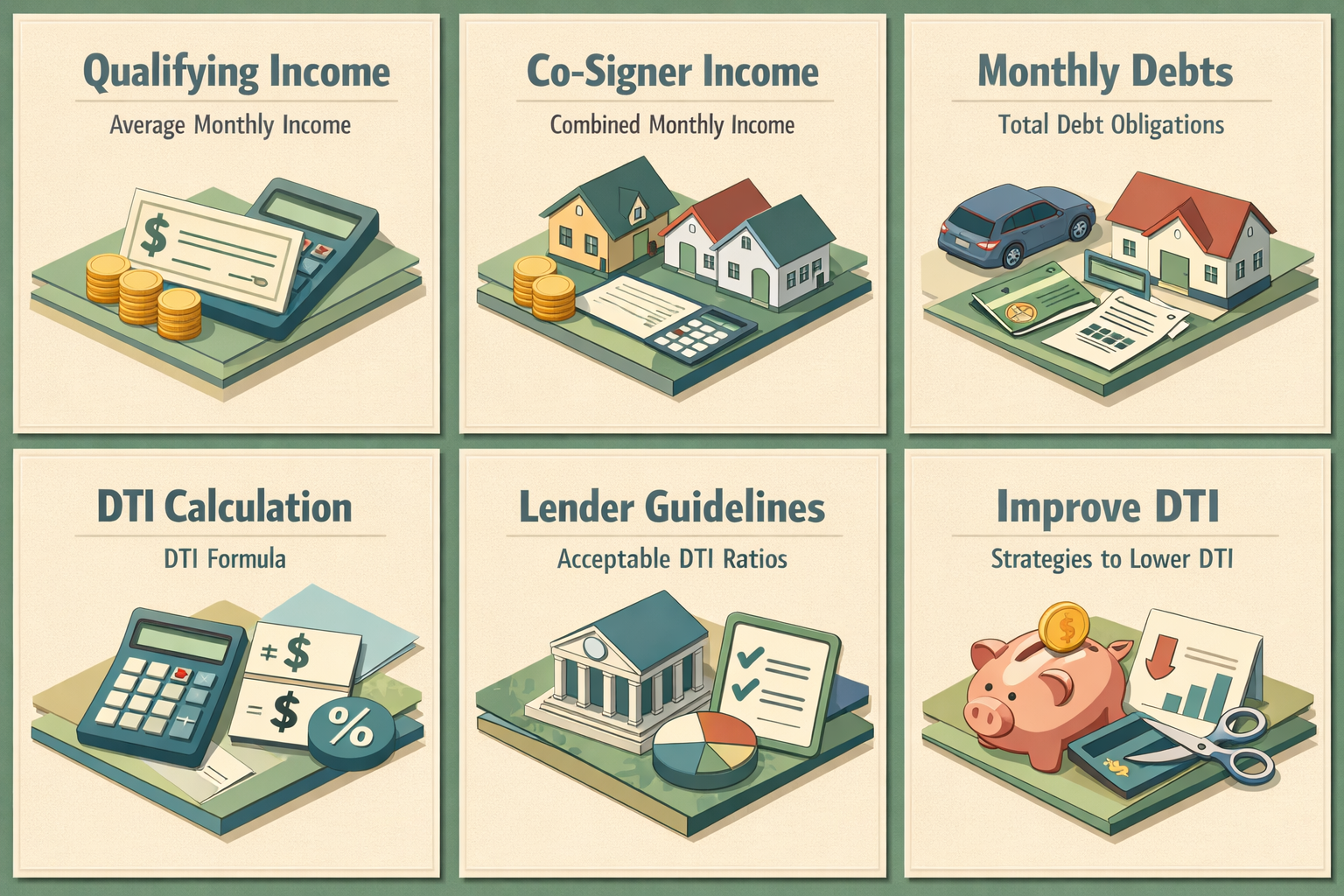
Understanding how to calculate DTI with freelance commission income and a co-signer requires you to look at the full financial picture — both yours and your co-signer's. Let's break this down into clear, manageable steps.
Step 1: Determine Your Qualifying Monthly Income
Start by averaging your freelance or commission income over 24 months using your tax returns. If your lender uses net income (after business deductions), use that figure. For example, if your averaged net monthly income works out to $4,000, that's your starting point.
Step 2: Add the Co-Signer's Monthly Income
A co-signer's income is typically included in the combined qualifying income for the loan. If your co-signer earns a gross monthly income of $5,000 from a salaried position, the combined income would be $9,000 per month.
Step 3: Add Up All Monthly Debt Obligations
Include debts for both you and your co-signer. Common items include:
- Projected monthly mortgage payment (principal, interest, taxes, insurance)
- Car loan payments
- Student loan payments
- Credit card minimum payments
- Any other recurring loan obligations
Let's say your combined monthly debts, including the new mortgage payment of $2,200, total $3,400.
Step 4: Apply the DTI Formula
Using the numbers above: $3,400 ÷ $9,000 = 0.378, or approximately 37.8% DTI. This would likely fall within an acceptable range for many lenders, especially when it might have been much higher — or potentially disqualifying — without the co-signer's income included.
Step 5: Compare to Lender Thresholds
Review your DTI against the guidelines for the loan type you're pursuing. Conventional loans often target 43% or below, while FHA loans may allow slightly higher ratios with compensating factors. Speaking with a mortgage professional can help you understand exactly where you stand.
The Role of a Co-Signer in Strengthening Your Mortgage Application
A co-signer can be a powerful tool for borrowers who have variable income or a limited credit history. When someone co-signs your mortgage, they agree to share legal responsibility for the loan. Their income, credit profile, and debt obligations are all factored into the lender's evaluation.
Here's how a co-signer may help your DTI and overall mortgage profile:
- Increases qualifying income: Adding a co-signer with steady, verifiable income — such as a salaried employee — can meaningfully reduce your DTI ratio by increasing the denominator of the equation.
- Improves creditworthiness: If your co-signer has a strong credit score, lenders may view the overall application more favorably, potentially unlocking better interest rates or loan terms.
- Offsets income instability: A co-signer's consistent paycheck can help counterbalance the perceived risk of your fluctuating freelance or commission earnings.
However, it's important to understand the responsibilities involved. A co-signer is equally liable for the mortgage. If you miss payments, their credit score will also be affected. This is a significant commitment, and both parties should fully understand what they're agreeing to before signing anything.
It's also worth noting that not all lenders handle co-signers the same way. Some programs may limit the relationship between borrower and co-signer, or may require the co-signer to also be an occupant of the home. These are details worth clarifying with your lender upfront.
Common Documentation Challenges for Freelancers and Commission Earners Applying for a Mortgage
One of the most frustrating parts of the mortgage process for self-employed and commission-based borrowers is gathering the right documentation. Lenders need to verify income in ways that go far beyond a simple pay stub, and gaps or inconsistencies in your records can slow down — or derail — your application.
Here are some common challenges and how you might address them:
Challenge 1: Tax Returns Show Lower Taxable Income
Many freelancers legally reduce their taxable income through business deductions. While this is smart tax planning, it can hurt mortgage qualifyication because lenders typically use your reported net income. One approach some borrowers explore is working with a tax professional to understand the trade-off between maximizing deductions and maintaining a qualifying income level — especially in the year or two before applying for a mortgage.
Challenge 2: Income Varies Significantly Year to Year
Lenders may be cautious if your income swings dramatically between years. If year two income is significantly lower than year one, some lenders might only use the lower figure. To strengthen your case, try to maintain consistent or growing earnings in the period leading up to your application.
Challenge 3: Gaps in Work History
Freelance careers can involve gaps between contracts. Lenders generally want to see a continuous, two-year history of self-employment in the same field. If you've recently transitioned from traditional employment to freelancing in the same profession, some lenders may be willing to combine your employment and freelance history to meet this requirement.
Challenge 4: Proving Business Legitimacy
For some loan programs, lenders may want confirmation that your business is real and operational. Having a business license, a professional website, a dedicated business bank account, or letters from clients can all help support your application.
Tips to Improve Your Debt-to-Income Ratio Before Applying for a Home Loan
If your current DTI is higher than lenders prefer, there are several strategies that might help you get it into a better range before you formally apply. Improving your debt-to-income ratio calculation for freelance commission income situations takes both financial planning and patience, but it's absolutely achievable.
- Pay down existing debts: Reducing or eliminating credit card balances, car loans, or other recurring obligations directly lowers your monthly debt total — which improves your DTI. Even small reductions can make a meaningful difference.
- Increase your income documentation: If you've recently had a strong year, make sure you're capturing all legitimate income and can document it clearly. Some lenders may also consider a signed letter from a client confirming ongoing work.
- Avoid taking on new debt: In the months leading up to your mortgage application, resist the urge to finance a new car or open new credit accounts. New debt will raise your monthly obligations and hurt your DTI.
- Consider a larger down payment: A larger down payment reduces the loan amount, which lowers your monthly mortgage payment and, in turn, your DTI. This can be especially helpful for freelancers who have savings but irregular income.
- Explore non-QM loan options: Non-qualified mortgage programs may offer more flexible income verification methods, such as bank statement loans, that could work better for your income profile. These programs often have different DTI thresholds or alternative qualification criteria.
- Work with your co-signer early: If you plan to use a co-signer, loop them in early so their credit and income can be assessed, giving you a clear picture of your combined qualification position.
●Conclusion
Navigating the mortgage process as a freelancer or commission earner isn't always straightforward, but it's far from impossible. Understanding how to calculate DTI with freelance commission income and a co-signer gives you a real advantage — it lets you walk into lender conversations prepared, informed, and strategic. By averaging your income correctly, documenting your earnings thoroughly, and leveraging a co-signer's financial strength where needed, you can build a compelling mortgage application even with a non-traditional income profile. Every borrower's situation is unique, so working closely with an experienced mortgage professional is one of the best steps you can take. At LoanWise, we're here to help you understand your options and find a path to homeownership that fits your financial reality. Connect with a LoanWise loan specialist today and take the first confident step toward your new home.