
If you're a freelancer trying to buy a home or refinance, you've probably already discovered that lenders don't make things easy. Your income doesn't arrive in neat, predictable paychecks. Some months are great. Others are slow. And if you also receive or pay child support, the calculation gets even more layered. The good news is that understanding how to calculate DTI with fluctuating freelance income and child support payments is entirely possible — and doing so could be the key that unlocks your path to mortgage approval. This article walks you through the process clearly, step by step.
What DTI Means and Why Lenders Care So Much About It
Your debt-to-income ratio, or DTI, is one of the most important numbers a mortgage lender will look at when reviewing your application. Simply put, it measures how much of your gross monthly income goes toward paying debts. Lenders use it to determine whether you can comfortably afford a new mortgage payment on top of your existing financial obligations.
The formula itself is straightforward:
- DTI = Total Monthly Debt Payments ÷ Gross Monthly Income × 100
For example, if your total monthly debts add up to $2,000 and your gross monthly income is $6,000, your DTI would be roughly 33%. Most conventional loan programs may prefer a debt-to-income ratio at or below 43%, though some programs could allow higher ratios depending on compensating factors like strong credit or a larger down payment.
There are also two types of DTI that lenders often reference. The front-end DTI looks only at your proposed housing costs — principal, interest, taxes, and insurance — as a percentage of your income. The back-end DTI includes all monthly debt obligations, which is typically the number lenders scrutinize most carefully.
The Freelance Income Challenge: How Lenders Typically View Variable Earnings
When you're self-employed or working as a freelancer, your income history tells a story — and lenders want to read the whole book, not just a recent chapter. Unlike a salaried borrower who can hand over a pay stub, freelancers typically need to document their earnings through tax returns, profit and loss statements, and sometimes bank statements going back 12 to 24 months.
Most lenders will calculate your average monthly income based on your last two years of net self-employment income as reported on your federal tax returns. They don't use your gross revenue. Instead, they typically look at your net profit after allowable business deductions — the number that shows up on your Schedule C or equivalent form. This is important because many freelancers write off significant expenses, which can lower their taxable income and, in turn, their qualifying income for mortgage purposes.
If your income has been increasing year over year, lenders may average the two years together, which could work in your favor. If it's been declining, some lenders may use only the lower year's figure, or they might view your application less favorably. That's why it's worth understanding your income trend before applying.
Some loan programs — often called non-QM or bank statement loans — may allow lenders to use 12 or 24 months of bank deposits instead of tax returns to calculate qualifying income. This could be particularly helpful for freelancers whose write-offs significantly reduce their reported taxable income. These programs may carry slightly different rate structures, so it's worth comparing options carefully.
Where Child Support Fits Into the DTI Equation
Child support can appear on both sides of the DTI calculation, depending on whether you're the one paying it or receiving it. Understanding how lenders treat each scenario is essential when you're trying to calculate debt-to-income ratio freelance income child support accurately.
If You Pay Child Support
If you're obligated to make child support payments under a court order, those payments are generally counted as a monthly debt obligation. Lenders will include the monthly amount in your total debt figure when calculating your back-end DTI. Even if you're making payments voluntarily or informally, lenders may still factor them in if they appear in your bank statements or financial records. Having a documented court order helps provide clarity on the exact amount owed.
If You Receive Child Support
If you receive child support, it can potentially be counted as qualifying income — but lenders typically require that the payments be consistent and likely to continue. Most guidelines suggest that child support income should have been received for at least 12 months and is expected to continue for at least three years from the date of application. You'll likely need to provide a copy of the court order or divorce decree and bank statements showing consistent deposits.
It's important not to assume child support will automatically be included as income. Each lender may have slightly different documentation requirements, and loan program guidelines — whether conventional, FHA, or VA — may handle this income type differently. Always confirm with your lender early in the process.
How to Calculate DTI With Fluctuating Freelance Income and Child Support Payments
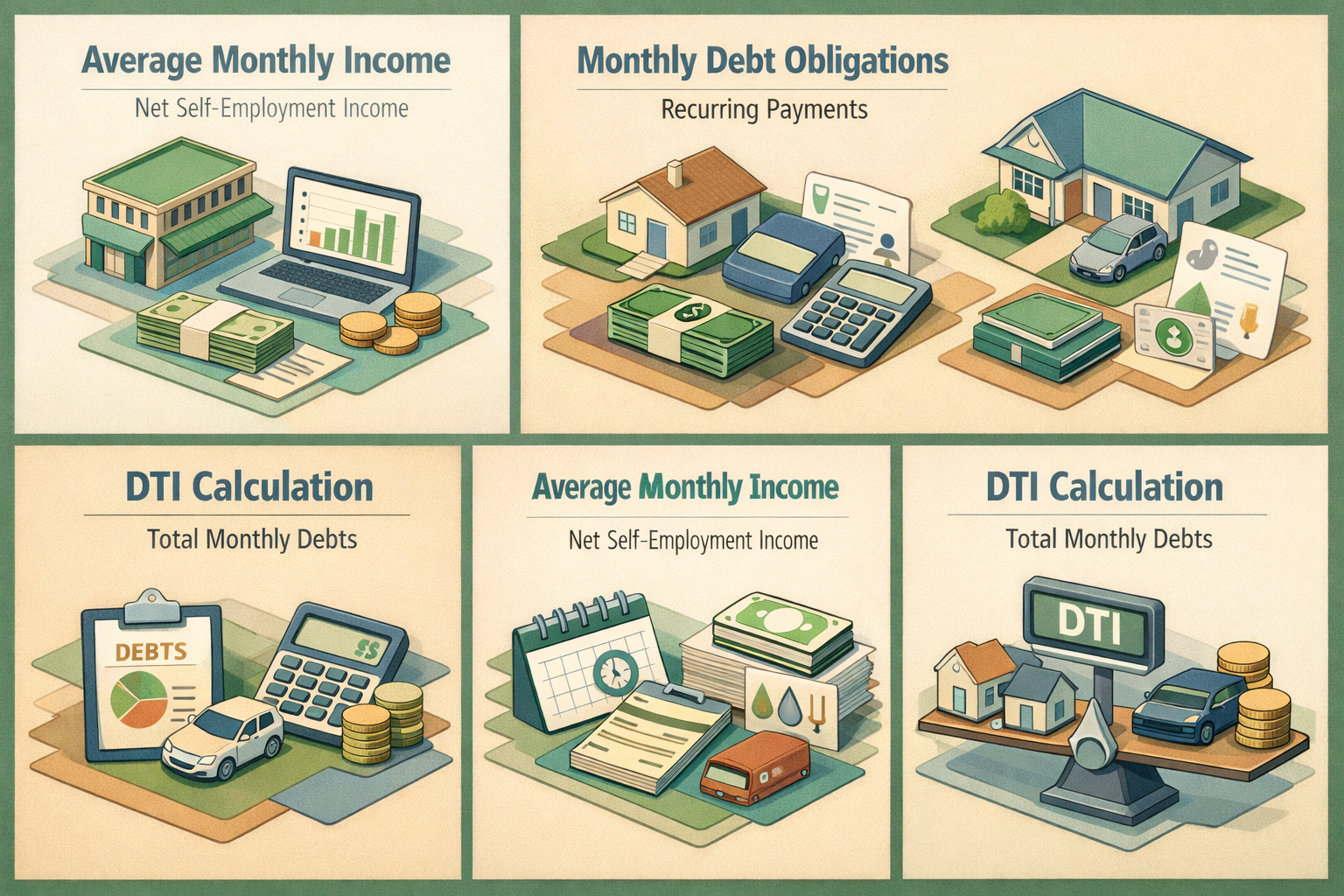
Now let's put it all together. Here's a practical walkthrough of how to calculate DTI with fluctuating freelance income and child support payments the way many lenders approach it.
Step 1: Determine Your Average Monthly Qualifying Income
Pull your last two years of federal tax returns and locate your net self-employment income. Add the two annual figures together and divide by 24 to arrive at your average monthly income. If you qualify under a bank statement program, your lender will calculate an average from your deposits instead.
If you also receive child support that meets the continuity requirements mentioned above, add the monthly child support amount to your calculated freelance income total.
Step 2: Identify All Monthly Debt Obligations
List every recurring monthly debt obligation, including:
- Proposed mortgage payment (principal, interest, taxes, insurance, and HOA if applicable)
- Car loans or leases
- Student loans
- Credit card minimum payments
- Personal loans
- Child support payments you are obligated to make
- Any other court-ordered obligations
Do not include utility bills, subscriptions, or groceries — lenders focus on installment and revolving debt accounts that appear on your credit report, plus any court-ordered obligations.
Step 3: Run the DTI Calculation
Divide your total monthly debt obligations by your average monthly qualifying income and multiply by 100. For example:
- Average monthly freelance income (net): $4,500
- Child support received (qualifying): $600/month
- Total qualifying income: $5,100/month
- Proposed mortgage PITI: $1,400
- Car loan: $350
- Credit card minimums: $150
- Child support paid: $400
- Total monthly debts: $2,300
- DTI = $2,300 ÷ $5,100 = 45.1%
In this example, the DTI sits just above the typical 43% threshold. That doesn't necessarily mean denial — compensating factors like strong reserves, a solid credit score, or a larger down payment may help the application still be considered by certain lenders or programs.
Documentation You'll Likely Need to Support Your Application
Preparation is everything when you're a freelancer qualifying for a mortgage with child support in the picture. Gathering the right documents early can prevent delays and strengthen your case with underwriters. Here's what you'll typically want to have ready:
- Two years of federal tax returns — personal and business, including all schedules
- Year-to-date profit and loss statement — prepared by a CPA or accountant if possible
- 12 to 24 months of bank statements — both personal and business accounts
- Child support court order or divorce decree — showing the amount and duration of the obligation
- 12 months of bank statements or payment records — confirming receipt or payment of child support
- 1099 forms — from clients, showing income sources
- Business license or professional certification — some lenders may request this as proof of self-employment
Being organized upfront signals to lenders that you're a responsible borrower. It can also help speed up the underwriting process considerably.
Strategies That May Help Improve Your DTI Before Applying
If your initial DTI calculation comes in higher than you'd like, don't panic. There are several strategies that might help bring it into a better range before you submit a mortgage application.
Pay Down Revolving Debt
Credit card balances contribute to your monthly minimum payment obligations. Paying these down — or paying them off entirely — can meaningfully reduce your total monthly debt figure and lower your DTI.
Avoid Taking on New Debt
In the months leading up to your application, it's wise to avoid opening new credit accounts, financing a vehicle, or taking on any new installment debt. New obligations increase your monthly debt load and could push your DTI in the wrong direction.
Increase Your Documented Income
This is easier said than done, but if you're in a position to take on additional freelance contracts and document that income properly, it can boost your qualifying average over time. Some borrowers also consider whether there are legitimate write-offs they can reduce before a tax year closes, to preserve more reportable net income.
Consider a Larger Down Payment
A bigger down payment reduces the loan amount, which lowers your proposed monthly mortgage payment. A lower mortgage payment means a lower monthly debt obligation — and a better DTI.
Explore Non-QM Loan Options
If traditional qualifying income methods don't work for your situation, a non-QM lender might offer programs that use alternative documentation. These aren't right for everyone, but for self-employed borrowers with strong financials and good credit, they can provide a path forward that conventional programs might not.
●Conclusion
Navigating the mortgage process as a freelancer with child support obligations takes patience, preparation, and a clear understanding of how lenders evaluate your financial picture. By learning how to calculate DTI with fluctuating freelance income and child support payments, you put yourself in a much stronger position — not just to apply, but to apply strategically. Know your numbers before your lender does. Gather your documentation early. And if your DTI needs work, give yourself time to improve it before submitting your application. At LoanWise, we understand that not every borrower fits a neat template, and we're here to help you find the financing path that works for your real-life situation. Ready to explore your options? Connect with a LoanWise mortgage specialist today and get clarity on where you stand.