
If you earn commission income and receive or pay alimony, qualifying for a mortgage might feel more complicated than it should. Lenders rely heavily on your debt-to-income (DTI) ratio to determine whether you can afford a home loan — but when your income doesn't arrive in neat, predictable paychecks, the calculation becomes a little more nuanced. Understanding how to calculate DTI with fluctuating 1099 commission income and alimony is a critical first step toward getting approved for the home financing you're after. This guide walks you through the process in plain language so you can approach your lender with confidence.
What the Debt-to-Income Ratio Really Means for Mortgage Borrowers
Your debt-to-income ratio, commonly referred to as DTI, is one of the most important numbers a mortgage lender will examine when reviewing your application. At its core, it's a simple comparison: how much of your gross monthly income goes toward paying your monthly debts?
Lenders typically look at two versions of DTI. The first is your front-end ratio, which only accounts for your proposed housing costs — things like your mortgage payment, property taxes, homeowners insurance, and any applicable HOA fees. The second is your back-end ratio, which includes all of those housing costs plus your other recurring monthly obligations, such as car loans, student loans, credit card minimum payments, and yes — alimony.
For conventional loans, lenders generally prefer a back-end DTI of 43% or lower, though some loan programs and compensating factors may allow for a higher ratio. FHA loans can sometimes permit DTIs up to 50% or beyond in certain circumstances. The specific threshold will depend on the loan type, the lender's guidelines, and the overall strength of your financial profile.
When your income is consistent — say, from a salaried W-2 job — calculating DTI is relatively straightforward. But when you're a 1099 earner whose commissions fluctuate month to month, the income side of that equation requires a different approach entirely.
How Lenders View 1099 Commission Income When Calculating Qualifying Income
Lenders don't simply take your best month's earnings and use that as your income figure. Instead, most mortgage underwriters will look at a two-year history of your commission income to establish a reliable average. This is because commission-based pay can vary significantly depending on the season, your industry, your client pipeline, or economic conditions — and lenders want to see a pattern they can count on.
Here's how the standard calculation typically works:
- Gather your federal tax returns (typically two years of 1040s) along with any 1099 forms received.
- Add up your total gross commission income reported over those two years.
- Divide that total by 24 to arrive at your average monthly qualifying income.
For example, if you earned $72,000 in commission income in year one and $84,000 in year two, your combined total is $156,000. Dividing by 24 gives you a monthly qualifying income of $6,500.
There's an important caveat here. If your income is declining from year one to year two, some lenders may only use the most recent year's income — or may flag the trend as a risk factor. On the other hand, if your income is rising, underwriters may be more comfortable using the two-year average. It's worth asking your loan officer how your specific income history will be evaluated before you apply.
Additionally, lenders will typically review your Schedule C or Schedule SE if you're self-employed, since business expenses and self-employment taxes can reduce your net qualifying income below what you might expect. This is an area where working with a mortgage professional who has experience with self-employed and 1099 borrowers can make a real difference.
Step-by-Step: How to Calculate DTI With Fluctuating 1099 Commission Income and Alimony
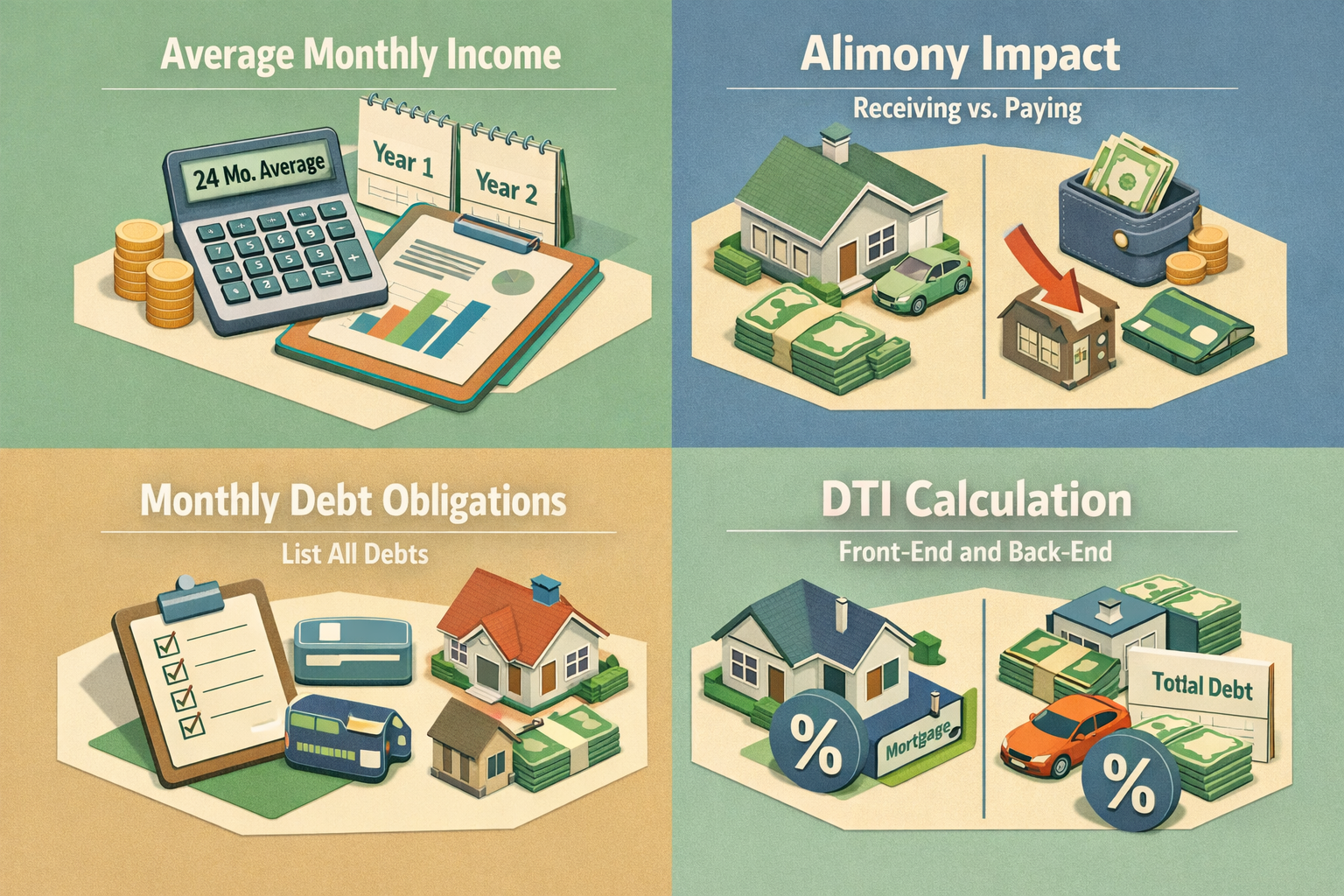
Once you understand how lenders arrive at your qualifying income, you can begin to map out how how to calculate DTI with fluctuating 1099 commission income and alimony works in practice. Here's a step-by-step breakdown:
Step 1: Establish Your Average Monthly 1099 Income
As outlined above, add your total 1099 commission income across the past two years and divide by 24. Be sure to account for any business expenses that may be deducted, as lenders typically use net income after allowable deductions for self-employed borrowers.
Step 2: Factor In Alimony Correctly
Alimony can affect your DTI in two very different ways depending on whether you're receiving it or paying it.
- If you receive alimony: You may be able to count it as qualifying income — but only if the payments are documented, court-ordered, and expected to continue for at least three years from the date of your mortgage application. Lenders will typically require a copy of your divorce decree or separation agreement as documentation.
- If you pay alimony: This obligation is counted as a monthly debt, much like a car payment, and will be included in your back-end DTI calculation. This can meaningfully increase your DTI and reduce the mortgage amount you qualify for.
Step 3: Add Up All Monthly Debt Obligations
List all of your recurring monthly debt payments. This should include your proposed mortgage payment (principal, interest, taxes, insurance, and HOA if applicable), auto loans, student loans, minimum credit card payments, child support obligations, and alimony payments if applicable.
Step 4: Calculate Your DTI Ratios
Divide your total monthly housing costs by your monthly qualifying income to get your front-end DTI. Then divide your total monthly debts (housing plus all other obligations) by your monthly qualifying income to get your back-end DTI. Multiply both results by 100 to express them as percentages.
For example: if your monthly qualifying income is $6,500 and your total monthly debts (including a proposed mortgage payment of $1,800 and $300 in alimony payments) total $2,800, your back-end DTI would be approximately 43% — right at the typical threshold for conventional loans.
The Role of Alimony in Your Debt-to-Income Ratio Calculation
Alimony is one of the more nuanced variables in any mortgage application, and it deserves its own focused discussion. Whether it works in your favor or against you depends entirely on your situation — and how well you document it.
For borrowers receiving alimony, the good news is that this income can potentially strengthen your qualifying picture. However, lenders don't just take your word for it. You'll likely need to provide:
- A copy of your divorce or separation agreement showing the alimony terms
- Bank statements or deposit records showing consistent receipt of payments
- Documentation confirming the payments are expected to continue for at least three years
For borrowers paying alimony, the situation is more challenging. Those payments are treated as a fixed monthly liability in the debt to income ratio 1099 income calculation, which can push your DTI higher and narrow the range of loan amounts available to you. One potential strategy — though not always feasible — is to negotiate a lump-sum settlement with your former spouse in lieu of ongoing monthly payments. This may remove the obligation from your monthly debt picture, though it involves legal and financial considerations well beyond the mortgage itself.
It's also worth noting that child support payments, while separate from alimony, are treated similarly in DTI calculations — as a monthly debt obligation if you pay them, or as potential qualifying income if you receive them under the right conditions.
Documentation You'll Need to Support Your Income and Obligations
One of the most important things you can do as a 1099 borrower with alimony in the picture is to prepare a thorough documentation package before applying for a mortgage. Lenders will want to verify everything, and having your paperwork organized in advance can speed up the underwriting process considerably.
Here's what you'll typically need to gather:
- Two years of federal tax returns (personal 1040s and any applicable schedules)
- All 1099 forms received over the past two years from clients or payers
- Year-to-date profit and loss statement if you operate as a self-employed individual or independent contractor
- Bank statements showing consistent deposits that align with your reported income
- Divorce decree or separation agreement detailing alimony terms
- Proof of alimony received — typically 12 months of bank statements showing deposits
- Any court orders related to ongoing alimony or support obligations
Lenders may also request a letter from a CPA or tax professional confirming that your business is active and your income is likely to continue. This is particularly common for borrowers whose income has fluctuated significantly from year to year.
Strategies to Improve Your DTI Before Applying for a Mortgage
If your DTI calculation comes out higher than you'd like, don't panic. There are several steps you might consider to bring that number down and strengthen your overall mortgage application.
Pay Down Existing Debt
Reducing or eliminating smaller debt balances — such as credit card balances or personal loans — can meaningfully lower your monthly obligations and reduce your DTI. Even paying off a single account with a $150 monthly payment can shift your ratio enough to make a difference.
Avoid Taking on New Debt
In the months leading up to your mortgage application, try to avoid opening new credit lines or financing large purchases. New monthly obligations will only push your DTI higher and could also affect your credit score.
Consider a Larger Down Payment
A larger down payment reduces the loan amount you're borrowing, which in turn lowers your proposed monthly mortgage payment. A lower housing payment translates directly into a lower front-end DTI and a more favorable back-end ratio.
Explore Non-QM Loan Options
If your DTI remains elevated due to the nature of your 1099 income and alimony obligations, it may be worth exploring non-qualified mortgage (Non-QM) loan programs. These products are designed for borrowers who don't fit neatly into conventional underwriting guidelines, including self-employed individuals and 1099 earners. Bank statement loans, for example, may allow lenders to use 12 or 24 months of bank deposits — rather than tax returns — to qualify your income, which could result in a higher qualifying income figure and a more favorable DTI.
Increase Your Qualifying Income
If you have other income sources — rental income, freelance projects, or investment dividends — talk to your loan officer about whether those can be documented and counted toward your qualifying income. Additional verified income streams can help offset the debt side of the equation.
●Conclusion
Navigating the mortgage process as a 1099 commission earner with alimony in the picture is genuinely more complex than the standard path — but it's absolutely manageable with the right preparation and guidance. Understanding how to calculate DTI with fluctuating 1099 commission income and alimony gives you a real advantage before you ever sit down with a lender. You'll know what documents to gather, how your income will likely be evaluated, and where alimony fits into the picture on both sides of the ledger.
The debt to income ratio 1099 income calculation doesn't have to be a mystery. With a clear two-year income average, properly documented alimony terms, and a realistic view of your monthly obligations, you can build a solid mortgage application even when your income doesn't follow a straight line. If you're ready to explore your financing options, connecting with a knowledgeable loan officer who specializes in non-traditional income scenarios is a smart place to start. LoanWise is here to help you find the right path forward.