If you're a freelancer, independent contractor, or someone who earns commissions, qualifying for a mortgage can feel more complicated than it does for traditional W-2 employees. Add child support payments into the mix — whether you're paying or receiving them — and the process can feel even more overwhelming. The good news is that lenders do have established methods for evaluating non-traditional income sources, and understanding how to calculate DTI with 1099 income and child support payments can make a real difference in your ability to get approved. This article walks you through everything you need to know, step by step.
What Is DTI and Why Does It Matter for Mortgage Approval
Your debt-to-income ratio (DTI) is one of the most important numbers a mortgage lender looks at when evaluating your application. In simple terms, it compares how much debt you carry each month to how much income you bring in. Lenders use this figure to gauge whether you can realistically handle a new mortgage payment without stretching your finances too thin.
DTI is typically expressed as a percentage and is calculated using this basic formula:
- DTI = Total Monthly Debt Payments ÷ Gross Monthly Income × 100
For example, if your total monthly debt obligations come to $2,000 and your gross monthly income is $6,000, your DTI would be roughly 33%. Most conventional loan programs prefer a DTI at or below 43%, though some programs may allow higher ratios depending on other qualifying factors like credit score and down payment size.
There are actually two types of DTI that lenders often consider. The front-end DTI looks only at housing-related costs — like your proposed mortgage payment, property taxes, and homeowner's insurance — relative to your income. The back-end DTI is broader and includes all monthly debt obligations, such as auto loans, student loans, credit card minimums, and yes, child support payments. Most lenders focus heavily on the back-end DTI when making approval decisions.
How Lenders Treat 1099 Income From Freelance and Commission Work
One of the biggest challenges for self-employed borrowers is that lenders don't simply take your word for how much you earn. When you receive a W-2, your income is straightforward to verify. But with 1099 income from freelance or commission work, lenders typically require a more thorough review to establish stability and consistency.
Most conventional lenders will ask for at least two years of federal tax returns — both personal and, if applicable, business returns — to verify 1099 income. They often use an average of your net income over those two years, after deducting business expenses reported on Schedule C. This is an important detail, because many self-employed borrowers write off significant expenses, which can reduce their reported income and, in turn, lower their qualifying DTI income figure.
Here's what lenders typically look for when assessing 1099 and freelance income:
- Two-year history: Lenders generally want to see at least 24 months of consistent self-employment or freelance income to consider it stable.
- Year-over-year trends: If income has been declining, lenders may use the lower year or may be more cautious in their assessment.
- Profit and loss statements: Some lenders may ask for a year-to-date profit and loss statement, especially if you're applying mid-year.
- Business bank statements: Certain non-QM (non-qualified mortgage) lenders may use 12 or 24 months of bank statements instead of tax returns to calculate qualifying income.
Commission-based workers — such as real estate agents or sales professionals who receive 1099 forms — face similar scrutiny. The lender may average your commission income over two years, and if commissions make up more than 25% of your total income, additional documentation is often required.
Including Child Support in Your Debt-to-Income Ratio Freelance Commission Child Support Calculation
Child support can affect your DTI in two distinct ways, depending on whether you're the one paying it or receiving it. Understanding this distinction is critical when you're working through a debt-to-income ratio freelance commission child support calculation for your mortgage application.
If You Are Paying Child Support
Child support payments you're legally obligated to make are counted as a monthly debt obligation. This means they go into the denominator of your DTI equation alongside your other debts. Lenders will typically verify this obligation by reviewing your court order or divorce decree. Even if you pay informally or have an arrangement outside of court, lenders generally require formal documentation to account for it.
Let's say you pay $700 per month in child support, have a $400 auto loan payment, and a $100 minimum credit card payment. Add in a proposed mortgage payment of $1,500. Your total monthly obligations would be $2,700. If your gross monthly income from 1099 sources averages to $6,500 per month, your back-end DTI would be approximately 41.5% — likely within an acceptable range for many loan programs.
If You Are Receiving Child Support
Child support you receive can actually help your DTI by boosting your qualifying income — but only under certain conditions. Most lenders require that the support payments be documented through a court order and have a history of being received consistently. Additionally, lenders typically want to see evidence that the payments are likely to continue for at least three years from the date of the mortgage application. Without this continuity, many lenders may not count the income at all.
If you can document it properly, received child support can meaningfully improve your income figure and reduce your overall DTI, making approval more achievable.
Step-by-Step: How to Calculate DTI With 1099 Income and Child Support Payments
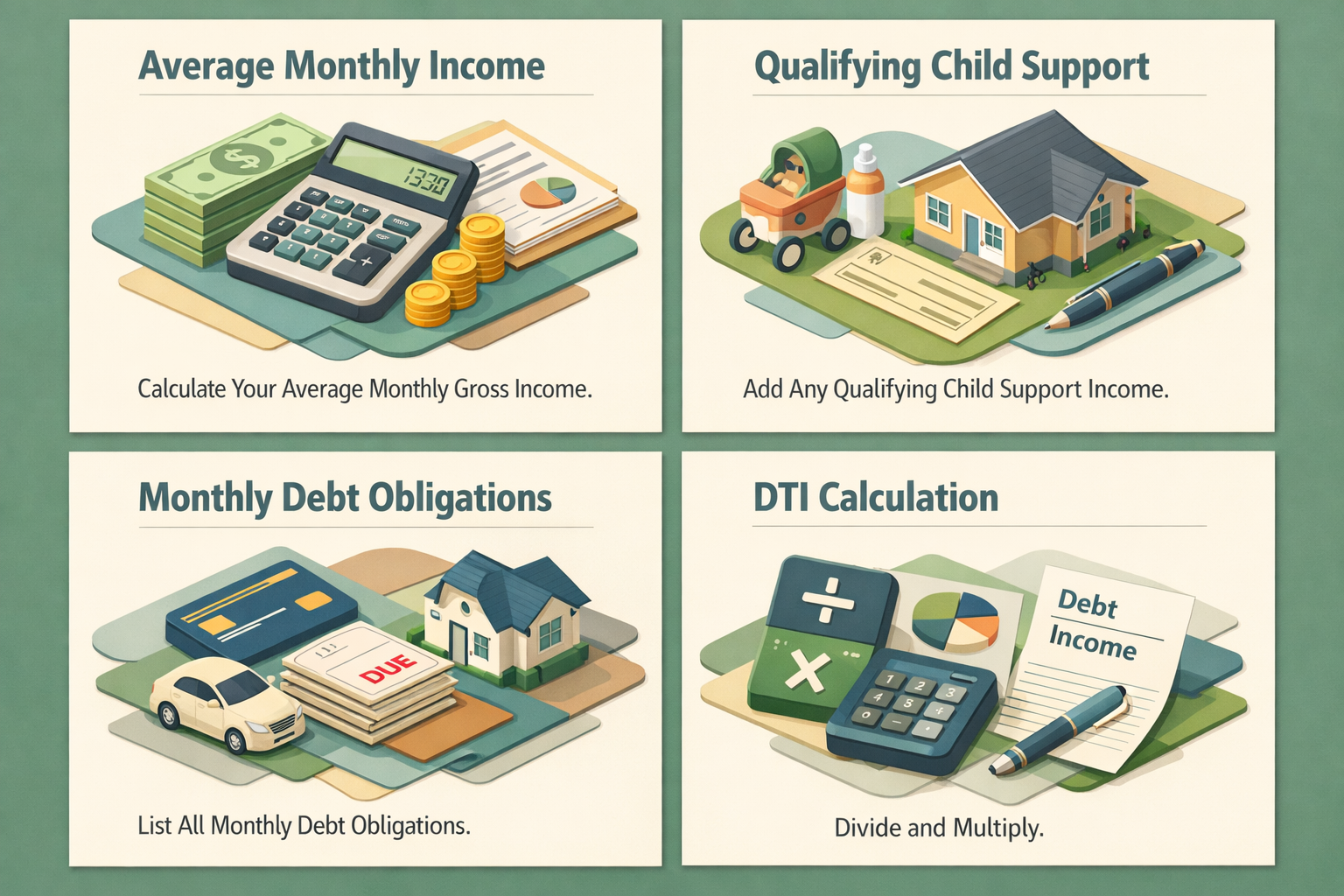
Now that we've broken down the components, let's walk through a practical example of how to calculate DTI with 1099 income and child support payments in a real-world scenario.
Step 1: Calculate Your Average Monthly Gross Income
Start by reviewing your last two years of tax returns. Add up your net self-employment income for each year — this is typically your gross receipts minus allowable business deductions as shown on Schedule C. Then divide the two-year total by 24 to get your average monthly income.
- Year 1 net income: $72,000
- Year 2 net income: $84,000
- Two-year total: $156,000
- Average monthly income: $156,000 ÷ 24 = $6,500/month
Step 2: Add Any Qualifying Child Support Income
If you receive child support and can document it with a court order and at least 12 months of consistent receipt, and there's a reasonable expectation it will continue for 3+ more years, add it to your monthly income figure. If you receive $600/month in child support payments, your total qualifying income may become $7,100/month.
Step 3: List All Monthly Debt Obligations
- Proposed mortgage payment (PITI): $1,800
- Auto loan: $350
- Student loan: $250
- Child support paid: $500
- Credit card minimum: $75
- Total monthly debts: $2,975
Step 4: Divide and Multiply
$2,975 ÷ $7,100 × 100 = approximately 41.9% DTI
This figure falls within a range that many lenders may find acceptable, particularly for FHA or conventional loans with strong credit and down payment. Always check with your specific lender, as guidelines can vary.
Loan Programs That May Work Well for Self-Employed Borrowers With Complex Income
Not every mortgage program evaluates income the same way. Depending on your situation, some loan types may be a better fit than others when you're navigating 1099 earnings and child support obligations.
FHA Loans
FHA loans, backed by the Federal Housing Administration, are often considered more flexible for borrowers with non-traditional income profiles. They may allow DTI ratios up to 50% in some cases, and they do accept 1099 income as long as it's documented and stable. Child support — both paid and received — is handled similarly to conventional guidelines.
Conventional Loans
Conventional loans backed by Fannie Mae or Freddie Mac have specific guidelines for self-employed borrowers. They typically require two years of self-employment history and use tax returns to determine qualifying income. DTI limits often fall around 43–45%, though compensating factors like strong credit or large reserves may allow for some flexibility.
Non-QM (Non-Qualified Mortgage) Loans
For borrowers who don't fit neatly into traditional guidelines, non-QM loans may offer an alternative path. These programs might use bank statement income, 1099-only income documentation, or profit-and-loss statements instead of tax returns. The tradeoff is that these loans may carry slightly higher interest rates or require larger down payments. However, they can be a valuable option for freelancers and commission earners who have strong cash flow but complex tax situations.
VA Loans
If you're an eligible veteran or service member and you also have 1099 income, VA loans may be worth exploring. VA loans are known for flexible qualifying standards and don't require private mortgage insurance, which could help keep your overall housing payment lower and your DTI more manageable.
Common Mistakes to Avoid When Documenting Freelance and Support Income
Even if your income is solid and your DTI is within range, documentation errors can slow down or derail your mortgage application. Here are some pitfalls to watch out for:
- Claiming too many deductions: It's tempting to maximize business deductions on your tax return, but doing so reduces your net income — and therefore your qualifying income for a mortgage. Consider working with a tax professional who understands the mortgage implications of self-employment deductions.
- Inconsistent income history: A significant drop in income from one year to the next can raise flags for lenders. If your income fluctuates, be prepared to explain why and provide documentation supporting the trend.
- Informal child support arrangements: If you pay or receive child support through an informal agreement, it may not count the way you expect. Lenders generally require a formal court order to either include it as debt or count it as qualifying income.
- Missing bank statements or 1099 forms: Lenders will cross-reference your tax returns with your actual 1099 forms and bank deposits. Make sure your records are organized and complete.
- Not accounting for seasonal income: If your freelance income is seasonal, lenders may still average it over 24 months, which could work in your favor — or against you. Know your numbers before you apply.
Tips to Strengthen Your Mortgage Application as a 1099 Earner
The good news is that there are real, actionable steps you can take to improve your chances of mortgage approval when you earn 1099 income and have child support obligations in the picture.
- Build cash reserves: Having several months' worth of mortgage payments in savings can act as a compensating factor, reassuring lenders that you can handle payments even during slower income periods.
- Improve your credit score: A higher credit score can offset a slightly higher DTI in many programs. Pay down revolving debt and avoid new credit inquiries in the months leading up to your application.
- Work with a mortgage professional who specializes in self-employed borrowers: Not all lenders have the same experience with 1099 income. A specialist may know which programs and lenders are most accommodating for your profile.
- Document child support thoroughly: Whether you're paying or receiving support, having your court order, payment history, and bank records readily available can speed up the underwriting process considerably.
- Consider a larger down payment: A bigger down payment reduces your loan amount and your monthly payment, which directly improves your DTI ratio. It may also open doors to better loan terms.
- Plan your taxes strategically: In the year or two before you plan to buy, consider taking fewer deductions to show higher net income. This approach may result in a slightly higher tax bill, but it could significantly improve your qualifying income for a mortgage.
●Conclusion
Navigating the mortgage process with 1099 income and child support payments takes a bit more preparation than a standard W-2 application, but it's absolutely achievable. Once you understand how to calculate DTI with 1099 income and child support payments, you're better positioned to assess your own financial picture honestly and take steps to strengthen your application before you approach a lender. Whether you're a freelancer, commission-based professional, or self-employed entrepreneur, the right lender and the right loan program can make homeownership a realistic goal. At LoanWise, we're here to help you understand your options and connect with financing solutions that fit your unique situation. Reach out today to speak with a lending specialist who understands the nuances of non-traditional income.