
If you earn income through 1099 contracts, sales commissions, or overtime pay, getting approved for a mortgage can feel more complicated than it needs to be. One of the biggest hurdles is understanding your debt-to-income ratio, or DTI — a key figure lenders use to decide whether you can comfortably manage a new mortgage payment. The challenge is that non-traditional income sources don't fit neatly into a standard paycheck formula. Knowing how to calculate DTI with 1099 commission income and overtime pay can give you a real advantage when you're ready to apply for a home loan. This guide walks you through the process step by step, in plain language.
What DTI Actually Means and Why It Matters for Homebuyers
Your debt-to-income ratio is a percentage that compares your total monthly debt payments to your gross monthly income. Lenders rely on this number to measure how much financial risk you represent as a borrower. A lower DTI typically signals that you have enough breathing room in your budget to take on a mortgage payment without stretching yourself too thin.
The standard formula is straightforward:
- DTI = Total Monthly Debt Payments ÷ Gross Monthly Income × 100
For example, if your total monthly debts — including your projected mortgage payment — add up to $2,500, and your gross monthly income is $7,000, your DTI would be roughly 35.7%.
Most conventional loan guidelines suggest keeping your debt-to-income ratio at or below 43%, though some loan programs may allow higher ratios depending on compensating factors like a strong credit score or a larger down payment. FHA loans may offer slightly more flexibility, while jumbo loans often require tighter ratios. The exact threshold can vary by lender and loan type, so it's worth confirming details with a licensed mortgage professional.
Where things get interesting — and more complicated — is on the income side of the equation. When your earnings fluctuate because of commissions or overtime, lenders don't just look at your most recent paycheck. They dig deeper.
How Lenders Treat 1099 Commission Income When Reviewing Your Application
Commission-based income received through a 1099 is considered variable income by most mortgage lenders. Because it can rise and fall depending on sales cycles, client activity, or market conditions, lenders typically won't accept a single month's earnings as a reliable baseline. Instead, they look for a consistent, documented history of that income over time.
Here's what lenders generally require when evaluating 1099 or freelance commission income:
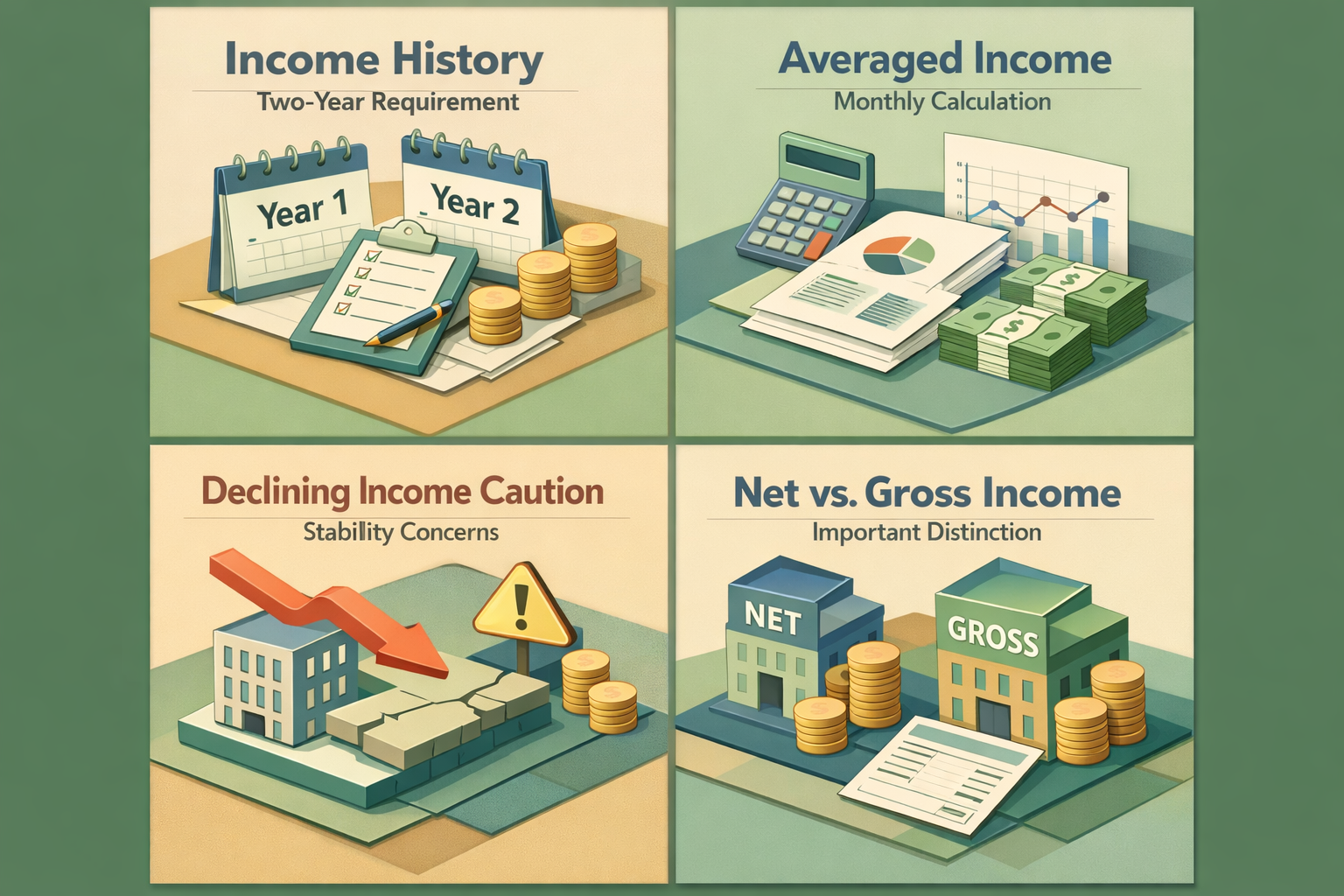
- Two-year income history: Most lenders want to see at least 24 months of self-employment or 1099 earnings, usually verified through federal tax returns (Form 1040) and any supporting schedules such as Schedule C for sole proprietors.
- Averaged income: Lenders typically average your commission income over 24 months. If you earned $60,000 in year one and $84,000 in year two, your qualifying monthly income might be calculated as $144,000 ÷ 24 = $6,000 per month.
- Declining income caution: If your income has been decreasing year over year, some lenders may use the lower of the two years — or decline to count it altogether — since downward trends raise concerns about stability.
- Net vs. gross income: For self-employed borrowers, lenders often use net income after business deductions rather than gross receipts. This is an important distinction because deductions that reduce your tax bill can also reduce the income a lender will count toward your DTI.
It's worth noting that some borrowers in commission-heavy roles are technically W-2 employees rather than 1099 contractors. If your commission income appears on a W-2, the documentation requirements may be slightly different, though lenders will still look for a consistent history — usually a minimum of one to two years — before counting that income toward your qualifying figure.
How Overtime Pay Fits Into the DTI Calculation
Overtime pay is another income type that lenders handle with extra care. Because overtime isn't guaranteed — an employer can reduce or eliminate it at any time — most lenders treat it similarly to bonus income or commission: it needs to be documented and consistent before it qualifies.
When considering overtime pay in a mortgage application, lenders typically look for:
- A minimum history of two years: Lenders generally want to see overtime earnings reflected on your W-2s and pay stubs for at least the past two years to consider it stable and countable.
- Employer confirmation: Some lenders may request a written verification of employment or a letter from your employer indicating that overtime is likely to continue. While not always required, it can strengthen your file.
- Averaged overtime earnings: Like commission income, overtime is usually averaged over 24 months. If you earned $8,000 in overtime in year one and $10,000 in year two, the monthly qualifying figure might be approximately ($8,000 + $10,000) ÷ 24 = $750 per month added to your base income.
If your overtime history is shorter than two years, a lender may still consider it depending on the circumstances — for example, if you recently changed jobs but have a documented history of overtime in a similar role. Policies can vary, so communicating openly with your loan officer about your situation is always a good idea.
Step-by-Step: How to Calculate DTI With 1099 Commission Income and Overtime Pay
Now let's put it all together. Understanding how to calculate DTI with 1099 commission income and overtime pay means combining multiple income streams correctly, then dividing by your total monthly obligations. Here's a practical walkthrough:
Step 1 — Gather Your Income Documents
Collect your last two years of federal tax returns (including all schedules), your most recent 30 days of pay stubs if you also receive a base W-2 salary, and your 1099 forms. If you have both a salaried base and 1099 commissions, you'll need documentation for each.
Step 2 — Calculate Your Monthly Qualifying Income
Add up each income component using the lender's averaging method:
- Base salary (if applicable): Divide your annual base salary by 12.
- 1099 commission income: Total your net commission earnings from the past two tax years, then divide by 24.
- Overtime pay: Total your overtime earnings from the past two W-2s, then divide by 24.
For example: Base salary = $48,000/year → $4,000/month. 1099 commissions averaged = $6,000/month. Overtime averaged = $750/month. Total qualifying income = $10,750/month.
Step 3 — Total Your Monthly Debt Obligations
Add up all minimum monthly debt payments that will appear on your credit report, including:
- Proposed new mortgage payment (principal, interest, taxes, and insurance)
- Car loans
- Student loans
- Credit card minimum payments
- Any other installment or revolving debts
Step 4 — Apply the DTI Formula
Divide your total monthly debts by your total qualifying income, then multiply by 100. If your total monthly debts are $3,800 and your qualifying income is $10,750, your DTI would be approximately 35.3% — a figure that would typically fall within an acceptable range for many loan programs.
Common Mistakes That Inflate Your DTI and How to Avoid Them
Even if your actual income is strong, certain missteps can make your DTI look worse than it is — or prevent certain income from counting at all. Here are some of the most common pitfalls to watch for:
- Excessive business deductions: For 1099 earners, writing off large business expenses on your tax return is smart for reducing your tax bill, but it can significantly lower the net income lenders will count. Finding the right balance between tax savings and qualifying income is an important conversation to have with both your accountant and your mortgage advisor before you apply.
- Gaps in income history: If you recently transitioned from W-2 employment to 1099 work, or if there are unexplained gaps in your earnings, lenders may discount or exclude that income period. A consistent, uninterrupted history is your strongest asset.
- New or fluctuating overtime: Starting a new job or recently picking up significant overtime could mean lenders won't count all of it yet. Give your new income pattern time to become documentable before applying if possible.
- Ignoring existing debt: Even small debts — a store credit card with a $25 minimum payment — count toward your DTI. Paying down existing obligations before applying can meaningfully improve your ratio.
- Underestimating the full housing payment: Your projected mortgage payment should include principal, interest, property taxes, homeowner's insurance, and any HOA fees or mortgage insurance premiums. Using just principal and interest in your estimate will understate your true DTI.
Loan Programs That May Offer More Flexibility for Variable Income Borrowers
If your DTI calculation is tight because of how your 1099 or overtime income is averaged, it may help to know that not all mortgage programs treat income exactly the same way. Some options worth exploring include:
Non-QM and Bank Statement Loans
Non-qualified mortgage programs — often called Non-QM loans — are designed for borrowers whose income doesn't fit neatly into conventional documentation requirements. Some lenders offer bank statement loans that allow self-employed borrowers and 1099 earners to qualify using 12 to 24 months of bank deposits instead of tax returns. This can be particularly helpful if your net income after deductions is significantly lower than your actual cash flow.
FHA Loans
FHA-backed loans may offer somewhat more DTI flexibility than conventional financing, and they can be a strong option for first-time homebuyers with commission or variable income. Income documentation requirements are still thorough, but the program's guidelines may accommodate certain borrower profiles that conventional underwriting does not.
Conventional Loans With Compensating Factors
If your DTI is slightly above standard thresholds, strong compensating factors — such as a high credit score, significant cash reserves, or a larger down payment — may allow a conventional lender to approve your application through automated underwriting systems. This isn't guaranteed, but it's a realistic avenue worth discussing with your loan officer.
It's always wise to speak with a mortgage professional who has experience working with borrowers who have debt-to-income 1099 overtime situations. They can help you identify which program may be the best fit for your specific income profile.
Practical Tips to Strengthen Your Mortgage Application Before You Apply
Whether you're a commissioned sales professional, a freelancer, or an hourly worker with steady overtime, a little preparation goes a long way. Here are some actionable steps to put your best foot forward:
- File taxes on time and completely: Lenders rely heavily on your tax returns. Missing or amended returns can slow down the process and raise questions about your income reliability.
- Minimize new debt before applying: Every new credit inquiry or debt obligation can impact your DTI and your credit score. Hold off on major purchases like a vehicle or new credit accounts in the months before your mortgage application.
- Build cash reserves: Having several months of mortgage payments in savings can act as a compensating factor, giving lenders more confidence in your ability to weather income fluctuations.
- Work with a knowledgeable loan officer early: A mortgage professional experienced with calculate DTI freelance commission overtime scenarios can help you understand your qualifying income before you fall in love with a home — saving you time and disappointment later.
- Consider a co-borrower: If your individual DTI is too high, adding a co-borrower with stable W-2 income could help balance the equation and expand your purchasing power.
- Keep business and personal finances separate: For 1099 earners, maintaining clear separation between business accounts and personal accounts makes documentation cleaner and can simplify the underwriting process.
●Conclusion
Understanding how to calculate DTI with 1099 commission income and overtime pay is one of the most important steps a variable-income borrower can take before applying for a mortgage. The process involves more than just running a quick calculation — it requires knowing how lenders average income, which documents they'll need, and where flexibility may exist within different loan programs. The good news is that with proper preparation and the right guidance, homeownership is absolutely within reach even when your income doesn't follow a traditional path. At LoanWise, we work with borrowers across all income types to find financing solutions that fit real-life situations. Ready to see where you stand? Connect with one of our mortgage specialists today and take the guesswork out of your DTI.