
Getting approved for a mortgage can feel overwhelming when your income doesn't fit the traditional nine-to-five mold. If you earn freelance or commission-based income, or if you receive child support payments, you may be wondering how lenders view your financial picture. The good news is that these income types can count toward your mortgage qualification — but only when documented and calculated correctly. Understanding how to calculate debt-to-income ratio with freelance commission income and child support is one of the most important steps you can take before submitting a home loan application. This guide walks you through everything you need to know, step by step.
What the Debt-to-Income Ratio Actually Means for Homebuyers
Your debt-to-income ratio (DTI) is a simple but powerful number that lenders use to evaluate your ability to manage monthly debt payments alongside a new mortgage. It compares your total monthly debt obligations to your gross monthly income — the income you earn before taxes and other deductions.
There are actually two versions lenders typically look at:
- Front-end DTI: This measures only your proposed housing costs — including principal, interest, taxes, insurance, and any HOA fees — divided by your gross monthly income.
- Back-end DTI: This includes all monthly debt obligations, such as car loans, student loans, credit card minimum payments, and the new mortgage payment, divided by gross monthly income.
Most conventional loan programs prefer a back-end DTI at or below 43%, though some programs may allow higher ratios depending on compensating factors like strong credit scores or significant cash reserves. FHA loans may permit DTI ratios somewhat above that threshold in certain circumstances. The key point is that lenders want to see that your income is reliable and sufficient to support your debts — and that's where freelance and commission earnings introduce important nuances.
How Lenders View Freelance and Commission Income Sources
Freelance income and commission-based earnings are considered variable income sources by mortgage underwriters. Unlike a salaried employee who receives a consistent paycheck, a freelancer's monthly deposits can fluctuate significantly. Because of this variability, lenders typically require a more thorough documentation process before they'll count this income toward your qualifying amount.
Here's what lenders generally look for when evaluating freelance or commission income:
- A two-year history: Most lenders want to see at least 24 months of self-employment or freelance activity, typically verified through federal tax returns (usually both personal returns and, if applicable, business returns).
- Consistency or upward trend: Underwriters often average your income over two years. If your income dropped significantly in the most recent year, some lenders may only use the lower figure — or may decline to count the income at all.
- Net income after deductions: For freelancers who file Schedule C, lenders typically use net profit after business expenses, not gross revenue. This means if you wrote off a large portion of your earnings as business expenses, your qualifying income could be lower than you expect.
- 1099 forms and profit-and-loss statements: These documents supplement your tax returns and help lenders build a clearer picture of your income stream.
Commission income follows a similar path. If you're a real estate agent, sales professional, or broker who earns commissions, lenders will typically average the commission income reported on your W-2s or tax returns over the past two years. One strong year followed by one weak year could result in a lower qualifying income than the good year alone might suggest.
Including Child Support in Your Mortgage Income Calculation
Child support is a legitimate source of income for mortgage qualification purposes — but lenders have specific requirements before they'll count it. Understanding the rules around child support mortgage qualification can make a meaningful difference in the total income lenders use to calculate your DTI.
To include child support as qualifying income, most lenders require:
- A court order or legal agreement: The child support arrangement must be documented through a divorce decree, separation agreement, or formal court order. Informal verbal agreements typically won't be accepted.
- Proof of receipt: Lenders want to see evidence that you've actually been receiving payments consistently. Bank statements showing deposits — typically for the past 12 months — are the most common form of verification.
- Continuance of at least three years: Most conventional and FHA guidelines require that the child support payments are expected to continue for at least three years after the mortgage closing date. If the child will turn 18 and age out of support within three years, lenders may exclude that income from the calculation.
When these conditions are met, child support income can be added to your gross monthly income figure, which directly lowers your DTI ratio and may improve your chances of approval. It's worth noting that alimony income is generally treated under similar rules, though some borrowers choose not to disclose it if they prefer to keep it out of the equation.
Step-by-Step: How to Calculate Debt-to-Income Ratio With Freelance Commission Income and Child Support
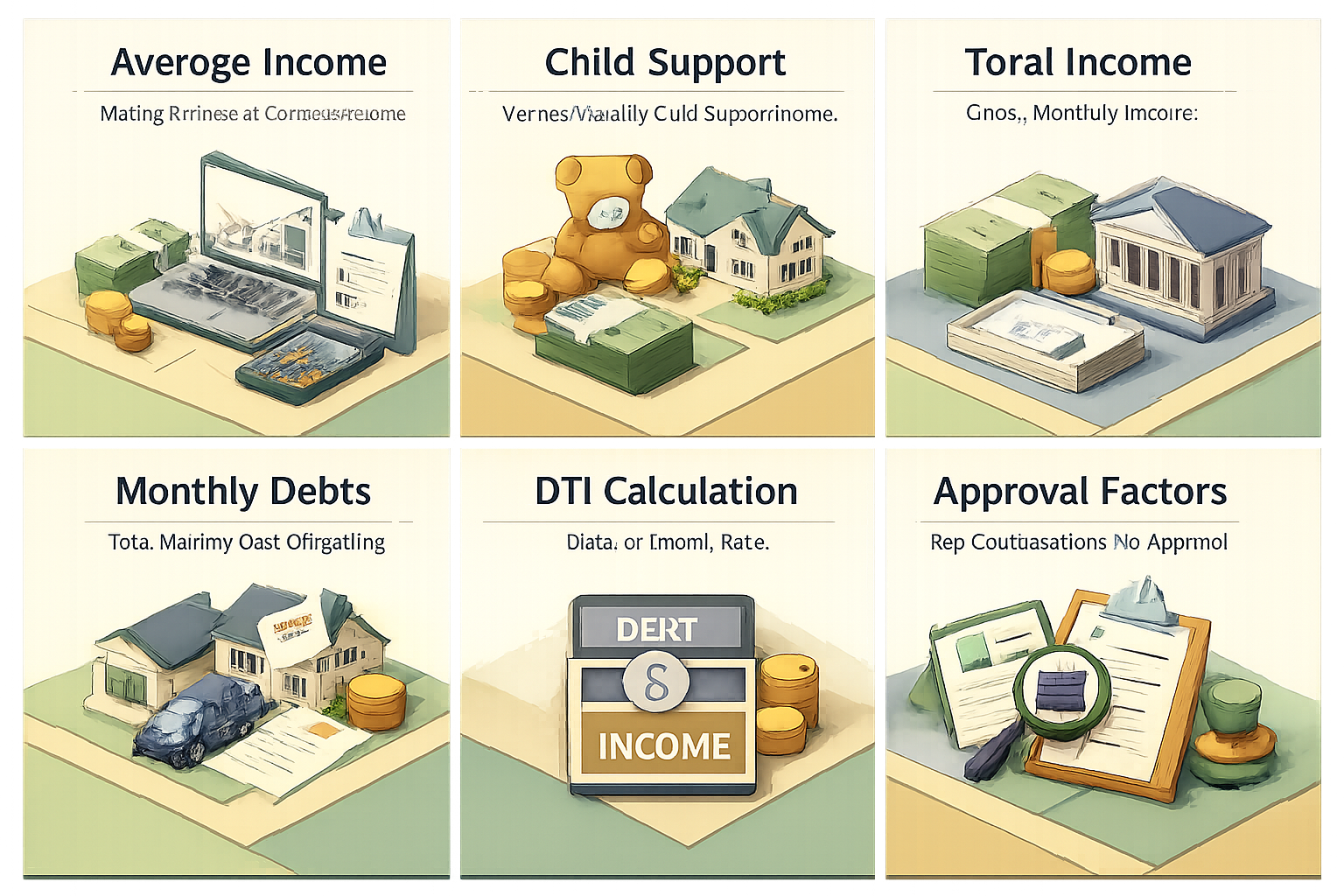
Now let's put it all together. Here's a practical walkthrough of how to calculate debt-to-income ratio with freelance commission income and child support the way a mortgage underwriter might approach it.
Step 1 — Calculate your average monthly freelance or commission income.
Pull your last two years of tax returns. Add together the net self-employment income (Schedule C net profit) or commission income (from W-2s or Schedule C) reported in both years. Divide by 24 to get a monthly average.
Example: Year 1 net income: $54,000. Year 2 net income: $66,000. Total: $120,000 ÷ 24 = $5,000 per month.
Step 2 — Add verified child support income.
If you receive $800 per month in child support and can document it with a court order and 12 months of bank statements — and it's expected to continue for at least three more years — add that to your monthly income figure.
Continuing example: $5,000 + $800 = $5,800 gross monthly income.
Step 3 — Add up all monthly debt obligations.
List every recurring monthly debt that appears on your credit report, plus your proposed mortgage payment. Common debts include: auto loans, student loans, credit card minimum payments, personal loans, and the new PITI (principal, interest, taxes, insurance) mortgage payment.
Example monthly debts: Auto loan: $350. Student loan: $200. Credit card minimums: $75. Proposed mortgage PITI: $1,500. Total: $2,125.
Step 4 — Divide total monthly debts by gross monthly income.
$2,125 ÷ $5,800 = approximately 0.366, or a 36.6% DTI ratio. This would generally fall within acceptable ranges for most conventional loan programs.
If your DTI comes out higher than desired, you may have options — such as paying down revolving debt, increasing your down payment, or finding a co-borrower — to bring the ratio into a more favorable range.
Common Mistakes That Could Undermine Your Freelance Income DTI Calculation
Even well-prepared borrowers sometimes make errors that hurt their freelance income DTI calculation. Being aware of these pitfalls in advance can save you time, frustration, and potential loan denials.
- Over-deducting on tax returns: Freelancers who maximize business deductions to minimize their tax bill may inadvertently reduce their qualifying income. Lenders use taxable net income, not gross revenue. Sometimes it may be strategically worthwhile to take fewer deductions in the years leading up to a mortgage application — though you should consult a tax professional before making that decision.
- Inconsistent income history: A short freelance track record — less than two years — can make it difficult for lenders to establish a reliable income baseline. Starting a freelance career shortly before applying for a mortgage could result in the income being excluded entirely.
- Missing child support documentation: Failing to bring the right paperwork — especially bank statements proving consistent receipt — can result in child support income being left out of the calculation, potentially pushing your DTI higher than it needs to be.
- Forgetting about self-employment taxes: Self-employed borrowers often owe quarterly estimated taxes, which are not automatically withheld. High tax liabilities can reduce available cash flow and may concern underwriters reviewing your overall financial health.
- Not accounting for all debts: Some borrowers overlook debts that appear on their credit report — such as co-signed loans or installment accounts with small balances. All of these factor into the back-end DTI calculation.
Loan Programs That May Offer More Flexibility for Non-Traditional Income Borrowers
If your income situation is complex — combining freelance earnings, commissions, and child support — certain loan programs may offer more accommodating guidelines than others.
FHA Loans: The Federal Housing Administration's loan program is often considered accessible for borrowers with non-traditional income. FHA guidelines may allow for somewhat higher DTI ratios with compensating factors, and the documentation requirements for variable income can sometimes be interpreted more flexibly by individual lenders. A minimum down payment of 3.5% is typically required with a qualifying credit score.
Conventional Loans with Fannie Mae or Freddie Mac Guidelines: Both agencies have guidelines that permit the use of freelance, commission, and child support income when properly documented. Fannie Mae's guidelines, for example, generally allow a 45% DTI — and in some automated underwriting cases, potentially higher — with strong credit and reserves.
Non-QM (Non-Qualified Mortgage) Programs: For borrowers who don't fit agency guidelines — perhaps because their two-year income history shows too much variability, or their tax returns don't reflect their actual earning power — Non-QM programs may offer an alternative path. Bank statement loans, for instance, allow lenders to calculate income based on 12 to 24 months of bank deposits rather than tax returns. These programs may carry higher interest rates but could open doors that traditional financing cannot.
Working with a knowledgeable mortgage advisor who understands non-traditional income is often the best starting point. The right loan program can make a significant difference in both your approval odds and your long-term costs.
Tips to Strengthen Your Mortgage Application When Income Is Variable
Beyond understanding the DTI calculation itself, there are several proactive steps you can take to present the strongest possible mortgage application when your income comes from freelance work, commissions, or child support.
- Maintain meticulous records: Keep organized copies of all contracts, invoices, 1099 forms, bank statements, and court-ordered child support agreements. Lenders appreciate borrowers who can quickly provide documentation without delays.
- Build up cash reserves: Having several months of mortgage payments sitting in a savings or investment account signals financial stability to underwriters. Reserves can sometimes offset concerns about income variability.
- Improve your credit score: A strong credit score — typically 740 or above — can open access to better loan terms and may allow lenders to approve slightly higher DTI ratios. Pay down credit card balances, avoid opening new accounts before applying, and correct any errors on your credit report.
- Reduce existing debt before applying: Paying off a car loan or eliminating a credit card balance lowers your monthly debt obligations and directly improves your DTI ratio.
- Work with a mortgage specialist familiar with self-employed borrowers: Not all loan officers have deep experience with complex income scenarios. Seeking out someone who regularly works with freelancers, commission earners, and single parents can make the process far smoother.
The path to homeownership may require a bit more preparation when your income doesn't follow a predictable pattern — but it's entirely achievable with the right strategy and the right guidance.
●Conclusion
Understanding how to calculate debt-to-income ratio with freelance commission income and child support isn't just a technical exercise — it's a foundational step toward knowing where you stand and what you can do to improve your position. Lenders can and do approve borrowers with variable income, but they need to see consistency, documentation, and a realistic balance between income and debt. Whether you're a freelance designer, a commissioned sales professional, or a parent receiving child support, your income can work for you — as long as it's presented correctly. If you're ready to explore your mortgage options, LoanWise is here to help you navigate the process with confidence. Reach out to a LoanWise mortgage advisor today to get a personalized assessment of your qualifying income and loan options.