For many homebuyers eyeing rural and suburban communities, the USDA loan program offers one of the most accessible paths to homeownership available today. With no down payment requirement and competitive interest rates, it's a financing option that deserves serious attention. But before you fall in love with a property, it's smart to understand exactly how to calculate affordability for USDA loan programs so you can set realistic expectations and move through the process with confidence. This guide breaks down every major factor that shapes your USDA loan affordability — from household income limits to debt-to-income ratios — so you can approach the homebuying journey fully informed.
What Makes the USDA Loan Program Unique for Homebuyers
The USDA Rural Development Guaranteed Housing Loan Program is backed by the U.S. Department of Agriculture and is specifically designed to help low- to moderate-income borrowers purchase homes in eligible rural and suburban areas. Unlike conventional loans, USDA loans typically require no down payment, which removes one of the biggest barriers to homeownership for many families.
Beyond the zero-down feature, USDA loans often come with lower mortgage insurance costs compared to FHA loans, and they may offer below-market interest rates depending on current lending conditions. These benefits make them especially appealing to first-time homebuyers and those with modest savings who still want to build equity through homeownership.
However, qualifying for a USDA loan isn't automatic. The program has specific eligibility requirements tied to property location, household income, and creditworthiness. Understanding these requirements upfront is the foundation of calculating whether this program is a realistic fit for your financial situation.
How Household Income Shapes Your Eligibility
One of the first things lenders and the USDA review is your household income. Unlike many loan programs that only look at the borrower's income, USDA guidelines typically consider the income of all adults living in the household — not just those on the loan application. This distinction is important and often surprises applicants.
The USDA sets income limits based on the area's median income and the size of your household. Generally speaking, your total household income must fall at or below 115% of the median income for your area to qualify for the standard guaranteed loan program. These thresholds vary significantly by county and state, which is why using a USDA loan income limits calculator is so helpful when starting your research.
For example, a family of four in a lower-cost rural county might face a different income cap than a family of the same size in a higher-cost suburban area that still qualifies as USDA-eligible. It's worth checking the USDA's official eligibility map and income tables early in your homebuying process, because assuming you're over the limit — or under it — without verifying can lead to missed opportunities.
- Household size matters: Larger households typically have higher income limits.
- Location matters: Income caps differ by county and metropolitan statistical area.
- All income counts: Wages, Social Security, child support, and rental income may all be included in the household income calculation.
Understanding DTI for USDA Loans and Why It Matters
Your debt-to-income ratio, or DTI, is one of the most critical numbers in any mortgage application — and USDA loans are no exception. DTI measures how much of your gross monthly income goes toward paying debts. Lenders use this ratio to assess whether you can comfortably manage a new mortgage payment alongside your existing financial obligations.
USDA loan guidelines generally look at two types of DTI for USDA loans:
- Front-end DTI (housing ratio): This is your proposed monthly housing payment — including principal, interest, taxes, insurance, and any applicable fees — divided by your gross monthly income. USDA guidelines typically prefer this ratio to stay around 29% or below.
- Back-end DTI (total debt ratio): This adds all your monthly debt payments — car loans, student loans, credit cards, and the new mortgage — and divides them by your gross monthly income. USDA guidelines generally target a back-end DTI of 41% or below, though exceptions may be possible with compensating factors.
It's important to note that lenders may have some flexibility here. Borrowers with strong credit scores, significant cash reserves, or a history of stable employment might be approved with a slightly higher DTI. That said, keeping your DTI within the preferred ranges will make your application stronger and your approval path smoother.
To estimate your own DTI for USDA loans, add up all your monthly debt payments, then divide by your gross monthly income. Multiply by 100 to get a percentage. If that number is close to or above 41%, it may be worth paying down some debts before applying.
Step-by-Step: How to Calculate Affordability for USDA Loan Programs
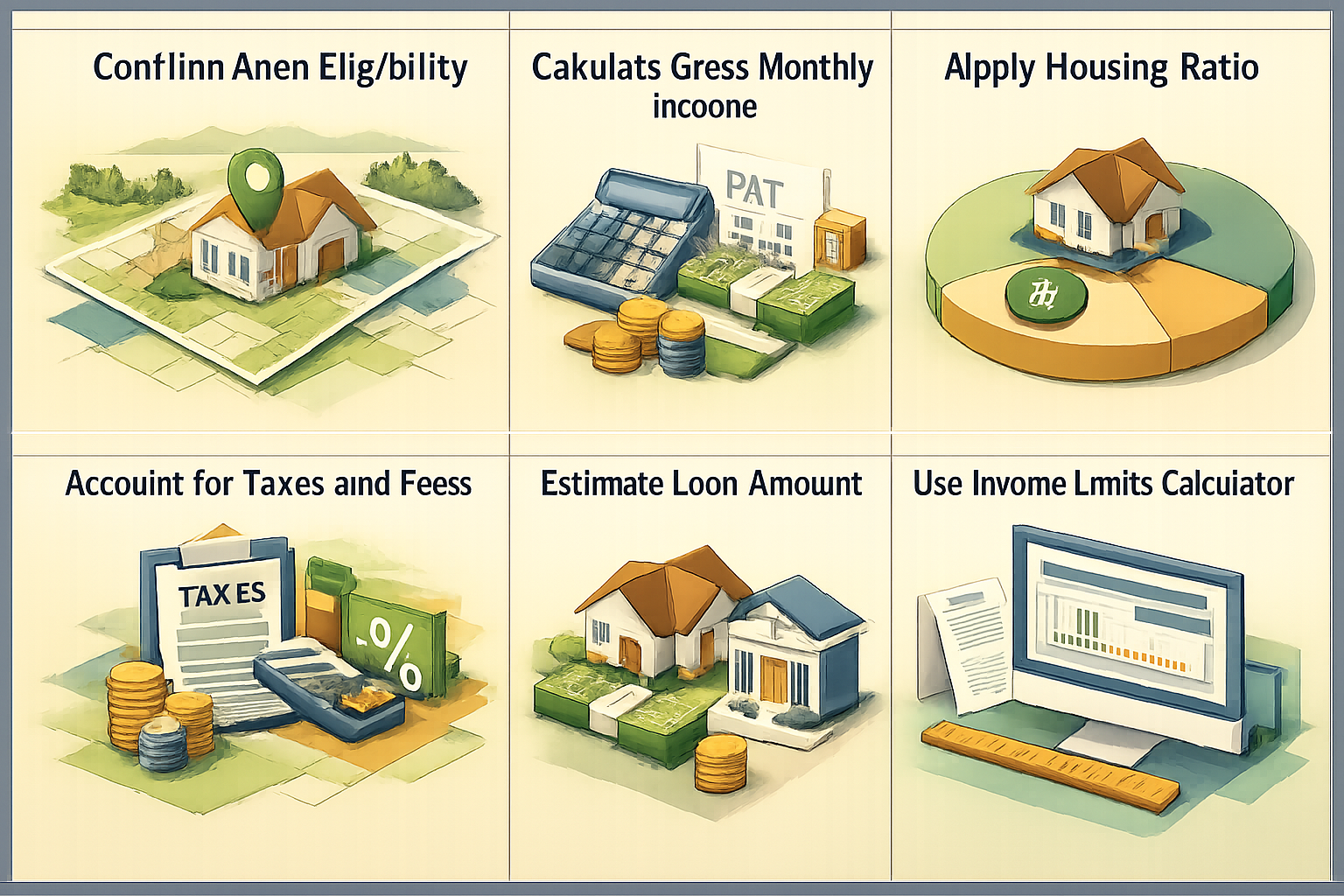
Now that you understand the core eligibility factors, let's walk through a practical approach to estimating how much house you might afford under the USDA program. Keep in mind that these are estimates — a USDA-approved lender will provide an official pre-qualification based on your full financial profile.
Step 1: Confirm Your Area and Property Eligibility
Before running any numbers, verify that the property you're considering is located in a USDA-eligible area. The USDA's online property eligibility map makes this straightforward. Rural housing loan affordability starts with location — if the property isn't in a qualifying zone, none of the other calculations apply.
Step 2: Calculate Your Gross Monthly Income
Add up all income sources for your household before taxes. This includes wages, self-employment income, Social Security benefits, alimony, child support, and other regular income streams. Divide annual income by 12 to get your gross monthly figure.
Step 3: Apply the Housing Ratio
Multiply your gross monthly income by 0.29 (representing 29%). This gives you a rough estimate of the maximum monthly housing payment the USDA program would typically allow. For instance, if your gross monthly income is $5,000, your estimated maximum housing payment would be around $1,450.
Step 4: Account for Taxes, Insurance, and Fees
Your monthly housing payment isn't just principal and interest. You'll also need to budget for property taxes, homeowner's insurance, and the USDA's annual guarantee fee, which is typically rolled into your monthly payment. These costs can vary widely, so it's wise to research local tax rates and insurance quotes early.
Step 5: Estimate the Loan Amount
Once you have your estimated maximum monthly payment, you can work backward to estimate a loan amount. Using an online mortgage calculator, plug in current USDA interest rates and a 30-year term to find the loan principal that fits within your housing payment ceiling. This gives you a practical answer to the question: how much USDA loan can I get?
Using a USDA Loan Income Limits Calculator Effectively
A USDA loan income limits calculator is one of the most useful tools available to prospective borrowers. These calculators — available through the USDA's official website and many lending platforms — allow you to input your state, county, and household size to quickly see whether your income falls within the program's eligibility thresholds.
When using one of these tools, keep a few things in mind:
- Use total household income: Remember that the USDA counts income from all adult household members, not just the loan applicants. Inputting only the applicant's income could give you a misleadingly favorable result.
- Check for deductions: The USDA does allow certain deductions from gross household income — such as childcare expenses and medical costs for elderly household members — that can lower your counted income and potentially bring you within eligibility limits.
- Revisit the calculator annually: Income limits are updated periodically, so a limit that applied last year may be higher or lower today.
Pairing an income limits calculator with a standard mortgage affordability calculator gives you a more complete picture of your borrowing potential. Together, these tools help you understand both whether you qualify and how much you might be able to borrow — two distinct but equally important questions.
Credit Score, Savings, and Other Factors That Influence Approval
While income and DTI are central to USDA loan affordability, other financial factors also play a meaningful role in the approval process. Understanding these can help you strengthen your application before you apply.
Credit Score Requirements
USDA guidelines don't set a universal minimum credit score for all lenders, but most approved lenders look for a score of at least 640 for streamlined processing. Borrowers with scores below this threshold may still qualify but may face a more manual underwriting review, which could require additional documentation and take more time.
Employment History and Income Stability
Lenders typically want to see a consistent two-year employment history. Frequent job changes or gaps in employment can raise questions about income stability. Self-employed borrowers may need to provide two years of tax returns and profit-and-loss statements to demonstrate reliable earnings.
Cash Reserves
Although USDA loans don't require a down payment, having some savings in reserve can work in your favor. Lenders may view cash reserves as a compensating factor if your DTI is slightly above the preferred threshold. Reserves also help you cover closing costs, moving expenses, and any immediate home repairs.
Existing Debt Obligations
High balances on credit cards, student loans, or auto loans directly impact your back-end DTI. Before applying, consider whether paying down certain debts could meaningfully improve your ratio and expand your borrowing capacity. Even small reductions in monthly obligations can shift your eligibility picture.
Common Mistakes to Avoid When Estimating Rural Housing Loan Affordability
Even well-prepared borrowers can make missteps when estimating their USDA loan affordability. Being aware of these common errors can save you time, frustration, and potential disappointment during the homebuying process.
- Ignoring all household income: Forgetting to include income from non-applicant household members is one of the most frequent mistakes. This can lead to borrowers thinking they qualify when their total household income actually exceeds the limit.
- Overlooking the guarantee fee: USDA loans include an upfront guarantee fee and an annual fee. These costs should be factored into your monthly payment estimate and overall affordability calculation.
- Assuming all rural properties qualify: Not every home outside of a city qualifies under USDA guidelines. Property eligibility is determined by official USDA maps, not general location perception.
- Skipping pre-qualification: Running your own estimates is a great starting point, but getting pre-qualified by a USDA-approved lender gives you a far more accurate and lender-verified borrowing range.
- Underestimating ongoing costs: Property taxes, homeowner's insurance, utilities, and maintenance can add hundreds of dollars per month beyond the mortgage payment. Factoring these into your budget helps ensure your purchase remains sustainable long-term.
Taking the time to avoid these pitfalls puts you in a much stronger position when you're ready to make an offer on a home.
●Conclusion
Understanding how to calculate affordability for USDA loan programs doesn't have to be overwhelming. By checking income limits for your household size and location, estimating your front- and back-end DTI ratios, and using reliable online tools like a USDA loan income limits calculator, you can build a clear and realistic picture of your homebuying potential before speaking with a lender. Rural housing loan affordability is within reach for many buyers who might not realize they qualify — and taking a methodical approach to the numbers is the best first step. When you're ready to take the next step, connect with a USDA-approved lender who can review your full financial profile and help you move confidently toward homeownership.