
Buying a high-priced home is an exciting milestone, but it comes with a more complex financing process than a standard purchase. If the home you're eyeing exceeds the conforming loan limits set by the Federal Housing Finance Agency (FHFA), you'll likely need a jumbo mortgage — and understanding how to calculate affordability for a jumbo mortgage is one of the most important steps you can take before applying. Unlike conventional loans backed by Fannie Mae or Freddie Mac, jumbo loans carry stricter qualification standards, and lenders scrutinize your financial profile more carefully. In this guide, we'll walk you through the key factors that shape your jumbo loan affordability, from income and debt ratios to credit scores and reserves, so you can approach the process with confidence.
What Makes a Jumbo Mortgage Different from a Conventional Loan
Before diving into affordability calculations, it helps to understand what sets jumbo mortgages apart. A jumbo loan is any mortgage that exceeds the conforming loan limits established by the FHFA. These limits can vary by location, with higher-cost areas sometimes having elevated thresholds, but once your loan amount surpasses the applicable ceiling, it falls outside the guidelines that Fannie Mae and Freddie Mac use to purchase loans from lenders.
Because jumbo loans aren't government-backed or eligible for sale on the secondary market in the same way, lenders take on more risk. To offset that risk, they typically impose tighter lending criteria. You can generally expect:
- Higher credit score requirements — many lenders prefer scores of 700 or above, with some requiring 720 or higher
- Larger down payment expectations — often ranging from 10% to 20% or more of the purchase price
- Lower debt-to-income (DTI) ratio thresholds — lenders may cap DTI at 43% or even lower
- Significant cash reserves — some lenders require 6 to 12 months of mortgage payments held in verified accounts
Understanding these baseline differences helps you prepare a stronger application and gives you a more realistic picture of what's achievable at your current financial position.
How to Calculate Affordability for a Jumbo Mortgage: The Core Formula
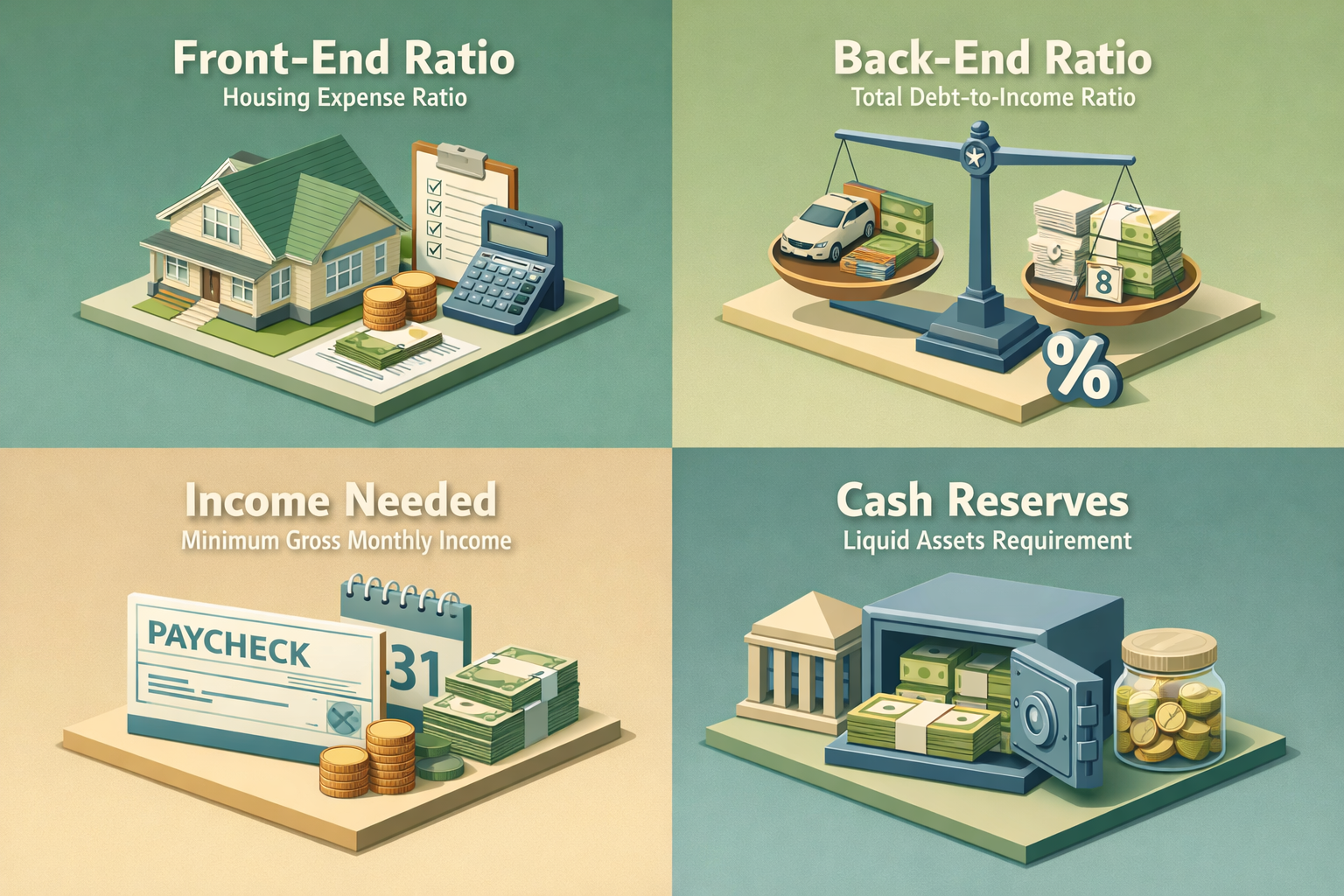
When lenders evaluate your eligibility, they primarily look at two ratios: the front-end ratio and the back-end ratio. Together, these help both you and the lender determine how much of your income can safely go toward housing costs and total debt obligations.
Front-End Ratio (Housing Expense Ratio)
The front-end ratio measures what percentage of your gross monthly income goes toward housing costs alone. This typically includes your principal, interest, property taxes, and homeowner's insurance — sometimes referred to as PITI. Some lenders also factor in HOA fees if applicable.
For jumbo loans, lenders often prefer a front-end ratio of no more than 28% to 31% of your gross monthly income, though this can vary. Here's a simple way to estimate it:
- Determine your gross monthly income (before taxes and deductions)
- Multiply that number by your target front-end ratio (e.g., 0.28 or 0.31)
- The result is the maximum monthly housing expense a lender may be comfortable with
Back-End Ratio (Total Debt-to-Income Ratio for Jumbo Loans)
The back-end ratio — more commonly known as the debt-to-income (DTI) ratio for jumbo loans — compares your total monthly debt obligations to your gross monthly income. This includes your projected mortgage payment plus all recurring debts such as car loans, student loans, credit card minimums, and any other installment obligations.
For jumbo mortgages, lenders may prefer a back-end DTI of 43% or lower, and some portfolio lenders could require it to be as low as 36% to 38%. To calculate yours:
- Add up all monthly minimum debt payments
- Include your estimated new mortgage payment (principal + interest + taxes + insurance)
- Divide the total by your gross monthly income
- Multiply by 100 to get your DTI percentage
Keeping your DTI well within an acceptable range not only improves your odds of approval but may also help you secure more favorable interest rate terms.
Income Needed for a Jumbo Mortgage: How Much Is Enough
One of the most common questions homebuyers ask is: how much income do I need for a jumbo mortgage? The honest answer is that it depends on several variables — the loan amount, your interest rate, your existing debts, the property taxes in your area, and the lender's specific guidelines. There's no universal threshold, but you can work backward from these figures to get a reasonable estimate.
Let's say you're purchasing a home that requires a $1.5 million jumbo loan. Assuming a 30-year fixed rate and a hypothetical interest rate environment, your monthly principal and interest payment might fall somewhere in the range of several thousand dollars per month. Add property taxes, insurance, and any HOA dues, and your total monthly housing cost could easily exceed $8,000 to $10,000 or more depending on the location.
If a lender uses a 31% front-end ratio, you'd divide your estimated monthly housing cost by 0.31 to find the minimum gross monthly income needed. For a $9,000 monthly housing cost, that calculation would suggest you'd need roughly $29,000 per month in gross income — or approximately $348,000 annually — just to meet the front-end requirement.
Keep in mind that this is a simplified illustration. Your actual income requirement will shift based on your specific loan terms, local tax rates, and your lender's unique underwriting guidelines. Using a jumbo loan affordability calculator — available through many lenders and financial tools — can help you model different scenarios with greater precision.
Using a Jumbo Loan Affordability Calculator Effectively
A jumbo loan affordability calculator is one of the most practical tools you can use early in your homebuying journey. These online tools allow you to input variables like gross income, monthly debts, estimated interest rate, down payment amount, and property tax estimates to generate an approximate loan amount you might qualify for.
To get the most accurate results from a jumbo loan affordability calculator, you'll want to have the following information ready:
- Gross monthly income — include all verifiable income sources such as salary, self-employment income, rental income, or investment distributions
- Monthly debt obligations — list car payments, student loans, credit card minimums, and any other recurring liabilities
- Estimated interest rate — jumbo mortgage rates may differ from conforming loan rates, sometimes slightly higher or occasionally competitive depending on the lender and market conditions
- Down payment amount — a larger down payment reduces the loan amount and can improve your DTI profile
- Local property tax and insurance estimates — these vary widely by region and significantly affect your monthly housing cost
It's worth running multiple scenarios through a calculator. For example, if you increase your down payment, you may see a notable improvement in your affordability range. Similarly, paying down existing debts before applying could lower your DTI and expand the loan amounts available to you.
While calculators provide a helpful starting point, they're estimates — not pre-approvals. A formal assessment from a qualified mortgage lender will give you a much clearer and binding picture of your borrowing capacity.
How Much Jumbo Loan Can I Get Based on My Credit and Reserves
Beyond income and DTI, two additional factors play a significant role in determining how much jumbo loan you can get: your credit score and your cash reserves.
Credit Score Requirements
Jumbo lenders typically require higher credit scores than those needed for conventional conforming loans. While some lenders may consider applicants with scores in the 680 to 700 range, many prefer borrowers with scores of 720 or above, and some may set even higher thresholds for the largest loan amounts. A stronger credit score not only improves your chances of approval but may also help you access better interest rate pricing, which directly impacts your monthly payment and overall affordability.
Cash Reserves and Asset Verification
One of the more distinctive aspects of jumbo loan underwriting is the emphasis on cash reserves. Lenders want to see that you have sufficient liquid assets to continue making mortgage payments even if your income were to experience a disruption. Requirements can vary, but it's not uncommon for lenders to ask for 6 to 12 months — or sometimes more — of total monthly mortgage payments held in verifiable accounts such as checking, savings, or investment accounts.
For example, if your total monthly mortgage payment is $9,500, a lender requiring 12 months of reserves would expect you to have approximately $114,000 in accessible assets after your down payment and closing costs have been paid. This is a critical factor that many borrowers overlook when initially assessing whether they can afford a jumbo loan.
Having strong reserves not only satisfies lender requirements but also signals financial stability, which could work in your favor during the approval process.
Self-Employed Borrowers and Non-Traditional Income Documentation
Entrepreneurs, freelancers, and self-employed professionals often face additional scrutiny when applying for jumbo mortgages. Because their income can fluctuate from year to year and may not appear straightforwardly on pay stubs, lenders typically require a more thorough documentation process.
If you're self-employed, you may be asked to provide:
- Two years of personal and business tax returns
- Year-to-date profit and loss statements prepared by a CPA
- Business bank statements covering 12 to 24 months
- Documentation of business ownership and structure
In some cases, lenders may average your income over two years, which can reduce your qualifying income if one year was particularly strong. If your tax returns show significant deductions that lower your reported income, this could affect your qualifying DTI, even if your actual cash flow is healthy.
Some lenders offer bank statement loan programs or other non-QM (non-qualified mortgage) products tailored to self-employed borrowers who may not qualify under traditional documentation guidelines. These products often carry different rate structures and terms, so it's worth exploring multiple lender options if you fall into this category.
Working with a mortgage professional experienced in jumbo and non-QM lending can make a meaningful difference in finding a program that accurately reflects your financial situation.
●Conclusion
Learning how to calculate affordability for a jumbo mortgage is an essential step before beginning your high-value home search. By understanding your front-end and back-end ratios, estimating the income needed for a jumbo mortgage, and accounting for credit requirements and cash reserves, you'll be far better positioned to approach lenders with confidence. Use a jumbo loan affordability calculator as an early planning tool, but follow up with a qualified mortgage professional who can evaluate your full financial picture and connect you with the right program. At LoanWise, we specialize in helping homebuyers and homeowners navigate the complexities of jumbo financing — reach out today to explore your options and take the next step toward the home you've been working toward.