
If you work overtime regularly, you might be sitting on more purchasing power than you realize. Many homebuyers who earn variable pay wonder, how much house can I afford with overtime pay? The honest answer is that it depends on how lenders choose to evaluate that income. Overtime is not automatically excluded from your mortgage application, but it does come with specific documentation requirements and underwriting rules that you'll want to understand before you start house hunting. This guide walks you through everything you need to know about using overtime income to qualify for a home loan.
How Lenders View Overtime Income for Mortgage Qualification
When you apply for a mortgage, lenders don't just look at your base salary. They examine your total qualifying income, which may include overtime, bonuses, commissions, and other variable earnings. However, lenders tend to be cautious about income that isn't guaranteed. Since overtime hours can be reduced or eliminated by an employer at any time, most lenders require that your overtime be consistent and likely to continue before they'll count it toward your qualifying income.
Generally speaking, lenders will want to see a two-year history of overtime earnings. This is typically verified through your W-2 forms, federal tax returns, and recent pay stubs. If your overtime income has been steady or increasing over those two years, there's a much stronger chance a lender will include it. On the other hand, if your overtime is sporadic or has been declining, lenders may discount it or leave it out of the calculation entirely.
It's also worth noting that different loan programs handle overtime income in slightly different ways. Conventional loans backed by Fannie Mae and Freddie Mac, FHA loans, VA loans, and USDA loans each have their own guidelines. Working with a knowledgeable loan officer can help you identify which program might be most favorable given your specific income structure.
Using a Mortgage Calculator With Overtime Income
A mortgage calculator with overtime income in mind can give you a helpful starting point, but it's important to understand what numbers to plug in. Rather than entering your highest paycheck, you'll want to calculate your average overtime earnings over 24 months. Lenders typically do this by dividing your total overtime income over two years by 24 to arrive at a monthly figure.
For example, if you earned $10,000 in overtime in year one and $14,000 in year two, a lender might average those figures to arrive at roughly $1,000 per month in qualifying overtime income. That amount would then be added to your base monthly income to determine your total qualifying income.
Once you have that combined monthly income figure, a mortgage affordability calculator can help you estimate how much house can I afford based on current interest rates, your credit score range, expected down payment, and estimated monthly debts. Keep in mind these tools provide estimates only. A licensed mortgage professional can give you a far more accurate picture once they've reviewed your full financial profile.
- Gather your last two years of W-2s before using any mortgage calculator.
- Use your averaged monthly overtime, not your highest-earning month.
- Factor in your existing debts to get a realistic affordability estimate.
- Check multiple loan scenarios using different down payment amounts.
Qualifying for a Mortgage With Variable Pay: What You Need to Know
Qualifying for a mortgage with variable pay requires a bit more preparation than qualifying on a simple salaried income. Variable pay includes overtime, shift differentials, bonuses, commissions, and seasonal earnings. Each of these income types may be treated slightly differently by underwriters, but the underlying principle is the same: the income must be documented, consistent, and reasonably expected to continue.
Here are some key steps to strengthen your application when relying on variable income:
- Maintain thorough records. Keep your pay stubs, W-2 forms, and tax returns organized and readily available. Lenders will request at least two years of documentation.
- Avoid large gaps in overtime. If your overtime hours have recently dropped significantly, a lender may only count a reduced portion or exclude it altogether.
- Get a written verification of employment (VOE). Some lenders may request a letter from your employer confirming that overtime opportunities are expected to continue.
- Strengthen other areas of your application. A higher credit score, larger down payment, or lower debt load can offset some of the uncertainty that comes with variable income.
It's also a smart idea to speak with your loan officer early in the process rather than after you've found a property. Understanding how much of your overtime a specific lender will count gives you a realistic budget before you fall in love with a home that may be just out of reach.
DTI Calculation With Overtime: How It Affects Your Approval Odds
Your debt-to-income ratio (DTI) is one of the most important numbers in your mortgage application. It compares your total monthly debt obligations to your gross monthly income. Lenders use this ratio to assess whether you can comfortably manage a new mortgage payment on top of your existing financial commitments.
When performing a DTI calculation with overtime, the lender adds your averaged monthly overtime income to your base salary. This combined figure becomes the denominator in the DTI equation. The higher your qualifying income, the lower your DTI ratio will be — which generally improves your approval chances and could help you qualify for a larger loan amount.
Most conventional loan programs prefer a DTI of 43% or lower, though some programs may allow higher ratios with compensating factors like strong credit or significant reserves. FHA loans may be somewhat more flexible on DTI, while VA loans also consider residual income alongside DTI. Here's a simplified example of how overtime affects the equation:
- Base monthly income: $5,000
- Averaged monthly overtime: $1,000
- Total qualifying income: $6,000
- Monthly debts (including proposed mortgage): $2,400
- DTI ratio: 40% — potentially within acceptable range
Without overtime, the same $2,400 in debts against $5,000 in income would produce a 48% DTI, which could trigger denial or require a co-borrower. This illustrates just how meaningful consistently documented overtime can be to your overall qualification.
How Lenders Verify and Document Your Overtime Earnings
Understanding how lenders view overtime for mortgages helps you prepare the right documentation in advance. The verification process for overtime income typically involves multiple documents reviewed together to build a complete picture of your earnings history.
Here's what you'll likely need to provide:
- Two years of W-2 statements from your employer showing total annual earnings, including overtime.
- Federal tax returns (1040s) for the same two-year period. These confirm what was reported to the IRS and help lenders cross-reference your W-2 figures.
- Recent pay stubs — usually covering the most recent 30-day period — to show current earnings and year-to-date overtime totals.
- A written verification of employment (VOE), which some lenders require to confirm your position, base pay, and the likelihood of continued overtime availability.
If your overtime income has fluctuated between the two years on record, the lender may use the lower of the two annual figures rather than the average, or they may average both years. Policies can vary between lenders and loan programs, so it's worth asking your loan officer directly how they will handle your specific situation. Being proactive with documentation tends to speed up the underwriting process and reduce the chance of surprises later on.
Tips to Maximize Your Home Buying Budget With Overtime Income
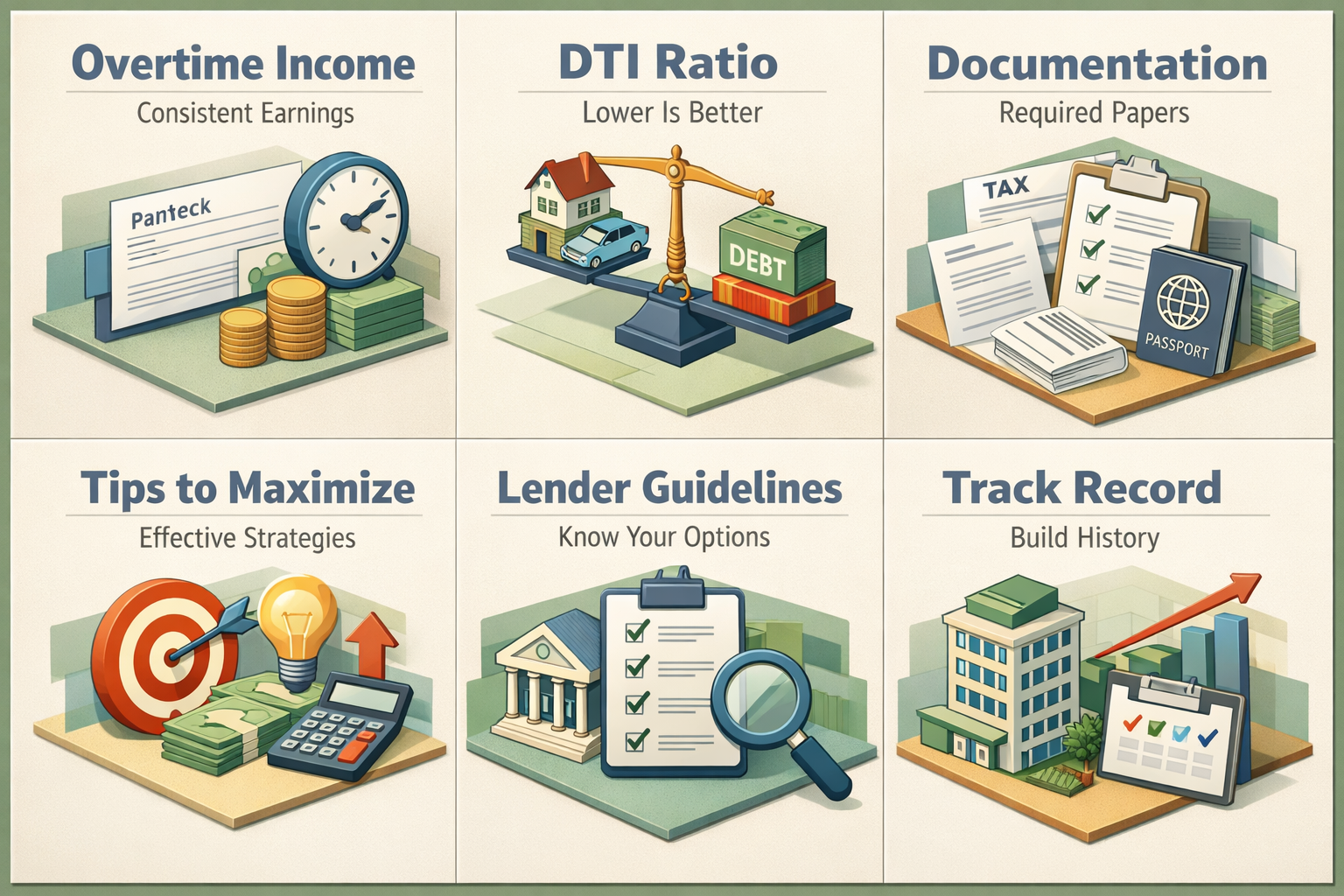
Now that you understand how lenders evaluate variable pay, let's talk about practical strategies to make your overtime work as hard as possible when answering the question: how much house can I afford with overtime pay?
Build a Strong Two-Year Track Record
The single most effective thing you can do is maintain consistent overtime hours over a two-year period. If you're just starting to pick up extra shifts, it may be worth waiting until you have a full 24-month history before applying for a mortgage. Patience here could meaningfully increase the income a lender is willing to count.
Pay Down High-Interest Debt
Reducing credit card balances, car loans, or personal loans before applying can lower your DTI ratio significantly. Even if your overtime income doesn't qualify in full, a lower debt load could still push your DTI into an approvable range.
Improve Your Credit Score
A stronger credit profile could open doors to better interest rates and more flexible loan programs. Lower rates mean lower monthly payments, which in turn improves your affordability ceiling. Small improvements in your credit score can sometimes make a surprisingly big difference.
Consider a Larger Down Payment
Putting more money down reduces the loan amount you need to qualify for. This lowers your required monthly mortgage payment, which makes DTI compliance easier and may also eliminate the need for private mortgage insurance (PMI).
Shop Multiple Lenders
Different lenders may apply slightly different guidelines when evaluating overtime income. One lender might average two full years of W-2s while another might give more weight to recent pay trends. Comparing offers from multiple lenders could reveal meaningful differences in how much income they'll count and, consequently, how large a loan you might qualify for.
●Conclusion
Overtime pay can be a genuinely valuable asset when you're trying to determine your mortgage eligibility. While it does come with additional documentation requirements and underwriting scrutiny, borrowers with a consistent and well-documented overtime history may be able to qualify for a meaningfully larger loan than they'd get on base salary alone. The key is understanding how lenders calculate variable income, keeping your DTI in check, and preparing your paperwork thoroughly before you apply. If you're ready to explore your options, speaking with a licensed mortgage professional is the best first step. At LoanWise, our team is here to help you make sense of your income picture and find a loan solution that fits your goals.