Buying your first home is one of the most exciting milestones in life — but it can also feel overwhelming, especially when it comes to financing. If you're worried about saving a large down payment or your credit score isn't perfect, an FHA loan could be exactly what you need. Backed by the Federal Housing Administration, FHA loans are designed to make homeownership more accessible for people who might not qualify for a conventional mortgage. In this guide, we'll walk you through how FHA loans work, who qualifies, and what to expect during the process — so you can move forward with confidence.
What Is an FHA Loan and How Does It Work?
An FHA loan is a government-backed mortgage insured by the Federal Housing Administration, a division of the U.S. Department of Housing and Urban Development (HUD). Because the government provides insurance to lenders against potential borrower default, lenders can offer more flexible qualification standards than they typically would with conventional loans.
It's important to understand that the FHA doesn't actually lend money directly to homebuyers. Instead, you apply through an approved private lender — such as a bank, credit union, or mortgage company — and the FHA insures the loan. This setup lowers the lender's risk, which is why they can extend credit to buyers who may have lower credit scores or smaller down payments.
FHA loans are particularly popular among first-time homebuyers, though they're not exclusively limited to this group. Repeat buyers and even homeowners looking to refinance may also use FHA financing under the right circumstances. The loan can be used to purchase single-family homes, certain condominiums, and multi-unit properties up to four units — provided the borrower occupies one of the units as their primary residence.
Key Eligibility Requirements You Should Know
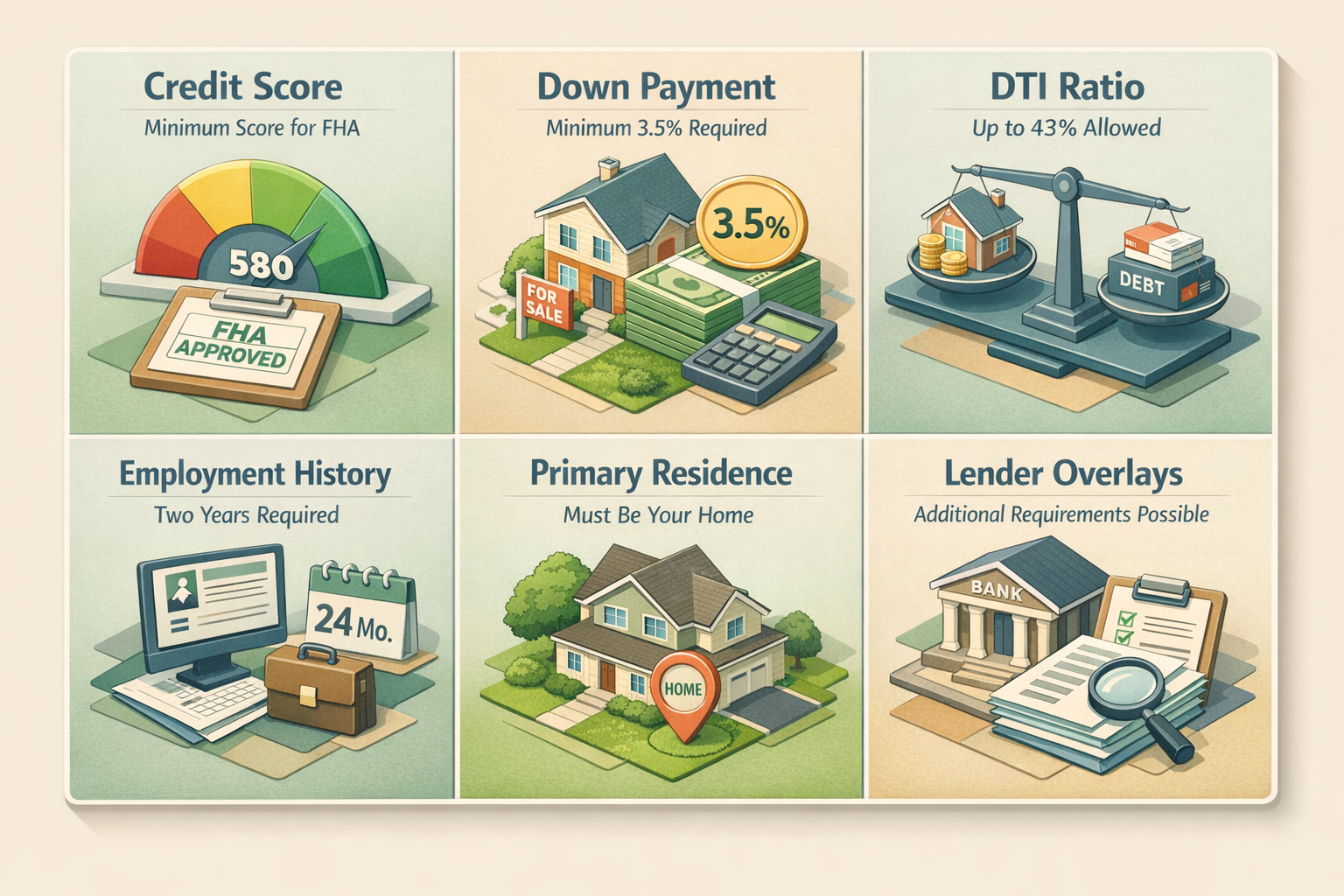
One of the biggest advantages of an FHA loan is its relatively accessible qualification criteria. While specific lender requirements may vary, the general FHA guidelines tend to be more forgiving than those for conventional mortgages. Here's what you'll typically need to qualify:
- Credit Score: Borrowers with a credit score of 580 or higher may qualify for the minimum down payment of 3.5%. If your score falls between 500 and 579, you may still be eligible, but lenders often require a 10% down payment. Scores below 500 generally don't qualify under standard FHA guidelines.
- Down Payment: As lower down payment as 3.5% of the purchase price for eligible borrowers, making it significantly more achievable than the 20% often associated with conventional loans.
- Debt-to-Income Ratio (DTI): FHA guidelines typically allow a DTI of up to 43%, though some lenders may approve higher ratios with strong compensating factors.
- Employment and Income: Lenders will verify a stable employment history, typically reviewing at least two years of work and income documentation.
- Primary Residence Requirement: The property must be your primary home — FHA loans cannot be used for vacation properties or investment homes.
Keep in mind that individual lenders may impose additional requirements, sometimes called lender overlays, that go beyond the minimum FHA standards. Shopping around with multiple lenders is always a smart strategy.
Understanding FHA Mortgage Insurance Premiums
One aspect of FHA loans that buyers should understand upfront is mortgage insurance. Because the FHA insures the loan, borrowers are required to pay mortgage insurance premiums (MIP). There are two types:
- Upfront MIP (UFMIP): This is a one-time fee equal to 1.75% of the loan amount, typically rolled into the loan balance rather than paid out of pocket at closing.
- Annual MIP: This is an ongoing monthly charge divided into 12 payments per year. The exact rate depends on your loan term, loan amount, and loan-to-value ratio, but it commonly ranges from 0.15% to 0.75% annually.
Unlike private mortgage insurance (PMI) on some conventional loans, FHA mortgage insurance may remain for the life of the loan in certain cases — particularly if your down payment was less than 10%. If you put down 10% or more, MIP may be canceled after 11 years. This is an important cost consideration when comparing FHA loans to conventional alternatives, especially as your home equity grows over time.
That said, for many first-time buyers, the lower upfront barrier to entry — especially the reduced down payment — can outweigh the added cost of long-term mortgage insurance. It often depends on your financial situation and how long you plan to stay in the home.
FHA Loan Limits: How Much Can You Borrow?
FHA loans come with borrowing limits that vary by location and property type. The FHA sets loan limits annually based on local median home prices and conforming loan limits established by the Federal Housing Finance Agency (FHFA). These limits are divided into two categories:
- Floor Limit: The minimum loan limit applied in lower-cost housing markets.
- Ceiling Limit: The maximum loan limit applied in high-cost areas like major metropolitan cities.
Because home prices differ so significantly across the country, it's essential to check the FHA loan limits specific to the county where you're purchasing. If the home you're interested in exceeds the local FHA limit, you may need to explore other financing options, such as a conventional loan or a jumbo mortgage.
Multi-unit properties also have higher loan limits than single-family homes. For example, a duplex or triplex will have a higher allowable loan ceiling than a standard one-unit property. If you're considering using an FHA loan to house-hack — meaning you live in one unit while renting out others — this can be a valuable financing strategy worth exploring with a knowledgeable mortgage advisor.
The FHA Loan Application Process Step by Step
Applying for an FHA loan follows a process similar to other mortgage types, but it helps to know what to expect at each stage. Here's a general overview of the journey from application to closing:
- Step 1 – Get Pre-Approved: Before you start house hunting, connect with an FHA-approved lender to get pre-approved. This involves submitting financial documents — including pay stubs, tax returns, bank statements, and ID — so the lender can assess your eligibility.
- Step 2 – Find an FHA-Approved Property: The home you purchase must meet the FHA's minimum property standards. Your lender will order an FHA appraisal to verify that the property is safe, sound, and secure.
- Step 3 – Submit Your Full Loan Application: Once you have a signed purchase agreement, you'll complete a formal loan application. The lender will verify all your financial information in detail.
- Step 4 – Underwriting: An underwriter reviews your file to confirm it meets FHA and lender guidelines. They may request additional documents during this stage.
- Step 5 – Clear to Close: Once the underwriter approves your loan, you'll receive a closing disclosure outlining final loan terms and costs. Review this carefully before your closing date.
- Step 6 – Closing: At closing, you'll sign all final documents, pay your closing costs and down payment, and receive the keys to your new home.
The entire process typically takes around 30 to 60 days, though timelines can vary depending on property issues, documentation delays, or lender workloads.
FHA Loans vs. Conventional Loans: Which Is Right for You?
Choosing between an FHA loan and a conventional mortgage is one of the most common decisions first-time homebuyers face. Both options have their merits, and the right choice depends largely on your credit profile, down payment savings, and long-term financial goals.
FHA loans tend to be a better fit if you have a lower credit score, limited savings for a down payment, or a higher debt-to-income ratio. The more flexible qualification standards make them especially appealing for buyers who are just starting to build their financial footing.
Conventional loans, on the other hand, may offer advantages for borrowers with strong credit and a larger down payment. Private mortgage insurance on conventional loans can be canceled once you reach 20% home equity — unlike FHA MIP, which may stick around longer. Conventional loans also typically come without the same property condition requirements as FHA loans, which can matter in competitive markets where homes may need some work.
It's worth running the numbers for both scenarios with your lender. In some cases, a conventional loan with a slightly higher rate might cost you less over time than an FHA loan with ongoing mortgage insurance. A trusted mortgage advisor can help you compare total loan costs side by side.
●Conclusion
For many first-time homebuyers, an FHA loan opens the door to homeownership that might otherwise feel out of reach. With lower down payment requirements, more forgiving credit standards, and broad lender availability, it's a financing option worth taking seriously. That said, every buyer's situation is unique — and what works well for one person may not be the ideal fit for another. The best next step is to speak with an FHA-approved lender who can review your specific financial picture and help you determine whether this loan type aligns with your homeownership goals. At LoanWise, we're here to help you navigate the process with clarity and confidence. Reach out today to explore your options and take the first step toward owning your home.