Using gift funds to cover a down payment can be a smart way to get into a home sooner — especially for first-time homebuyers who haven't had years to save. But if you're putting down 5% and part or all of that money comes from a gift, you may be wondering what happens to your private mortgage insurance costs. Understanding the cost of PMI for a conventional loan with 5% gifted down payment is an important step before you close on any home. PMI protects the lender, not you, but you're the one paying for it. Knowing how it's calculated, what affects it, and when it goes away can save you real money over the life of your loan.
What PMI Actually Is and Why It Applies Here
Private mortgage insurance, or PMI, is a type of coverage that conventional lenders typically require when a borrower puts down less than 20% of a home's purchase price. It's not optional under those circumstances — it's a condition of getting the loan approved. The insurance protects the lender in the event you stop making payments and the home goes into foreclosure.
When you put down just 5%, you're borrowing 95% of the home's value. That's considered a higher loan-to-value (LTV) ratio, which means greater risk for the lender. PMI is how lenders manage that risk. Once your equity reaches 20% — either through payments, appreciation, or a combination of both — you may be eligible to request PMI cancellation.
Now, here's an important clarification: using gift funds for your down payment doesn't automatically raise or lower your PMI rate on its own. What matters most to the PMI calculation is your loan-to-value ratio, your credit score, and the loan structure. However, the source of funds can affect underwriting decisions and how lenders view your overall risk profile, which in turn may influence the final terms of your loan.
How Gift Funds Are Treated on Conventional Loans
Conventional loans backed by Fannie Mae and Freddie Mac do allow gift funds for down payments, but there are specific rules about where that money can come from. Eligible gift donors typically include immediate family members such as parents, siblings, grandparents, or spouses. The funds must come with a signed gift letter confirming that no repayment is expected.
If the entire 5% down payment is a gift, lenders will still require documentation. This usually means a gift letter, proof of the donor's ability to give the funds, and evidence that the money has been deposited into your account before closing. Some lenders may also want to see that you have additional reserves beyond the gifted amount — especially if you're using 100% gift funds.
It's worth noting that when gift funds make up your full down payment, lenders may apply slightly more scrutiny during underwriting. Your credit score, debt-to-income ratio, and employment history become even more important factors. These elements don't change the PMI rate formula directly, but they can affect whether you qualify for the best pricing tiers available.
If you contribute at least some of your own funds alongside a gift — even a small amount — some lenders may view that favorably. It signals financial responsibility and may make underwriting smoother, though this varies by lender and loan program guidelines.
Breaking Down the Cost of PMI for Conventional Loan With 5% Gifted Down Payment
The cost of PMI for a conventional loan with 5% gifted down payment is typically calculated as an annual percentage of your loan amount, then divided into monthly installments that are added to your mortgage payment. The exact rate depends on several key variables, but there are general ranges that can help you plan ahead.
For a conventional loan with 5% down, PMI rates generally fall somewhere in the range of 0.5% to 1.5% of the loan amount per year, though your individual rate could be higher or lower depending on your financial profile. Here's a simplified look at how that plays out:
- Loan amount: $300,000 (home price of $315,789 with ~5% down)
- PMI at 0.75% annually: approximately $2,250 per year, or $187.50 per month
- PMI at 1.0% annually: approximately $3,000 per year, or $250 per month
- PMI at 1.25% annually: approximately $3,750 per year, or $312.50 per month
These numbers are illustrative, not guaranteed. Your actual rate will depend heavily on your credit score. Borrowers with credit scores above 740 typically qualify for PMI pricing in the lower range, while those with scores between 620 and 680 may see significantly higher rates. The loan term, property type, and whether the loan is a fixed or adjustable-rate mortgage can also play a role.
The source of your down payment — whether it's a gifted down payment or personal savings — doesn't directly alter the PMI rate table itself. However, if using gift funds affects your overall risk profile or leads the lender to price the loan differently, that can have downstream effects on your total monthly costs.
Key Factors That Influence Your PMI Rate With a Partial Gift Down Payment
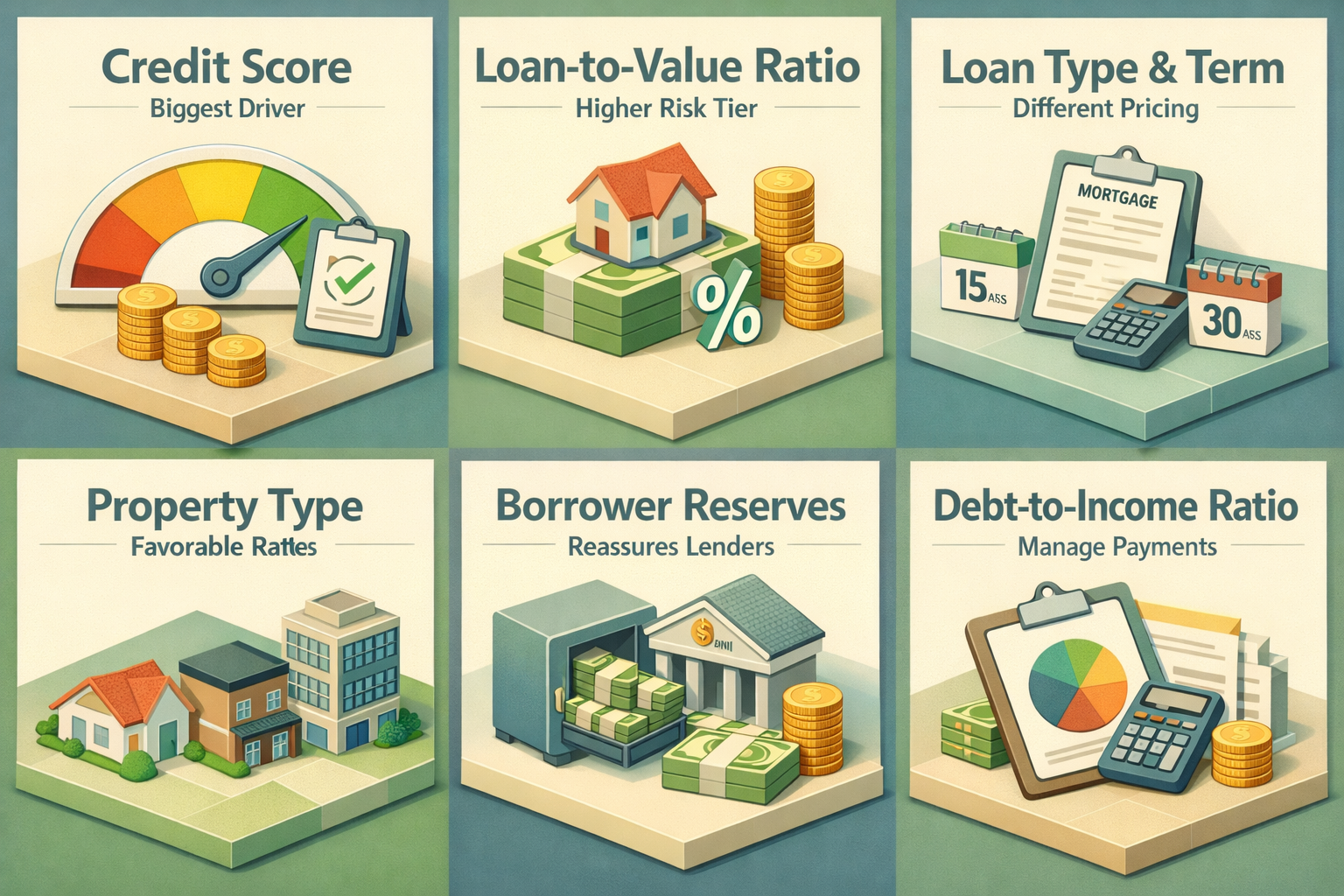
Understanding PMI rates with partial gift down payment scenarios means looking at all the variables lenders use to price mortgage insurance. Here are the most important ones:
- Credit score: This is arguably the biggest driver of your PMI rate. A higher credit score means a lower perceived risk, which typically translates to a lower PMI premium. Even a 20-point difference in your score can shift your rate noticeably.
- Loan-to-value ratio: At 5% down, you're at a 95% LTV. This is one of the higher risk tiers for PMI pricing. If you can contribute even a little more to bring your LTV down to 90%, your PMI rate may improve meaningfully.
- Loan type and term: A 30-year fixed conventional loan typically has different PMI pricing than a 15-year loan or an adjustable-rate mortgage. Shorter loan terms may carry lower PMI costs because the lender recovers equity faster.
- Property type: Single-family primary residences often receive the most favorable PMI rates. Condos or multi-unit properties may come with slightly higher PMI costs due to perceived risk differences.
- Borrower reserves: Having cash reserves in your bank account after closing — especially when using gift funds for the down payment — can help reassure lenders and may positively influence underwriting decisions.
- Debt-to-income ratio (DTI): A lower DTI signals that you can comfortably manage your mortgage payments. Lenders and PMI providers tend to price risk more favorably for borrowers with DTIs well below the maximum allowed threshold.
None of these factors work in isolation. Lenders and PMI providers look at the full picture of your financial profile, which is why it's helpful to get pre-approved and request a loan estimate that shows your projected PMI cost before you commit to a purchase.
Types of PMI Structures Available to Homebuyers
Most homebuyers assume PMI is just a single monthly charge, but there are actually several ways it can be structured. Knowing your options can help you manage costs more effectively.
- Monthly PMI: This is the most common structure. You pay a monthly premium that's added to your mortgage payment. It's cancelable once you reach 20% equity, making it flexible over time.
- Single-premium PMI: You pay a lump sum at closing to cover your PMI upfront. This eliminates the monthly charge but requires more cash at closing — which can be a challenge if you're already relying on gift funds for your down payment.
- Split-premium PMI: A hybrid approach where you pay a portion upfront and a reduced monthly premium going forward. This can lower your monthly payment without requiring as large an upfront payment as single-premium.
- Lender-paid PMI (LPMI): The lender covers the PMI cost but typically charges a higher interest rate in return. There's no monthly PMI line item, but you pay more interest over the life of the loan and can't cancel it the way you can with borrower-paid PMI.
For homebuyers using gift funds and working with limited cash, monthly PMI is often the most practical choice. It doesn't require extra funds at closing and can be removed once your home equity grows. Your loan officer can help you compare the long-term costs of each structure based on your specific situation.
When and How PMI Can Be Removed From Your Loan
One of the most reassuring things about conventional loan PMI is that it's not permanent. Under the federal Homeowners Protection Act, lenders are required to automatically cancel PMI when your loan balance reaches 78% of the original purchase price — as long as you're current on your payments. That means you don't have to do anything for it to eventually go away on its own.
However, you don't have to wait for automatic cancellation. Once your loan-to-value ratio reaches 80% — meaning you have 20% equity — you can submit a written request to your lender to cancel PMI. You'll likely need to demonstrate that your home's value hasn't declined and that your payment history is in good standing. Some lenders may require a formal appraisal to confirm the current property value.
If your home appreciates significantly in value after purchase, you might reach the 20% equity threshold faster than your original amortization schedule would suggest. In that case, you could potentially request PMI removal ahead of schedule based on the new appraised value, though lender policies on this vary and you're typically required to have owned the home for at least two years before using appreciation alone to justify cancellation.
For homebuyers who started with a 5% gifted down payment, building equity may take longer than for those who put down 20% upfront. But with consistent mortgage payments and even modest appreciation over time, PMI removal is an achievable milestone — not a permanent cost.
Practical Tips for Managing PMI Costs When Using Gift Funds
If you're planning to use gift funds for your down payment on a conventional loan, there are smart steps you can take to keep your overall PMI costs as low as possible.
- Strengthen your credit score before applying: Since your credit score is one of the biggest drivers of your PMI rate, taking a few months to improve it — by paying down balances or correcting errors on your credit report — could meaningfully reduce your premium.
- Combine gift and personal funds when possible: Even adding a small amount of your own money alongside a gift can help with lender confidence and may open up more favorable loan pricing options.
- Shop multiple lenders: PMI isn't priced the same by every lender or insurer. Different lenders work with different PMI providers, and the rate you're quoted can vary. Getting multiple loan estimates lets you compare apples to apples.
- Ask about piggyback loans: Some borrowers use a second mortgage — sometimes called an 80-10-10 — to avoid PMI altogether. You'd put 5% down, take a second loan for 10%, and get a primary mortgage for 80%. This isn't always the right move, but it's worth exploring if avoiding PMI is a priority.
- Make extra payments when possible: Paying down your loan principal faster accelerates the point at which you can request PMI cancellation. Even small additional payments made consistently over time can help.
- Keep documentation organized: Proper gift fund documentation speeds up underwriting and reduces delays. Have your gift letter, donor bank statements, and transfer records ready well before closing.
The goal isn't necessarily to avoid PMI at all costs — sometimes accepting it as a short-term expense is the right move to get into a home sooner. What matters is understanding what you're paying, why you're paying it, and how to exit it as efficiently as possible.
●Conclusion
Navigating the cost of PMI for a conventional loan with 5% gifted down payment doesn't have to be overwhelming. Yes, PMI adds to your monthly expenses — but it's also what makes homeownership possible for buyers who don't have large savings on hand. Gift funds are a legitimate and widely accepted tool in the mortgage process, and with the right preparation, they can get you into a home you might not have been able to afford otherwise. The key is going in with clear eyes: know your credit score, understand how PMI is priced, compare lenders, and have a plan for building equity over time. When you're ready to take the next step, speaking with an experienced loan officer can help you find the structure that works best for your situation and budget.