
Refinancing an adjustable-rate mortgage is already a significant financial decision — but when your income comes primarily from stock dividends or other variable sources, the process can feel even more layered. Lenders rely heavily on income stability when evaluating refinance applications, and dividend income doesn't always fit neatly into traditional verification models. Still, that doesn't mean it's impossible. Whether you're a long-term homeowner looking to lock in a fixed rate, a real estate investor managing cash flow, or a retiree living on investment returns, understanding the best options for refinancing ARM mortgage with variable dividend income can help you approach lenders with confidence and a clear plan.
Why ARMs and Variable Income Are a Common Combination
Adjustable-rate mortgages were often attractive to borrowers who expected their financial picture to evolve — investors, self-employed professionals, and those with fluctuating income streams like dividends. The initial lower rate made sense when cash flow wasn't entirely predictable. However, as ARM rates adjust over time, the monthly payment can rise significantly, making refinancing into a fixed-rate product a smart long-term move.
Dividend investors, in particular, frequently carry ARMs because they may have prioritized capital preservation at the time of purchase. Now, with rate environments shifting, many of these borrowers are actively exploring a variable income mortgage refinance to bring more stability to their housing costs. The challenge lies in how lenders interpret dividend income — and that's where preparation becomes critical.
How Lenders Evaluate Dividend and Investment Income for Refinancing
When you apply to refinance ARM with stock dividends as your primary income source, lenders typically follow specific documentation guidelines. Most conventional lenders following Fannie Mae or Freddie Mac guidelines require a two-year history of dividend income shown on your federal tax returns. They may average the income over those two years to determine a qualifying monthly figure.
Here's what lenders generally look at when reviewing variable dividend income:
- Two years of tax returns (IRS Form 1040): Schedule B is commonly used to verify interest and dividend income received over the prior two years.
- Brokerage or investment account statements: Lenders may want to see that the assets generating dividend income still exist and are sufficient to continue producing returns.
- Continuance of income: Lenders often require evidence that the income is likely to continue for at least three years. If you're drawing down assets rapidly, this could raise concerns.
- Consistency and frequency: Irregular or one-time dividend distributions may be excluded or discounted by underwriters.
It's also worth noting that some lenders may apply more conservative averaging methods if your dividend income fluctuates significantly from year to year. Understanding these nuances early helps you set realistic expectations before submitting an application.
Loan Programs That May Be Well-Suited for Variable Income Borrowers
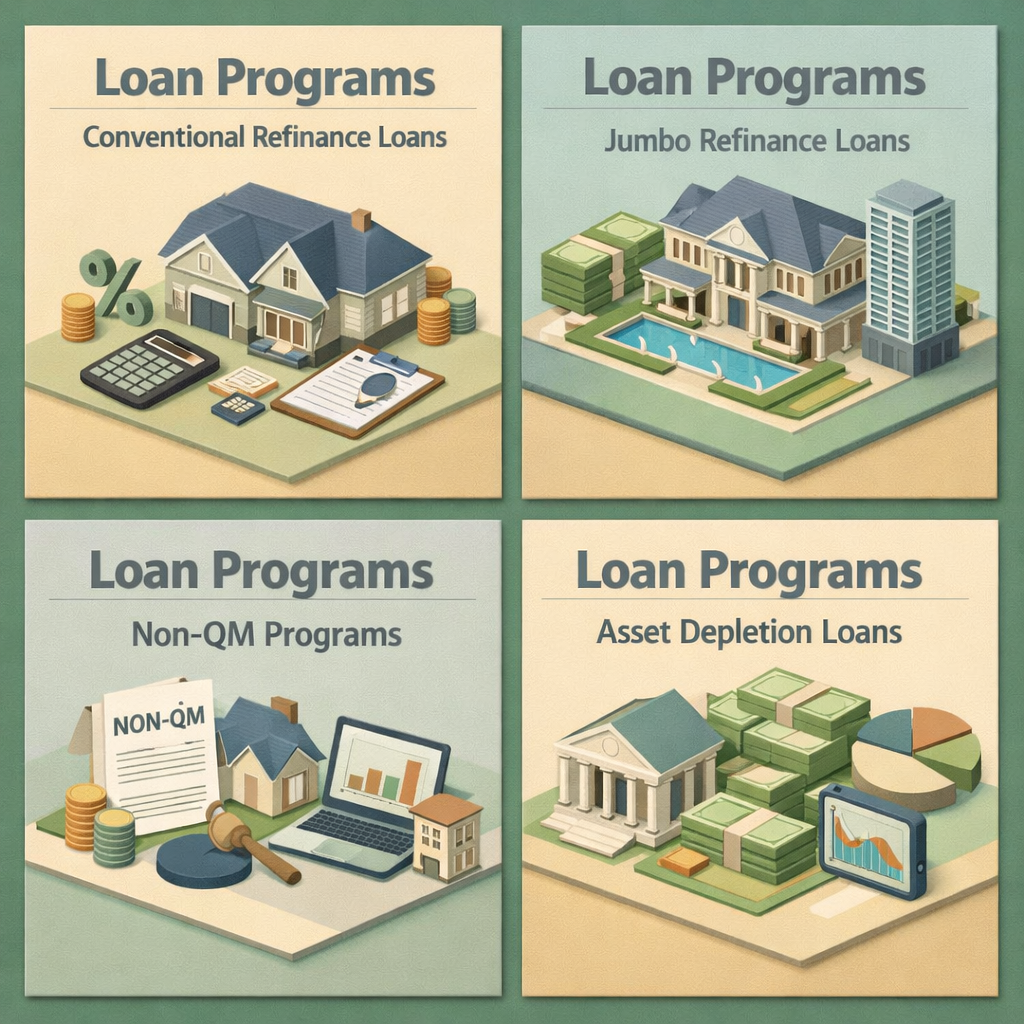
Not every refinance product is built the same way, and for borrowers with dividend-based income, some programs may offer more flexibility than others. Here are a few options worth exploring:
Conventional Refinance Loans
Conventional loans backed by Fannie Mae or Freddie Mac are among the most commonly used products for refinancing. If your dividend income is well-documented and consistent over two years, you may find that a conventional fixed-rate refinance is accessible. These loans typically offer competitive rates and a wide range of term options, from 10 to 30 years.
Jumbo Refinance Loans
For homeowners with higher property values and corresponding loan balances, a jumbo refinance may be the appropriate route. Jumbo lenders often have their own underwriting standards, which can sometimes be more flexible around income documentation — though they may also require higher reserves and stronger credit profiles. If a significant portion of your net worth is tied to investment portfolios generating dividends, some jumbo lenders view this favorably as an indicator of financial strength.
Non-QM (Non-Qualified Mortgage) Programs
Non-QM loans are designed for borrowers who don't fit into standard agency guidelines. For those whose dividend income is substantial but harder to document through traditional tax return averages, a non-QM lender might use alternative income verification methods. These could include asset depletion calculations, bank statement analysis, or a combination of income streams. Non-QM loans may carry slightly higher rates, but they can open doors that conventional programs might not.
Asset Depletion or Asset Dissipation Loans
Some lenders offer a specialized approach where they calculate qualifying income based on the total value of your liquid assets divided over a set number of months. For example, if you hold a large brokerage portfolio, a lender might divide the portfolio value over 360 months (30 years) to arrive at a monthly income figure. This can be particularly useful for retirees or investors whose dividends alone may not meet qualifying thresholds but whose overall asset base is strong.
Strengthening Your Application Before You Apply
Regardless of which program you pursue, there are practical steps you can take to improve your refinance position when your income comes from variable sources like stock dividends.
- Organize your tax documentation: Compile at least two years of complete federal tax returns, including all schedules. Make sure dividend income is clearly reported and consistent with what your brokerage statements show.
- Maintain healthy account balances: Lenders want to see that the assets generating your dividend income are intact. Avoid large withdrawals or transfers in the months leading up to your application.
- Check your credit profile: A strong credit score can offset some of the uncertainty that comes with variable income. Aim to reduce outstanding balances and avoid new credit inquiries before applying.
- Calculate your debt-to-income ratio: Even with dividend income, lenders will assess your DTI. Paying down other debts ahead of your application may help bring this ratio into a more favorable range.
- Document asset continuance: Prepare a brief letter or statement explaining the nature of your dividend income, how long you've held these investments, and why the income is expected to continue. While not always required, this kind of documentation can support an underwriter's decision.
Rate and Term Considerations When Moving From an ARM to a Fixed Rate
One of the primary motivations for exploring the best options for refinancing ARM mortgage with variable dividend income is achieving payment predictability. When your income already fluctuates with the market, locking in a stable monthly mortgage payment can provide meaningful financial balance.
Here are some factors to weigh when comparing your current ARM against a fixed-rate refinance:
- Remaining adjustment period: If your ARM is approaching a rate adjustment cap, refinancing sooner rather than later may protect you from a sharp payment increase.
- Break-even point: Refinancing involves closing costs, typically ranging from 2% to 5% of the loan amount. Calculate how many months it will take for your monthly savings to recover those costs. If you plan to stay in the home long-term, the math often favors refinancing.
- Loan term selection: A 15-year fixed rate typically comes with lower interest rates than a 30-year term, but the monthly payment is higher. For dividend income earners, a 30-year term may offer more monthly cash flow flexibility, even if the total interest paid over time is greater.
- Rate environment timing: While no one can predict rate movements with certainty, speaking with a mortgage advisor about current market conditions can help you determine whether acting now or waiting may be more advantageous for your situation.
Working With the Right Lender for Dividend Income Scenarios
Not all lenders have the same experience or appetite for borrowers with variable income profiles. Choosing the right lending partner can make a significant difference in both the approval process and the final loan terms you receive.
When researching lenders, consider the following:
- Experience with investment income borrowers: Ask potential lenders directly whether they've worked with applicants whose primary income is from dividends or other investment sources. Experienced loan officers will know how to structure your application effectively.
- Access to multiple loan programs: Mortgage brokers and lenders with both agency and non-QM product offerings may be better positioned to find a solution that fits your specific income profile.
- Transparency about documentation requirements: A knowledgeable lender will tell you upfront what documentation they'll need and flag any potential issues before you submit a formal application.
- Willingness to do a pre-qualification review: Before committing to a hard credit pull, ask if the lender can review your income documentation informally to assess your likelihood of approval. This can save time and protect your credit score.
Ultimately, the right lender is one who treats your financial situation holistically rather than forcing your income into a rigid box. For dividend income borrowers, this kind of nuanced underwriting approach can make all the difference.
●Conclusion
Refinancing an ARM when your income comes from variable sources like stock dividends requires careful preparation, the right loan program, and a lender who understands investment-based income. While the process may involve more documentation than a traditional W-2 refinance, it's entirely achievable with the right strategy. Whether you pursue a conventional fixed-rate refinance, a jumbo product, or explore non-QM alternatives like asset depletion loans, the key is starting with a clear picture of your income history and asset strength. If you're ready to explore your options, connect with a LoanWise mortgage advisor today — we'll help you find the most suitable path forward for your unique financial profile.