
Refinancing a home loan is already a big decision — but when you're dealing with an adjustable-rate mortgage and an income that shifts with bonuses, commissions, or variable pay, the process can feel especially tricky. Many homeowners in this situation wonder whether they qualify, which loan types make sense, and how lenders will view their earnings. The good news is that there are several strong paths forward. Understanding the best options for refinancing ARM mortgage with fluctuating bonus income starts with knowing how lenders think and what documentation they typically need.
Why Homeowners With Variable Pay Often Stay in ARMs Longer Than They Should
Adjustable-rate mortgages can offer lower initial interest rates, which makes them attractive when rates are high or when a borrower expects their income to grow. However, ARMs are tied to market indexes and can adjust periodically — sometimes significantly — after the initial fixed-rate period ends. For homeowners who earn a large portion of their income through bonuses or variable pay, this creates a double layer of uncertainty: a mortgage payment that may rise and an income that's hard to predict.
Many homeowners in this position delay refinancing simply because they're unsure if they'll qualify. They may worry that a lender won't count their bonus income fairly, or that an inconsistent income history will hurt their application. These concerns are understandable, but they may cause borrowers to stay in riskier loan products longer than necessary. The reality is that many lenders do have pathways for borrowers with variable income — it just takes knowing which loan programs to pursue and how to document your earnings properly.
How Lenders Typically Evaluate ARM Refinance Variable Bonus Pay
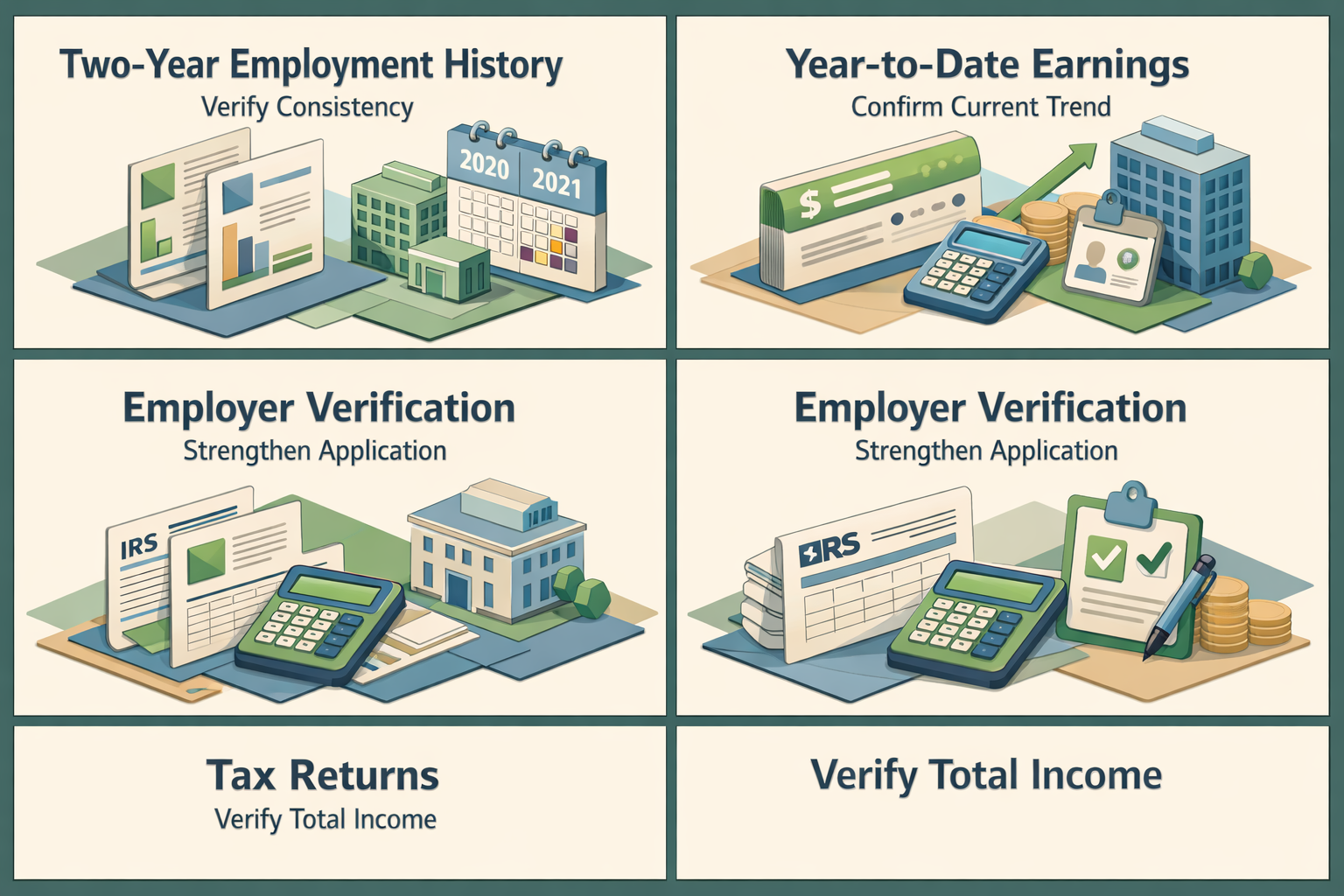
When it comes to ARM refinance variable bonus pay, lenders generally want to see a consistent history of receiving that income. Most conventional lenders following agency guidelines will typically look at a two-year history of bonus or variable pay before they're willing to include it in your qualifying income. The standard approach is to average the income over those two years, provided the income appears stable or is trending upward.
Here are a few important factors lenders often consider:
- Two-year employment history: Lenders may want to verify that you've been with the same employer or in the same field long enough to establish a track record of bonus income.
- Year-to-date earnings: A pay stub showing current-year bonus amounts helps confirm that the trend is continuing.
- Employer verification: A written verification of employment or a letter from your employer confirming the likelihood of continued bonus income may strengthen your file.
- Tax returns: IRS Form 1040s from the past two years are commonly used to verify total reported income, including bonuses and supplemental pay.
If your bonus income has dropped significantly from one year to the next, some lenders may either average it conservatively or exclude it from qualifying income altogether. This doesn't automatically disqualify you — it simply means your base salary and other income sources may carry more weight in the application.
Exploring Your Fixed-Rate Refinance Options as a Bonus-Earning Homeowner
One of the most popular moves for homeowners with an ARM is to refinance into a fixed-rate mortgage. Locking in a stable monthly payment can provide real peace of mind when your income already fluctuates. Let's look at some of the most common refinance loan types available:
Conventional Fixed-Rate Refinance
A conventional loan backed by Fannie Mae or Freddie Mac is often the most flexible product for borrowers with strong credit and documented income. If you can show two years of bonus income on your tax returns and maintain a solid debt-to-income ratio, you may qualify for a competitive fixed rate. Conventional loans typically require a credit score of at least 620, though better scores generally unlock lower rates.
FHA Refinance
An FHA streamline refinance or standard FHA cash-out refinance could work well for borrowers who have existing FHA loans or who want more flexible credit requirements. However, if you're currently in a conventional ARM, you'd be doing a standard FHA refinance, which still requires income documentation. FHA loans are government-backed and tend to be more forgiving with income irregularities, though they do come with mortgage insurance premiums.
VA Interest Rate Reduction Refinance Loan (IRRRL)
If you're a veteran or active-duty service member with an existing VA loan, the VA IRRRL — sometimes called the VA streamline refinance — could be a straightforward option. It typically requires minimal documentation and no income verification in many cases, making it especially convenient for borrowers with variable pay. It's worth confirming eligibility directly with a VA-approved lender.
Non-QM and Bank Statement Loans for Income That's Hard to Document
Sometimes conventional loan programs may not fully capture how much a bonus-earning homeowner actually makes. This is especially true for those who are self-employed, work in sales, or receive irregular supplemental pay that may not appear consistently on tax returns. In these cases, non-qualified mortgage (Non-QM) products may offer a viable alternative.
Non-QM loans are designed for borrowers who fall outside traditional agency guidelines. Rather than relying solely on W-2s and tax returns, some Non-QM lenders may accept:
- 12 or 24 months of personal or business bank statements to calculate income
- Asset depletion methods, where a lender divides verified assets over a loan term to calculate qualifying income
- Profit-and-loss statements prepared by a CPA
These options can be particularly useful for high earners whose taxable income appears lower than their actual cash flow due to deductions or business expenses. Keep in mind that Non-QM loans may come with slightly higher interest rates than conventional products, as they carry more risk for the lender. However, for many borrowers, the ability to qualify at all may outweigh the rate difference — especially if the refinance moves them out of an ARM with escalating payment risk.
Improving Your Refinance Approval Chances When Bonus Income Varies
There are several practical steps you can take to strengthen your refinance application, even when your income isn't consistent year to year. Preparation matters — and lenders tend to respond well to borrowers who come in organized and informed.
- Build up your reserves: Having two to six months of mortgage payments in savings can reassure a lender that you can cover your loan even in a low-bonus year.
- Lower your debt-to-income ratio: Paying down credit cards or other debts before applying can make a meaningful difference in how your file looks to an underwriter.
- Maintain strong credit: A higher credit score may give you access to better rates and more loan program options. Avoid opening new credit lines or making large purchases before refinancing.
- Get a written bonus continuance letter: If your employer can provide a letter confirming that bonus pay is expected to continue, this could help lenders feel more confident including it in your qualifying income.
- Work with a knowledgeable loan officer: Not all lenders handle variable income the same way. Finding one with experience in this area can make the process smoother and more efficient.
Timing can also play a role. If possible, applying after a strong bonus year — when your most recent tax return reflects higher earnings — may give your application a better chance of success.
Understanding Rate Environment and When Refinancing Makes Financial Sense
The decision to refinance isn't just about eligibility — it's also about timing and financial math. Moving from an ARM to a fixed-rate loan typically means exchanging short-term rate risk for long-term payment stability. Whether that trade-off makes sense depends on current market rates, how far you are into your ARM's fixed period, and how long you plan to stay in the home.
A common rule of thumb suggests that refinancing may make sense if you can lower your interest rate by at least a meaningful margin and if you plan to remain in the home long enough to recover the closing costs. Closing costs on a refinance can vary but often range from 2% to 5% of the loan amount, depending on the lender, loan type, and location. Dividing your closing costs by your monthly savings can give you a rough break-even timeline.
For homeowners with fluctuating bonus income, there's also an emotional and practical value in payment certainty. Even if the rate difference seems marginal at first glance, knowing exactly what your mortgage payment will be each month — regardless of what the market does — can reduce financial stress and make budgeting more manageable when income swings up and down throughout the year.
●Conclusion
Navigating the best options for refinancing ARM mortgage with fluctuating bonus income requires a clear understanding of how lenders view variable earnings and which loan programs are most likely to work in your favor. Whether you pursue a conventional fixed-rate loan, an FHA product, or a Non-QM solution, the key is to document your income thoroughly, strengthen your overall financial profile, and work with a lending professional who understands your situation. Refinancing out of an ARM can bring real stability to your monthly budget — and with the right approach, variable bonus pay doesn't have to be a barrier to getting it done. If you're ready to explore your options, connecting with a knowledgeable mortgage advisor at LoanWise is a great place to start.