
Carrying an adjustable-rate mortgage while earning a significant portion of your income through bonuses can feel like navigating two moving targets at once. Your rate adjusts, your paycheck fluctuates, and lenders want predictability in both. But here's the good news — refinancing is absolutely within reach, and many homeowners in exactly this situation successfully lock in better terms every year. Understanding the best options for refinancing ARM mortgage with bonus income starts with knowing how lenders evaluate variable pay and which loan programs tend to be most flexible. This guide walks you through the full picture so you can move forward with confidence.
Why ARM Holders Consider Refinancing in the First Place
Adjustable-rate mortgages typically start with a lower introductory rate that's fixed for a set number of years — commonly five, seven, or ten — before adjusting periodically based on a market index. When that adjustment period arrives, monthly payments can rise substantially depending on where interest rates stand at the time.
For homeowners whose initial fixed period is ending or who've already entered the adjustment phase, refinancing into a fixed-rate loan offers payment stability and long-term predictability. Even if today's fixed rates are higher than your current ARM rate, the certainty of a locked payment may be worth the tradeoff — especially if you plan to stay in your home for many years.
Others may refinance simply to access better terms, reduce their loan balance faster, or tap into home equity through a cash-out refinance. Whatever the motivation, timing your refinance strategically around your income documentation can make a real difference in the outcome.
How Lenders Treat Bonus Pay When Qualifying Borrowers
One of the first questions homeowners with variable income ask is: will my bonus actually count? The answer is typically yes — but there are important conditions attached.
Most conventional lenders following Fannie Mae and Freddie Mac guidelines require a two-year history of receiving bonus income before they'll include it in your qualifying income calculation. The income is usually averaged over those two years, and lenders may also look at whether the bonus amounts have been consistent or declining. A declining trend could raise red flags, while stable or growing bonuses tend to be viewed more favorably.
To document bonus income, you'll generally need:
- Two years of W-2 forms showing bonus compensation
- Recent pay stubs reflecting year-to-date bonus earnings
- A written Verification of Employment (VOE) from your employer confirming the likelihood of continued bonus pay
If you're in a field where bonuses are a standard part of compensation — such as finance, sales, technology, or healthcare — lenders may be more accustomed to evaluating this income type. That said, each lender applies their own overlay policies, so it pays to shop around when your income structure is non-traditional.
Loan Programs That May Work Best for Variable Income Borrowers
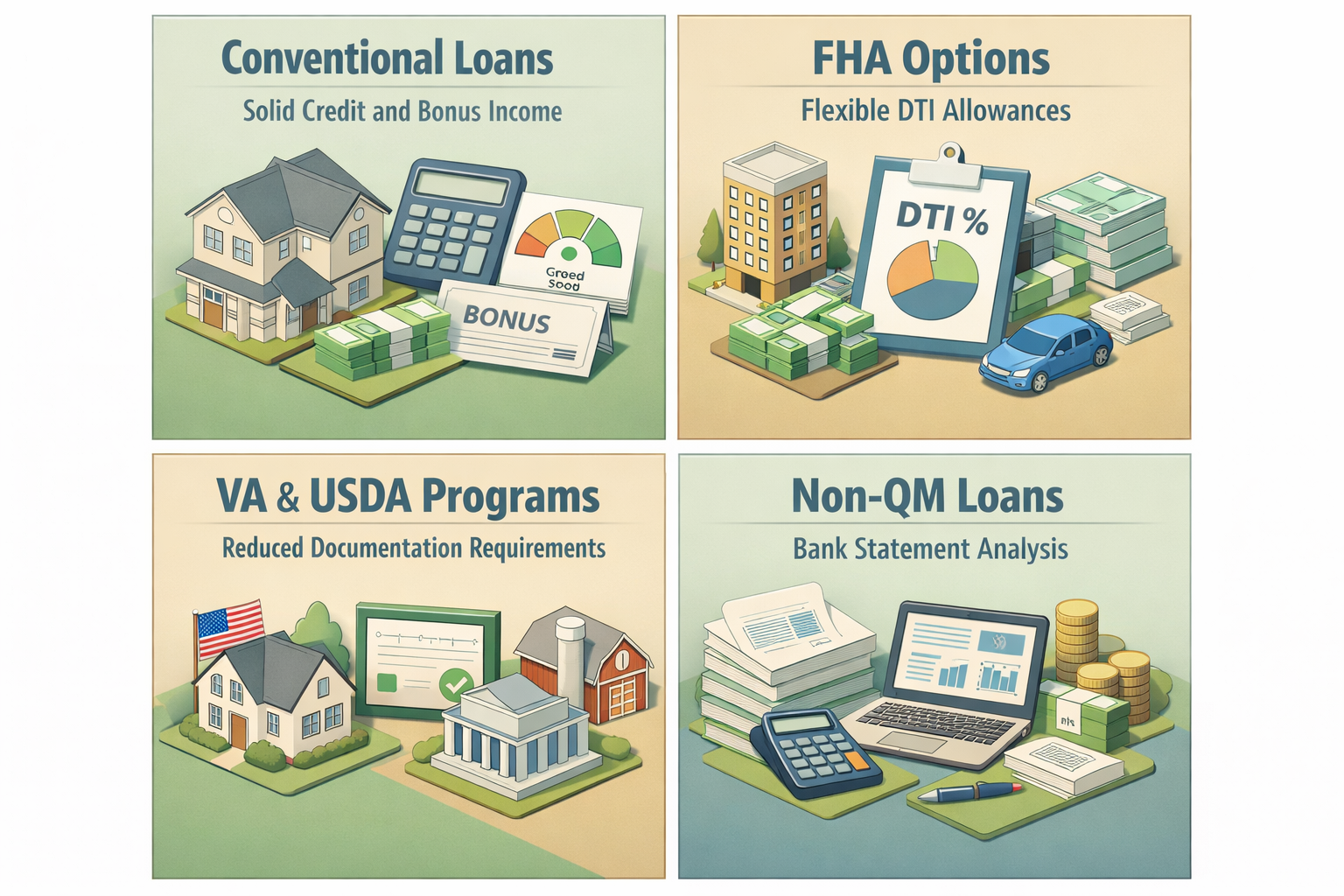
Not all refinance programs handle bonus income the same way. Knowing your options helps you choose a path that aligns with your financial profile.
Conventional Refinance Loans
Conventional loans backed by Fannie Mae or Freddie Mac are often the starting point for homeowners with solid credit and documented bonus income. These programs allow bonus pay to be counted as qualifying income as long as the two-year history requirement is met. Borrowers with strong credit scores — typically 680 or higher — and moderate debt-to-income (DTI) ratios tend to qualify more easily.
FHA Refinance Options
FHA streamline and standard refinances may offer more lenient credit requirements, though they still follow guidelines around income documentation. If your bonus history is well-documented and your base salary alone doesn't quite get you to the qualifying threshold, FHA's more flexible DTI allowances could help bridge the gap.
VA and USDA Refinance Programs
Eligible veterans and rural homeowners may have access to VA or USDA streamline refinance options that reduce documentation requirements. These programs can be particularly useful if your bonus income is inconsistent, as streamline refinances sometimes place less emphasis on full income re-verification.
Non-QM and Bank Statement Loans
For borrowers whose income doesn't fit neatly into standard documentation requirements — perhaps because bonuses are irregular, paid as incentive compensation, or tied to commission structures — non-qualified mortgage (non-QM) programs may offer a workable alternative. These loans often use bank statement analysis rather than W-2s, allowing lenders to see actual cash flow patterns over time. The tradeoff is typically a slightly higher interest rate.
Smart Strategies to Strengthen Your Refinance Application
When your income includes variable elements like bonuses, a few proactive steps can significantly improve your refinance outcome.
Time Your Application Wisely
If your annual bonus is typically paid in a specific month, consider applying for your refinance shortly after that deposit hits your account. This ensures your most recent pay stub and bank statements reflect the highest possible income figure, which can strengthen your qualifying numbers.
Lower Your Debt-to-Income Ratio First
Because bonus income may be averaged or partially discounted by lenders, your DTI ratio might look higher than expected. Paying down credit card balances, auto loans, or other revolving debt before applying can bring your DTI into a more favorable range. Most conventional lenders prefer a DTI at or below 45%, though some programs allow higher ratios with compensating factors.
Build a Strong Credit Profile
A higher credit score gives you access to better rates and more lender options. Aim to check your credit report for errors, keep credit utilization low, and avoid opening new accounts in the months before you apply. Even a modest improvement in your score could meaningfully reduce your refinance rate.
Prepare Thorough Documentation
Lenders evaluating refinance ARM mortgage bonus pay will want a clear, consistent paper trail. Organize your W-2s, pay stubs, bonus award letters, and bank statements in advance. If your employer can provide a letter confirming your bonus structure and likelihood of continuation, include it. The more clearly you can demonstrate income stability, the smoother the process tends to go.
Understanding the Role of Home Equity in Your Refinance
Your home's current value plays a major role in what refinance options are available to you. Lenders typically want you to retain a certain level of equity after the refinance — commonly at least 20% for conventional loans to avoid private mortgage insurance (PMI).
If home values in your area have risen since you purchased, you may have more equity than you realize. Getting a professional appraisal or reviewing recent comparable sales can give you a realistic picture. More equity generally means better loan terms and a wider range of program options.
For homeowners who want to access their equity through a cash-out refinance, keep in mind that doing so reduces your equity stake and may affect your loan-to-value (LTV) ratio in ways that influence your rate. Balancing your cash-out goals with the need for competitive refinance terms is an important part of the decision-making process.
Comparing Lenders When You Earn Bonus Income
Not every lender interprets income guidelines the same way, and this variability matters a great deal when bonus pay is central to your qualifying income. Some lenders apply stricter overlays — internal policies that go beyond standard agency guidelines — while others may be more comfortable with variable compensation structures.
Working with a mortgage broker or using a multi-lender comparison platform can expose you to a broader range of underwriting appetites. When you're exploring the best options for refinancing ARM mortgage with bonus income, getting quotes from at least three to five lenders allows you to compare not just rates, but also how each lender treats your income in the qualification process.
Ask each lender directly: How do you calculate bonus income for qualifying purposes? Do you average two years, or do you use the most recent year? Are there any overlays that apply? These questions reveal important differences that can affect whether you qualify and at what rate.
Also pay attention to closing costs, lender fees, and the annual percentage rate (APR) — not just the advertised interest rate. A slightly higher rate with lower fees might actually cost less over the life of your loan depending on how long you plan to keep the mortgage.
●Conclusion
Refinancing an adjustable-rate mortgage when a meaningful share of your income comes from bonuses takes more planning than a standard refinance, but it's far from impossible. Lenders have established pathways for evaluating variable compensation, and the right program — whether conventional, FHA, VA, or non-QM — can accommodate your income structure. The keys are documenting your bonus history thoroughly, timing your application strategically, and comparing multiple lenders to find the most favorable terms. If you're ready to explore your options, LoanWise can help you connect with lenders experienced in working with borrowers who lower ARM rate with variable income challenges. Taking the first step today could mean more stable, predictable payments for years to come.