
Private mortgage insurance, commonly known as PMI, is one of those extra costs that homebuyers often accept at closing — sometimes without fully understanding how long they'll be paying it. If you put down less than 20% on a conventional loan, your lender likely required PMI to protect themselves in case of default. While it serves a purpose early on, PMI adds to your monthly payment without building any equity for you. The good news? You don't have to keep paying it forever. Exploring the best options for refinancing a conventional loan with PMI to avoid it could save you hundreds of dollars each month and thousands over the life of your loan. This guide walks you through every major strategy available to homeowners who are ready to move past PMI and into a stronger financial position.
What PMI Is and Why Homeowners Want to Remove It
PMI, or private mortgage insurance, is a policy that protects your mortgage lender — not you — if you stop making payments. Lenders typically require it when a borrower puts down less than 20% of a home's purchase price on a conventional loan. The cost can vary depending on your loan size, credit score, and down payment, but it often adds a meaningful amount to your monthly mortgage bill.
For many homeowners, PMI made sense at the time of purchase because it allowed them to buy a home sooner without waiting years to save a full 20% down payment. However, once you've built sufficient equity in your home — either through regular payments, home price appreciation, or both — continuing to pay PMI becomes an unnecessary expense. That's why so many homeowners start looking at ways to remove PMI from a conventional loan as soon as their financial situation allows.
Understanding your options is the first step. Some paths require refinancing, while others may allow you to cancel PMI without taking out a new loan at all. Knowing the difference can help you choose the most cost-effective route for your specific circumstances.
When You May Be Ready to Eliminate PMI Through Refinancing
Before jumping into a refinance, it's worth confirming whether you actually qualify to drop PMI through your current loan. Under the Homeowners Protection Act, lenders are required to automatically cancel PMI once your loan balance reaches 78% of the original purchase price — provided you're current on payments. You can also request cancellation when your loan-to-value (LTV) ratio reaches 80% based on original value.
However, many homeowners may reach 20% or more equity sooner than expected due to rising home values in their area. If your home has appreciated significantly since you purchased it, your current LTV ratio could already be well below 80% — even if your loan balance hasn't changed dramatically. In this case, simply requesting a cancellation based on original value won't work because lenders use purchase price, not current market value, for automatic cancellation purposes.
This is exactly where refinancing becomes a powerful tool. A new appraisal is typically required when you refinance, which means your lender will assess your home's current market value. If that value has increased enough, your new loan could reflect an LTV ratio below 80% from the start — meaning no PMI on the new mortgage at all. This makes refinancing particularly appealing in markets where home values have risen steadily.
Rate-and-Term Refinancing: The Most Direct Path to Drop PMI
A rate-and-term refinance is one of the most straightforward ways to address PMI. With this approach, you replace your existing mortgage with a new one — ideally at a lower interest rate or with different loan terms — and the lender orders a new appraisal of your home. If your home's current value supports an LTV ratio of 80% or below, the new loan typically won't require PMI at all.
For homeowners who originally purchased with a small down payment but have since seen their home value rise, this strategy can deliver a two-part benefit: a lower interest rate and the elimination of monthly PMI. Even if market interest rates haven't fallen dramatically since you first took out your loan, removing PMI alone may produce enough monthly savings to justify the cost of refinancing.
It's important to run the numbers carefully. Refinancing comes with closing costs, which typically range from about 2% to 5% of the loan amount. You'll want to calculate your break-even point — how many months it will take for your monthly savings to offset those upfront costs. If you plan to stay in your home long enough to recoup those costs, a rate-and-term refinance is often worth serious consideration.
Cash-In Refinancing: Using Equity to Your Advantage
A cash-in refinance is essentially the opposite of a cash-out refinance. Instead of pulling equity out of your home, you bring additional funds to closing to pay down your loan balance. This strategy may be especially useful if your home hasn't appreciated enough on its own to push your LTV ratio below 80%, but you have savings available that you could apply to the loan.
By reducing your principal balance at refinancing, you may be able to reach that 80% LTV threshold — eliminating the need for PMI on the new loan. In some cases, homeowners combine this approach with a rate-and-term refinance to simultaneously lower their rate, shorten their loan term, and remove PMI in a single transaction.
Of course, this approach requires having liquid savings to contribute at closing. It's worth discussing with a financial advisor whether deploying those savings toward your mortgage makes more sense than keeping them invested or accessible for emergencies. The right answer depends on your overall financial picture, but for those with a healthy emergency fund and low-return savings sitting idle, a cash-in refinance can be a smart move.
Refinancing into a Jumbo or Portfolio Loan Without PMI
In some cases, homeowners may benefit from refinancing into a loan product that doesn't require PMI regardless of the LTV ratio. Certain jumbo loans and portfolio loans — products held by the lender rather than sold to the secondary market — may not require PMI even at higher LTV ratios, though they often come with stricter credit and income requirements.
These loan types are typically more common for higher-value properties where the loan amount exceeds conforming loan limits. If your home has appreciated into jumbo territory and your credit profile is strong, refinancing into a jumbo loan might allow you to sidestep PMI while also adjusting your rate or term. Portfolio lenders may offer more flexibility in their underwriting, which can benefit borrowers with unique financial situations.
Keep in mind that jumbo and portfolio loans often carry slightly different rate structures than conventional conforming loans. It's worth comparing the total cost — including interest and any alternative fees — against what you'd pay with a standard conventional refinance to determine which option offers better long-term value for your situation.
The Best Options for Refinancing a Conventional Loan with PMI to Avoid It: A Comparison
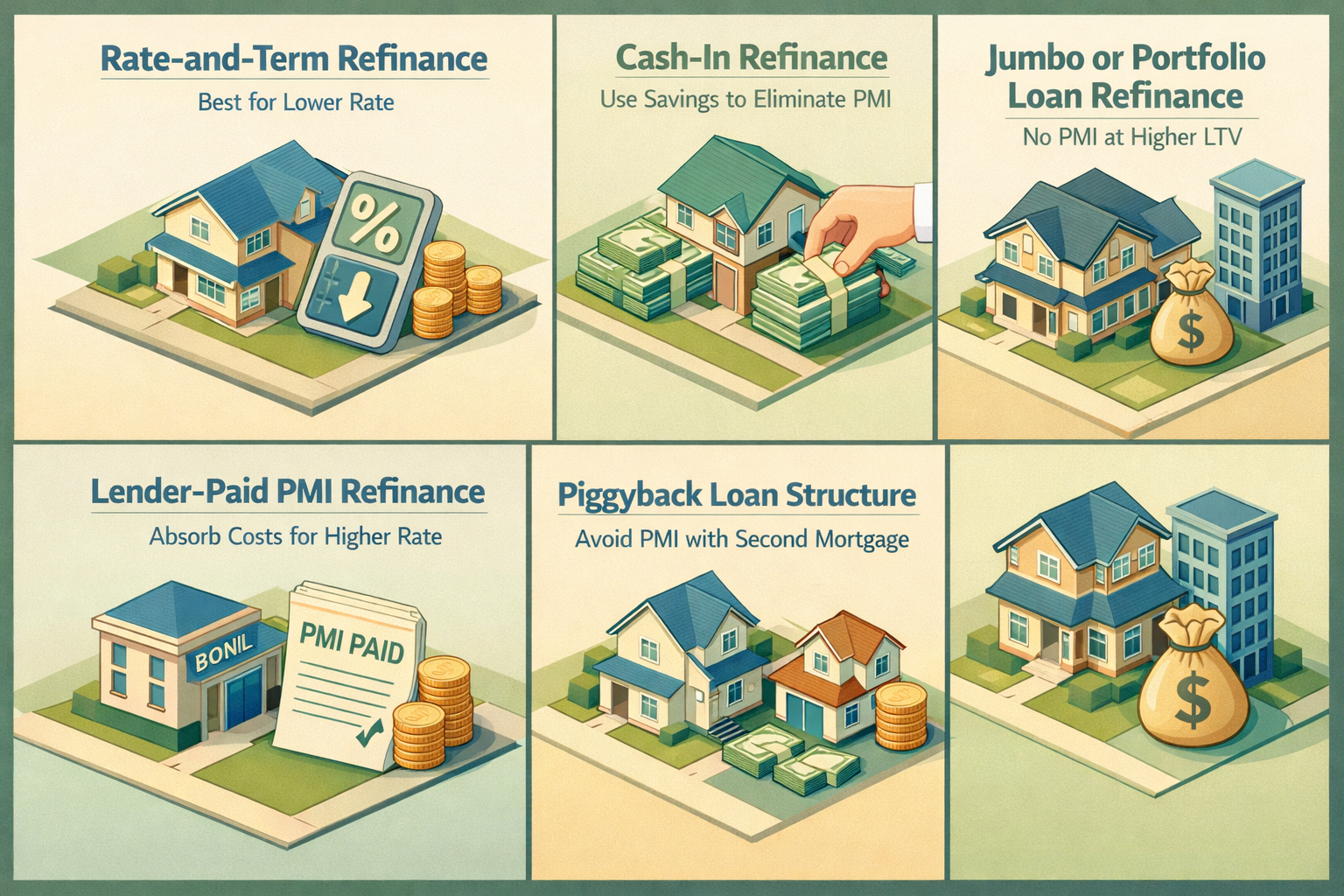
When evaluating the best options for refinancing a conventional loan with PMI to avoid it, it helps to see how each approach stacks up depending on your situation. Here's a practical breakdown:
- Rate-and-Term Refinance: Best if your home has appreciated enough to support an 80% LTV and you want to potentially lower your rate at the same time. Requires a new appraisal and closing costs.
- Cash-In Refinance: Best if your home hasn't appreciated sufficiently but you have savings to contribute at closing to reach the 80% LTV threshold. Combines debt reduction with PMI elimination.
- Jumbo or Portfolio Loan Refinance: Best if your property value has grown significantly and you qualify for non-conforming products that don't require PMI. Requires strong credit and financial documentation.
- Lender-Paid PMI (LPMI) Refinance: Some lenders offer to absorb PMI costs in exchange for a slightly higher interest rate. This may make sense if you plan to sell or refinance again within a few years before the higher rate cost accumulates.
- Piggyback Loan Structure: Refinancing into an 80-10-10 or similar structure, where a second mortgage covers part of the balance, can help avoid PMI — though it introduces a second loan with its own interest rate and payment obligations.
Each option carries its own trade-offs. Your best path forward will depend on your current LTV ratio, credit score, home value, available savings, and how long you plan to stay in the property. Consulting with an experienced mortgage professional can help you model the numbers and identify which approach delivers the most value for your specific goals.
Steps to Take Before You Refinance to Eliminate PMI
Before committing to a refinance strategy, taking a few preparatory steps can improve your chances of approval and help you secure better terms. Here's what to focus on:
- Check your current LTV ratio: Request a payoff statement from your servicer and get a rough estimate of your home's current market value using online tools or a real estate agent's opinion. This will help you gauge whether refinancing makes financial sense before paying for a formal appraisal.
- Review your credit score: Lenders typically offer the best rates to borrowers with scores of 740 or higher. If your score has room to improve, spending a few months paying down revolving debt and correcting any errors on your credit report could result in meaningfully better loan terms.
- Gather financial documentation: Lenders will want to see recent pay stubs, W-2s or tax returns, bank statements, and information about existing debts. Having these ready in advance can speed up the application process.
- Compare multiple lenders: Mortgage rates and fees can vary significantly from one lender to the next. Shopping at least three to five lenders — or working with a mortgage broker who has access to multiple loan products — may help you find a more competitive offer.
- Calculate your break-even point: Divide your estimated closing costs by your projected monthly savings after PMI elimination and any rate reduction. If you'll recoup those costs within a reasonable timeframe given your plans, refinancing is likely worthwhile.
Taking these steps before applying helps ensure that you enter the refinance process with clarity, realistic expectations, and the strongest possible application. The goal is to refinance to eliminate PMI in a way that truly improves your financial standing — not just on paper, but in your actual monthly budget and long-term wealth-building trajectory.
●Conclusion
Private mortgage insurance doesn't have to be a permanent fixture in your monthly budget. Whether your home has appreciated, you've built equity through regular payments, or you have savings to contribute at closing, there's likely a refinancing path that can help you move past PMI for good. The key is understanding which option aligns best with your current LTV ratio, credit profile, and long-term plans. From rate-and-term refinances to cash-in strategies and specialized loan products, homeowners today have more tools available than ever to shed this added cost. If you're ready to explore your options, connecting with a knowledgeable mortgage professional at LoanWise can help you map out a personalized strategy — one designed to save you money now and support your financial goals well into the future.