For many homeowners, their mortgage is the largest financial commitment they'll ever make. That's why even a small reduction in your interest rate can have a meaningful impact on your finances. The benefits of refinancing mortgage to lower interest rate go well beyond trimming your monthly bill — they can reshape your entire financial picture. Whether you've owned your home for two years or twenty, understanding how refinancing works and when it makes sense could be one of the smartest moves you make as a homeowner. In this article, we'll walk through everything you need to know, from calculating your potential savings to comparing lender offers and locking in the best possible rate.
What Refinancing Your Mortgage Actually Means
Refinancing simply means replacing your existing mortgage with a new one — ideally at a lower interest rate, different loan term, or both. When you refinance, your lender pays off your old loan and issues a fresh mortgage based on your current financial profile and today's market conditions.
Homeowners refinance for a variety of reasons. Some want to reduce their monthly payment. Others want to switch from an adjustable-rate mortgage (ARM) to a fixed-rate loan for more predictability. And some want to tap into their home equity through a cash-out refinance to fund renovations, pay off high-interest debt, or cover major expenses.
It's worth noting that refinancing isn't free. You'll typically encounter closing costs that may range from 2% to 5% of the loan amount. That's why it's important to calculate your break-even point — the month when your accumulated monthly savings offset those upfront costs. If you plan to stay in your home beyond that point, refinancing could make a lot of financial sense.
The Core Benefits of Refinancing Mortgage to Lower Interest Rate
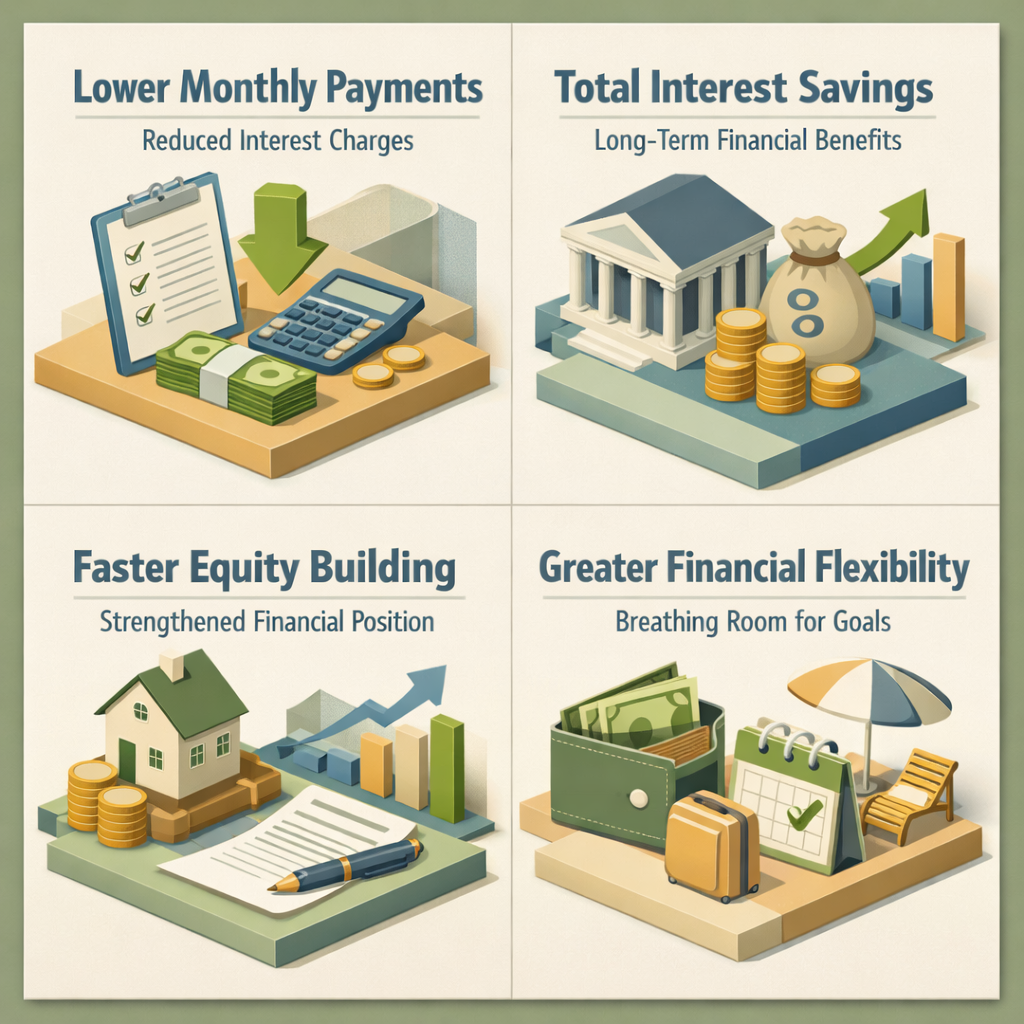
The most compelling reason homeowners refinance is to secure a lower interest rate. Even a reduction of half a percentage point can result in significant savings over the life of a 30-year loan. Here's a closer look at what that might mean for you:
- Lower monthly mortgage payments: A reduced rate means less interest charged each month, which directly lowers your required payment. This frees up cash for savings, investments, or everyday expenses.
- Reduced total interest paid: Over the life of a loan, a lower rate can save homeowners tens of thousands of dollars — sometimes more, depending on the loan balance and term.
- Faster equity building: When more of each payment goes toward principal rather than interest, you build home equity more quickly. This strengthens your financial position and increases your net worth.
- Greater financial flexibility: Lower monthly payments give you breathing room to address other financial goals, from retirement contributions to emergency funds.
- Opportunity to shorten your loan term: Some homeowners refinance into a 15-year mortgage at a lower rate. While monthly payments may stay similar, you could pay off the home much sooner and save substantially on interest.
These benefits of refinancing mortgage to lower interest rate are most pronounced when market rates have dropped noticeably since you first took out your loan, or when your credit score and financial profile have improved enough to qualify for better terms.
Using a Refinance Mortgage Calculator to Estimate Your Savings
Before you contact a lender, it's a good idea to run the numbers yourself. A refinance mortgage calculator savings tool can help you estimate how much you might save each month and over the full loan term. Most online calculators ask for a few key inputs:
- Your current loan balance
- Your existing interest rate and remaining loan term
- The new interest rate you're targeting
- Estimated closing costs for the refinance
Once you enter these figures, the calculator will typically show you your new estimated monthly payment, your monthly savings, and how many months it will take to break even on closing costs. This break-even analysis is critical — it tells you whether the refinance is truly worth pursuing given how long you plan to stay in the home.
For example, if you'd save $150 per month but face $4,500 in closing costs, your break-even point would be 30 months. If you plan to stay in the home for at least three years beyond that point, refinancing could be a smart financial decision. If you're planning to sell sooner, the numbers may not work in your favor.
Keep in mind that calculator results are estimates. Your actual savings will depend on the rate you qualify for, the lender's specific fees, and your loan structure. Use these tools as a starting point, not a guarantee.
How to Get a Lower Mortgage Rate When You Refinance
Knowing how to get a lower mortgage rate is just as important as understanding why you want one. Lenders evaluate several factors when determining the rate you'll qualify for. Improving these areas before you apply could help you secure more favorable terms:
Strengthen Your Credit Score
Your credit score is one of the most influential factors in your mortgage rate. Borrowers with higher scores typically qualify for the lowest available rates. Before applying to refinance, review your credit report for errors, pay down revolving balances, and avoid opening new credit accounts. Even a modest improvement in your score could translate to a meaningfully lower rate.
Lower Your Debt-to-Income Ratio
Lenders also look at how much of your monthly income goes toward debt obligations. A lower debt-to-income (DTI) ratio signals less financial risk and may help you qualify for better rates. Paying off smaller debts or increasing your income before applying can improve this ratio.
Increase Your Home Equity
Loan-to-value ratio (LTV) matters too. If your home has appreciated in value since you bought it, or if you've paid down a meaningful portion of your principal, you may have enough equity to qualify for more competitive rates. Borrowers with at least 20% equity typically avoid private mortgage insurance (PMI) and access better terms.
Choose the Right Loan Term
Shorter loan terms often come with lower interest rates. If your budget allows for a higher monthly payment, refinancing into a 15-year loan could get you a lower rate than a 30-year option. Run the numbers carefully to see which term aligns with your financial goals.
Mortgage Rate Comparison for Refinance: Why Shopping Around Matters
One of the most important — and often overlooked — steps in the refinance process is doing a thorough mortgage rate comparison for refinance across multiple lenders. Rates can vary significantly from one lender to another, and accepting the first offer you receive may leave real money on the table.
Here's what to keep in mind when comparing refinance offers:
- Look beyond the interest rate: The annual percentage rate (APR) gives a more complete picture because it includes fees and other loan costs. Two loans with the same interest rate can have very different APRs depending on lender fees.
- Request loan estimates: Under federal guidelines, lenders are required to provide a standardized Loan Estimate within three business days of your application. Use these documents to make apples-to-apples comparisons.
- Consider lender reputation and service: Rate is important, but so is working with a lender who communicates clearly and processes loans efficiently. Delays in closing can cost you money if your rate lock expires.
- Negotiate: Many borrowers don't realize that lenders sometimes have flexibility on fees or can match a competitor's offer. It's worth asking.
Shopping with at least three to five lenders is a commonly cited strategy among financial experts. Each lender will pull your credit, but multiple mortgage inquiries within a short window — typically 14 to 45 days depending on the scoring model — are often treated as a single inquiry, minimizing the impact on your credit score.
Lower Monthly Mortgage Payments Through Refinancing: Real-World Impact
The idea of lower monthly mortgage payments refinance can feel abstract until you see how it plays out in everyday life. For homeowners stretched thin by rising costs, a reduced mortgage payment can provide genuine financial relief. For those who are financially stable, it can accelerate savings and investment goals.
Consider a homeowner who originally financed their home with a 30-year fixed mortgage at a higher rate from several years ago. If rates have since dropped and their credit profile has improved, refinancing might reduce their payment by a meaningful amount each month. Over time, that difference compounds — either through direct savings or the ability to redirect funds elsewhere.
It's also worth thinking about how lower payments interact with other financial goals. For example, the monthly savings from refinancing could be redirected toward:
- Contributions to a retirement account or investment portfolio
- Paying down high-interest credit card debt
- Building an emergency fund
- Saving for a child's education
- Home improvements that increase property value
Of course, extending your loan term to achieve lower payments does mean paying more interest over time if you carry the loan to its full maturity. This trade-off is worth discussing with a qualified mortgage professional who can help you model different scenarios based on your specific situation.
When Refinancing May Not Be the Right Move
While the benefits are real and often significant, refinancing isn't always the best choice for every homeowner. There are situations where the costs may outweigh the advantages, and it's important to go in with clear eyes.
You might want to pause before refinancing if:
- You plan to move soon: If you're unlikely to reach your break-even point before selling, the upfront costs of refinancing won't pay off.
- Your credit score has declined: A lower score since your original loan was issued could mean you don't qualify for a better rate — or any improvement may be minimal.
- You're close to paying off your mortgage: In the early years of a loan, most of your payment goes toward interest. In the later years, you're mostly paying principal. Refinancing late in your loan term could reset that structure and cost you more interest overall.
- Closing costs are too high relative to savings: If your monthly savings are small and closing costs are steep, the break-even timeline could stretch to five or more years.
- You're considering a cash-out refinance for non-essential spending: Using home equity to fund vacations or discretionary purchases can put your home at risk if your financial situation changes.
The best approach is to run the numbers carefully, consult with a trusted mortgage professional, and make sure any refinance decision aligns with your broader financial goals.
●Conclusion
The benefits of refinancing mortgage to lower interest rate are clear: reduced monthly payments, long-term interest savings, faster equity growth, and improved financial flexibility. But like any major financial decision, refinancing works best when it's approached thoughtfully. Start by using a refinance mortgage calculator to estimate your savings, then take steps to strengthen your credit and financial profile. Compare offers from multiple lenders, review the full cost picture including APR and closing costs, and make sure the timing aligns with your plans for the home. At LoanWise, we're here to help homeowners navigate these decisions with confidence. If you're ready to explore whether refinancing could work for you, connect with one of our mortgage specialists today and take the first step toward a smarter home financing strategy.