
If you currently have an adjustable rate mortgage, you've probably noticed that your monthly payment can shift over time. When interest rates climb, those adjustments can put real pressure on your household budget. That's why so many homeowners are exploring the benefits of refinancing ARM mortgage to fixed rate loans. A fixed rate mortgage locks in your interest rate for the entire life of the loan, which means predictable payments, easier planning, and potentially significant long-term savings. Whether you're a first-time homeowner who took out an ARM during a low-rate period or a seasoned homeowner looking to stabilize your finances, understanding how this refinance strategy works could be one of the smartest financial moves you make.
What Is an Adjustable Rate Mortgage and Why Do People Refinance Out of One?
An adjustable rate mortgage, commonly called an ARM, starts with a fixed introductory interest rate for a set period — often five, seven, or ten years — and then adjusts periodically based on a financial index. Once that introductory period ends, your rate can go up or down depending on market conditions. While ARMs often come with lower initial rates compared to fixed rate loans, the uncertainty that follows can be unsettling for many borrowers.
When rates rise, homeowners on ARMs may see their monthly payments increase by hundreds of dollars. This unpredictability makes long-term budgeting difficult, particularly for families managing tight finances or planning major expenses. As a result, many homeowners choose to refinance ARM to fixed mortgage products to eliminate that uncertainty entirely.
It's worth noting that an ARM isn't a bad product. For borrowers who plan to sell or refinance before the adjustable period begins, it can actually be a cost-effective strategy. However, if you're planning to stay in your home for the long haul, the risks of an ARM may outweigh its early benefits. That's where refinancing becomes a compelling option.
The Core Benefits of Refinancing ARM Mortgage to Fixed Rate
The most immediate and well-recognized advantage of switching from an ARM to a fixed rate mortgage is payment stability. Once you lock in a fixed rate, your principal and interest payment stays the same every month for the life of the loan. That kind of consistency is something many homeowners deeply value, especially in volatile rate environments.
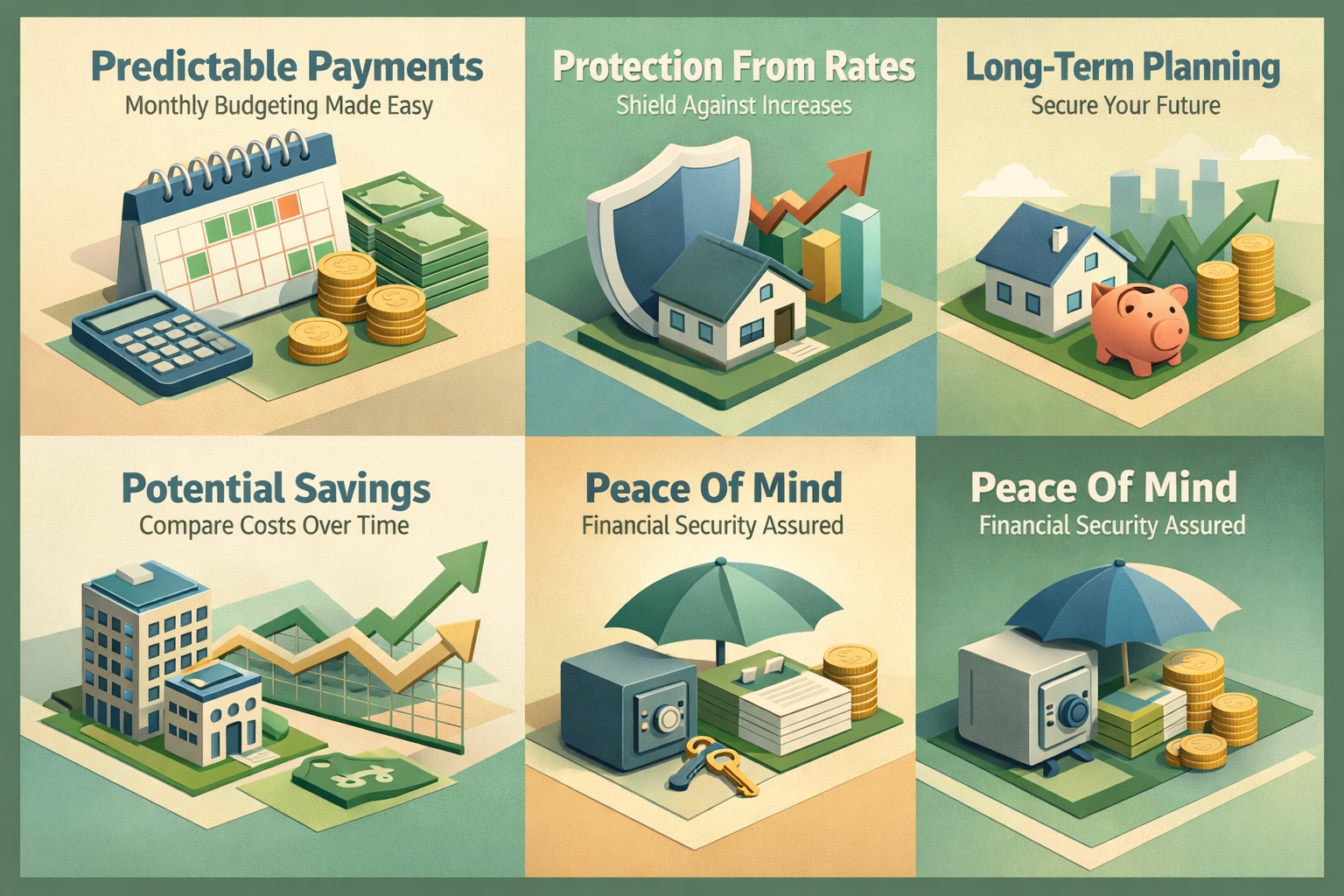
- Predictable monthly payments: You'll always know exactly what you owe each month, making household budgeting far more manageable.
- Protection from rising interest rates: If market rates trend upward, a fixed rate shields you from higher payments that an ARM would otherwise impose.
- Long-term financial planning: Fixed obligations make it easier to plan for retirement, education costs, or other financial goals without the worry of mortgage payment fluctuations.
- Potential interest savings over time: Depending on where rates stand when you refinance, you may secure a rate that saves you money compared to projected ARM adjustments over the coming years.
- Peace of mind: Many homeowners simply feel more financially secure knowing their mortgage payment won't surprise them next year or five years from now.
These advantages make the fixed rate mortgage vs ARM comparison a fairly clear choice for borrowers who prioritize stability and long-term savings over short-term rate advantages.
Understanding the Mortgage Rate Comparison: ARM Versus Fixed Over Time
When evaluating whether to refinance, it helps to think carefully about how your ARM's rate trajectory compares to available fixed rate options. A thorough mortgage rate comparison ARM to fixed should consider several factors beyond just the current interest rate.
First, look at your ARM's adjustment caps. Most ARMs include periodic caps that limit how much your rate can change each adjustment period, as well as a lifetime cap that sets the maximum your rate could ever reach. Understanding those caps tells you the worst-case scenario for your current loan. Then compare that against what a fixed rate refinance would cost you today.
Next, consider how long you plan to stay in the home. If you expect to move within a few years, the closing costs of refinancing may not be worth it. But if you plan to stay for a decade or more, locking in today's fixed rate could result in meaningful savings over hundreds of monthly payments.
It's also helpful to calculate your break-even point — the number of months it takes for your monthly budget savings to offset the cost of refinancing. If your break-even is 24 months and you plan to stay 10 years, the math likely works in your favor. Speaking with a mortgage professional can help you run these numbers with accuracy and confidence.
How to Convert Adjustable Rate to Fixed Loan: The Refinancing Process Explained
If you've decided that refinancing makes sense for your situation, it's helpful to understand what the process looks like before you begin. To convert adjustable rate to fixed loan, you'll essentially be applying for a new mortgage that pays off your existing ARM. Here's a general overview of how it typically works:
- Review your current loan terms: Pull your mortgage statement and note your current rate, remaining balance, adjustment schedule, and any prepayment penalties that may apply.
- Check your credit profile: Lenders will evaluate your credit score, debt-to-income ratio, and payment history. Stronger credit typically qualifies you for better fixed rates.
- Assess your home equity: Most lenders prefer that you have at least 20% equity in your home. If you have less, you may still qualify but could face additional costs like private mortgage insurance.
- Shop multiple lenders: Rates and terms can vary meaningfully from one lender to the next. Comparing at least three to five offers may help you find the most favorable terms.
- Submit your application: Once you've chosen a lender, you'll go through underwriting, which involves verifying your income, assets, employment, and property value.
- Close on your new loan: After approval, you'll sign the closing documents and your new fixed rate mortgage will replace the existing ARM.
The timeline for refinancing typically ranges from 30 to 60 days, though this can vary depending on the lender, the complexity of your file, and current market volume. Staying organized with your documents can help keep the process moving smoothly.
When Refinancing From an ARM May Not Be the Right Move
While the benefits of converting to a fixed rate are compelling for many homeowners, refinancing isn't always the ideal solution for every situation. There are certain scenarios where staying with your ARM, at least for now, might make more sense.
If your ARM's introductory period still has several years remaining and rates are currently high, waiting could be a reasonable strategy. Locking in a high fixed rate today means you'd be committed to that rate for decades, whereas your ARM rate might still be below that level for the foreseeable future.
Additionally, if you have plans to sell your home in the next few years, the closing costs associated with refinancing — which can range from roughly two to five percent of the loan amount — may not be recovered before you sell. In that case, the economics of refinancing simply may not work in your favor.
Homeowners who have very little equity in their property may also face challenges qualifying for a competitive fixed rate refinance. It's worth speaking with a lender to understand your options before assuming refinancing isn't possible — there may be programs available that fit your circumstances.
Preparing Financially to Get the Best Fixed Rate on Your Refinance
Qualifying for the most favorable fixed rate on your refinance typically requires some preparation. Lenders assess several key factors when determining what rate to offer you, and understanding these can help you position yourself well before you apply.
Your credit score is one of the most influential factors. Borrowers with higher scores — generally in the mid-700s and above — tend to receive the most competitive rates. If your score has room for improvement, taking a few months to pay down revolving debt, correct any errors on your credit report, and avoid opening new credit accounts could make a meaningful difference.
Your debt-to-income ratio, or DTI, is another important metric. Lenders generally prefer a DTI below 43%, though some programs allow for higher ratios depending on other qualifying factors. Reducing existing debts before applying may strengthen your application.
Home equity also plays a role. If your property has appreciated since you purchased it, you may be in a stronger equity position than you realize. An updated appraisal during the refinance process will determine your current home value, which affects your loan-to-value ratio and, in turn, the rates you may qualify for.
Finally, gathering your financial documents early — recent pay stubs, tax returns, bank statements, and your current mortgage statement — can help the process move efficiently once you apply.
●Conclusion
The benefits of refinancing ARM mortgage to fixed rate are clear for homeowners who value stability, long-term planning, and protection from market volatility. While ARMs can be useful tools in the right circumstances, the peace of mind that comes with a fixed monthly payment is something many borrowers find genuinely valuable over time. If your ARM's adjustment period is approaching, or if you're simply tired of uncertainty in your monthly budget, now may be a good time to explore your refinancing options. Speaking with a knowledgeable mortgage professional can help you evaluate the numbers specific to your situation and determine whether making the switch makes financial sense for your household. At LoanWise, we're here to help you navigate those decisions with confidence and clarity.