
Buying a home is one of the most exciting milestones in life, but if you earn 1099 commission income or recently started a new job, the mortgage process can feel a bit more complicated than usual. Lenders view variable income differently than a steady salaried paycheck, which means your qualification path may require a little extra preparation. The good news is that knowing how to qualify for a conventional loan with 1099 commission income and a new job is entirely possible — and thousands of borrowers in similar situations are approved each year. This guide walks you through what lenders typically look for, how to document your earnings, and what steps you can take to improve your chances of approval.
What Makes 1099 Commission Income Different in the Eyes of a Lender
When you earn a traditional W-2 salary, lenders can quickly verify your income through pay stubs and employer records. Commission-based or 1099 income works differently because it tends to fluctuate month to month, which makes it harder for underwriters to predict what you'll reliably earn in the future.
Lenders typically categorize 1099 earners similarly to self-employed borrowers, even if you technically work for a company as an independent contractor. Real estate agents, mortgage brokers, financial advisors, freelancers, and sales professionals often fall into this category. Because your income isn't guaranteed by a fixed salary, lenders typically want to see a consistent earning history before extending a conventional mortgage.
Understanding this distinction is the first step toward navigating the conventional loan requirements for self-employed commission income. Once you know how your income is perceived, you can gather the right documentation and set realistic expectations for the approval process.
The Standard Two-Year History Rule and When Exceptions May Apply
Fannie Mae and Freddie Mac — the two agencies that back most conventional loans — generally require a two-year history of self-employment or commission income before lenders can use it to qualify for a conventional loan for a mortgage. This guideline exists because a longer earnings track record gives underwriters more confidence that your income is stable and sustainable.
For many commission earners, this means lenders will typically average your income over the past 24 months using your tax returns and 1099 forms. If your income has been increasing year over year, lenders may use a more favorable calculation. If it's been declining, they may use the lower figure or question the stability of your earnings altogether.
That said, there may be exceptions. Some lenders could consider a one-year history under certain circumstances, particularly if you previously worked in the same field in a different capacity. For example, if you spent several years as a salaried employee in sales and recently transitioned to a 1099 commission role in the same industry, some lenders might view your overall experience as a mitigating factor. However, these exceptions are not universal, and approval will depend heavily on the individual lender and loan program guidelines.
How to Qualify for a Conventional Loan With 1099 Commission Income and a New Job
This is where things get more nuanced. If you've recently started a new job earning commission income, lenders will likely scrutinize your application more closely. A new position — especially one that hasn't yet generated a full tax return cycle — can raise questions about income continuity and reliability.
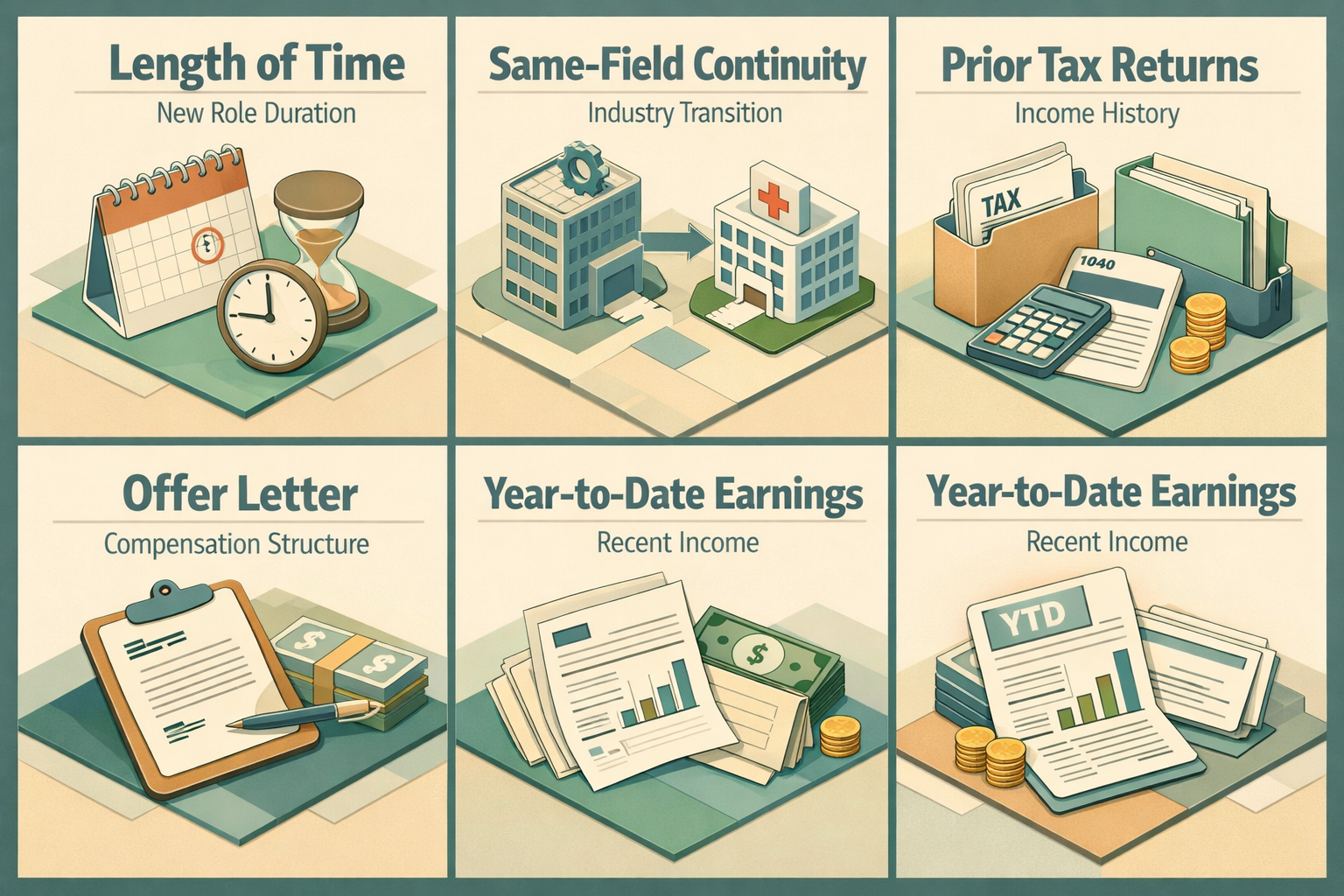
Here are some key factors lenders may evaluate when you're trying to understand how to qualify for a conventional loan with 1099 commission income and a new job:
- Length of time in the new role: If you've been in your new commission-based position for less than a year, many lenders may not be able to use that income at all for qualification purposes, unless you have compensating factors or a strong prior history in the same field.
- Same-field continuity: If your new job is in the same industry or profession as your previous work, lenders may view the transition more favorably. A licensed real estate agent moving to a new brokerage, for instance, may have a stronger case than someone switching industries entirely.
- Prior tax returns: Even if your current job is new, strong income documented on your prior two years of federal tax returns can still support your application — provided your new income is in a similar field.
- Offer letter or employment contract: Some lenders may consider a signed offer letter outlining your commission structure, especially if it includes a guaranteed base salary component alongside the variable commission pay.
- Year-to-date earnings: A recent pay stub or 1099 year-to-date statement showing solid earnings in your new role may help strengthen your file, even if the full history isn't yet available.
It's worth speaking with multiple lenders, as guidelines can vary between institutions. Some lenders may be more flexible than others depending on the full picture of your financial profile.
Documentation You'll Likely Need to Pull Together
One of the most important things you can do as a 1099 commission earner applying for a conventional loan is to be well-organized with your paperwork. Lenders will typically request a thorough set of documents to verify your income, and having everything ready in advance can speed up the underwriting process significantly.
Here's what you should generally expect to provide:
- Federal tax returns (two years): Both personal and, if applicable, business returns are often required. Lenders will look at your net income after deductions, which may be lower than your gross earnings.
- 1099 forms (two years): These confirm the income reported to you by clients or companies you contracted with.
- Year-to-date profit and loss statement: Especially if you're self-employed, a recent P&L statement signed by a CPA may be requested.
- Bank statements: Typically two to three months of personal and business bank statements to verify cash flow and reserves.
- Current contract or offer letter: Documenting your new role and compensation structure can help lenders assess your current earning potential.
- CPA letter: Some lenders may ask for a letter from a certified public accountant confirming the nature of your business or contracting arrangement.
Keep in mind that lenders often look at net income after deductions rather than your gross 1099 earnings. If you write off a significant portion of your income through business expenses, your qualifying income could be lower than you expect. Working with a tax professional who understands mortgage qualification can help you balance tax efficiency with borrowing power.
Credit Score, Debt-to-Income Ratio, and Down Payment Expectations
Beyond income documentation, conventional loan requirements for self-employed commission income also involve standard qualification benchmarks that all borrowers must meet. These include your credit score, debt-to-income ratio, and down payment amount.
Credit Score: Conventional loans typically require a minimum credit score of 620, though many lenders prefer scores of 680 or higher for borrowers with variable income. A stronger credit score can also help offset concerns about income consistency.
Debt-to-Income Ratio (DTI): Lenders typically look for a DTI at or below 43% to 45%, though some loan programs may allow slightly higher ratios with compensating factors. Your DTI is calculated by dividing your total monthly debt obligations — including the proposed mortgage payment — by your gross monthly income. Because commission income can be irregular, lenders may calculate your qualifying income conservatively, which could affect your DTI ratio.
Down Payment: Conventional loans generally require a minimum down payment of 3% to 5% for primary residences, though putting down 20% or more allows you to avoid private mortgage insurance (PMI). For commission earners with variable income, a larger down payment may improve your application by reducing lender risk and demonstrating financial stability.
Having strong reserves — funds left over after your down payment and closing costs — can also work in your favor. Lenders may feel more confident about approving a borrower with several months of mortgage payments held in savings or liquid assets.
Strategies to Strengthen Your Application Before Applying
If you're planning to apply for a conventional loan and you know your income situation may raise questions, taking some proactive steps ahead of time can make a meaningful difference.
- Wait until you have a fuller income history: If possible, giving yourself a few more months — or ideally a full year — in your new commission role before applying could significantly improve your qualifying profile.
- Minimize unnecessary write-offs in the qualifying year: Speak with a tax professional about which deductions to prioritize. Taking fewer deductions in a given tax year could increase your reported net income and improve your borrowing power.
- Pay down existing debts: Reducing credit card balances, auto loans, or student loan obligations can lower your DTI ratio and make your application stronger.
- Build your savings: A larger down payment and healthy cash reserves signal financial responsibility and reduce lender risk.
- Work with a mortgage broker: A broker who has experience with commission-based borrowers can match you with lenders who are more experienced and flexible with variable income situations.
- Consider non-QM loan alternatives: If conventional lending guidelines are too restrictive for your current situation, non-qualified mortgage (non-QM) programs — such as bank statement loans — may allow you to qualify based on actual cash flow rather than tax returns. These programs typically come with different terms and may carry slightly higher rates, but they can bridge the gap for borrowers who don't yet fit conventional criteria.
●Conclusion
Earning commission income and starting a new job doesn't automatically close the door on homeownership. It does, however, require a more thoughtful and well-prepared approach to the mortgage process. Lenders want to see that your income is reliable, consistent, and likely to continue — and with the right documentation and strategy, you can make a compelling case. Whether you're working toward a conventional loan approval now or positioning yourself for success in the coming months, understanding how to qualify for a conventional loan with 1099 commission income and a new job puts you ahead of the curve. At LoanWise, our lending specialists are experienced in helping commission earners and independent contractors navigate the path to homeownership. Reach out today to explore your options and take the next step with confidence.